Colossians 2 featured

Shadow and Substance

Shadow and Substance

Shadow and Substance

Colossians 2 and the Judgment Nobody's Talking About:
A Direct Response to Rob Solberg

Author’s Note: This article directly engages Rob Solberg’s interpretation of Colossians 2:16-17. Rather than simply refuting his claims, I want to walk through what Paul actually argues in this passage, show how it resolves interpretive tensions, and then examine where alternative readings struggle. My goal is clarity, not controversy – but where the text leads, we must follow.

If you’ve spent any time watching online critiques of Torah-observant Christians, you’ve probably come across Rob Solberg’s video on Colossians 2:16-17. He presents it as a silver bullet; the “plain reading” that, in his words, “defeats the false theology of Torahism.” He claims Paul was telling “Gentile believers” not to let anyone judge them for ignoring Sabbaths, festivals, and biblical food practices because these were merely “shadows,” now obsolete in Christ.*

It’s clean. It’s confident. It’s rhetorically smooth.

But is it what Paul actually says?

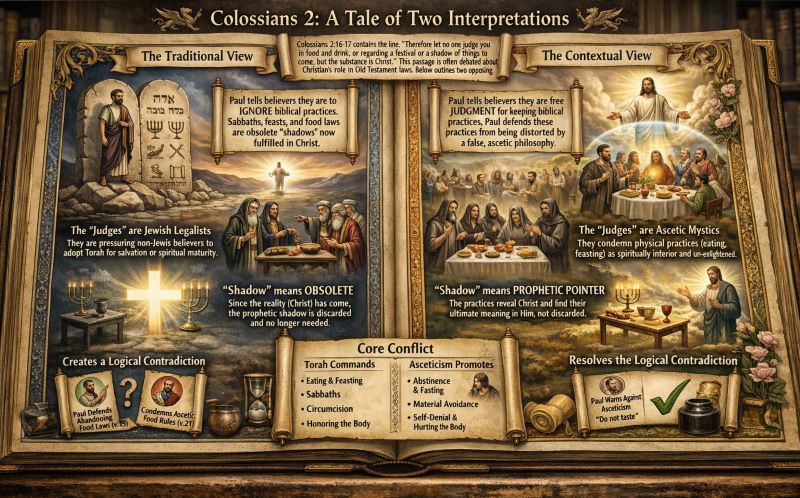
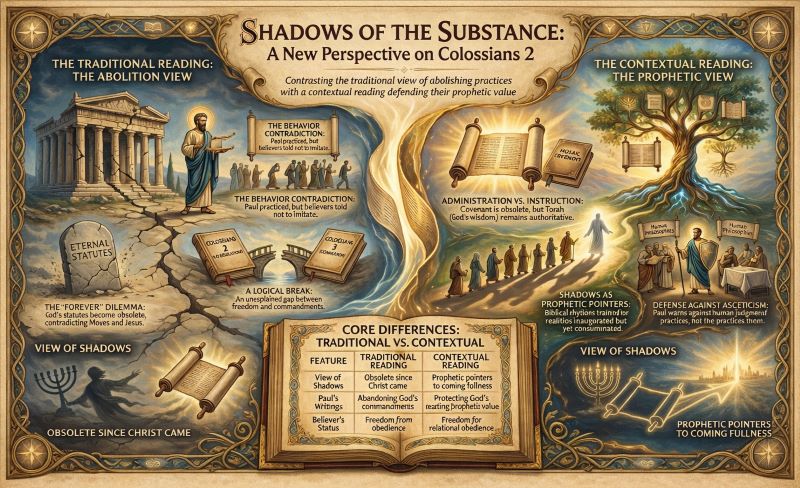
Not according to the text itself. When we trace Paul’s argument from verse 8 through chapter 3, a very different picture emerges, one where Paul defends biblical practices against ascetic judgment rather than dismissing them as obsolete. The traditional interpretation doesn’t just miss contextual clues; it creates logical contradictions within Paul’s own reasoning and forces him to argue against positions he never takes anywhere else in Scripture.

If we’re going to claim “plain reading,” we should at least make sure the reading is internally consistent, matches the historical context, and flows naturally into Paul’s next arguments.

What follows is a careful walk through what Paul actually argues, why this reading resolves problems, and where alternative interpretations break down.

A Note on Framework and Terminology

Before we begin, I need to be transparent about two things:

First, my theological framework: I hold a restoration-of-Israel reading of Paul’s mission. I believe Paul saw his work as fulfilling prophecies about gathering scattered Israel and reuniting the twelve tribes under Messiah (Ezekiel 37:15-28, Isaiah 11:11-12, Hosea 1:10). I argue that the term “Gentile” (Latin gentilis, introduced by Jerome) imposed ethnic-religious categories foreign to Scripture, and that Paul’s Greek ethnē simply means “nations” or “peoples”—a geographic-political term used even of Israel itself. In my view, many of those Paul addressed were likely scattered Israelites who’d lost covenant consciousness, God-fearers already attending synagogue, or nations being gathered into Israel’s reconstituted story through Messiah.

However, and this is crucial, I am not arguing from that framework in this article. My purpose is to demonstrate that Solberg’s interpretation of Colossians 2:16-17 fails on its own terms, using straightforward contextual and grammatical analysis that stands regardless of one’s position on the restoration question. The argument I present works even if you hold the traditional “Jew vs. Gentile” framework. I don’t want anyone dismissing this critique by assuming I’ve contrived a restoration theology just to counter Solberg’s position. The problems with his reading exist independent of my broader theological commitments.

Second, my terminology: To avoid reinforcing categories I believe are mistaken, I will not use the term “Gentile” except when directly quoting Solberg or discussing his specific claims. Instead, I’ll use more neutral language that renders ethnē as “nations” rather than imposing the later “Gentile” category. When the text refers to non-Judean believers, I’ll say “believers from the nations,” “grafted believers,” or simply “the Colossians.” This isn’t to sneak my framework in, it’s to avoid perpetuating terminology that predetermines the interpretation.

With that clarity established, let’s examine what Paul actually argues in Colossians 2.

PART 1: WHAT PAUL ACTUALLY ARGUES (2:8 → 3:17)

Section 1: The Colossian Context – Who and What

Before we can understand what Paul says in verses 16-17, we need to know who he’s addressing and what problem he’s solving.

1A: Who Are the Colossians?

Paul makes their identity clear throughout the letter. They are primarily non-Judean believers (or as Solberg would say, “Gentiles”):

  • Formerly “dead in sins and in the uncircumcision of your flesh” (2:13)
  • Previously “alienated and enemies in your mind” (1:21)
  • Now “reconciled in His body of flesh through death” (1:22)
  • Incorporated into “the body” of which Christ is the head (1:18)

But notice how Paul consistently describes their new identity. They are:

  • “Fellow citizens with the saints and members of the household of God” (Eph 2:19)
  • Grafted into “Israel’s olive tree” (Rom 11:17-24)
  • Made “fellow heirs and members of the same body” (Eph 3:6)
  • Brought near to “the covenants of promise” (Eph 2:12-13)

This explains something crucial: Why would believers from the nations be observing Sabbaths, festivals, new moons, and food laws in the first place? If these practices were understood as obsolete or inappropriate for non-Jewish believers, why are the Colossians keeping them?

The answer: Upon believing in Israel’s Messiah, they understood themselves as joining God’s people. Whether they were God-fearers already familiar with synagogue worship or newer converts, they recognised that belonging to God’s people meant living according to His wisdom. This wasn’t “converting to Judaism”, it was expressing their new identity in Messiah.

The alternative—that brand new believers spontaneously adopted Israel’s entire calendar and food laws for no clear reason—makes no historical sense.

1B: What Was the Colossian Heresy?

The false teaching troubling the Colossians was not mainstream Judaism. It was not pressure from Jewish believers to keep Torah for salvation. Paul describes it with very specific markers:

From 2:8: “Philosophy and empty deception, according to human tradition, according to the elementary principles of the world, and not according to Christ”

From 2:18: “Let no one disqualify you, insisting on asceticism and worship of angels, going on in detail about visions, puffed up without reason by his sensuous mind”

From 2:21-23: “Do not handle, Do not taste, Do not touch” (referring to things that perish with use), “according to human precepts and teachings… promoting self-made religion and asceticism and severity to the body”

Notice what characterizes this system:

  • Philosophical speculation rather than biblical instruction
  • Human tradition rather than divine command
  • Angel worship and visionary experiences as spiritual advancement
  • Harsh ascetic practices and severe treatment of the body
  • Prohibitions against handling, tasting, touching physical things
  • A claim to higher spiritual knowledge that makes people “puffed up”

This is not the profile of biblical Judaism. Torah commands eating (feasting), celebrates the material world as God’s good creation, brings people together in community, and sanctifies physical time and space. The Colossian heresy, by contrast, despised physical engagement, promoted mystical visions over embodied obedience, and treated matter as spiritually inferior.

The core claim of this heresy was: “Christ + our system = true fullness.” Our ascetic practices, our angelic intermediaries, our visionary experiences—these are what complete what Christ began.

This is what Paul is fighting. Not biblical Judaism. Not God’s commandments. But a syncretistic mystical asceticism that treated physical, embodied practices as inadequate for true spirituality.

Section 2: Paul’s Argument Flow (2:8-15) – The Setup

Paul’s response to this heresy follows a clear logical progression. Understanding this flow is essential to understanding verse 16.

2A: The Warning (v.8)

“See to it that no one takes you captive through philosophy and empty deception, according to human tradition, according to the elementary principles of the world, and not according to Christ.”

Paul’s concern from the very beginning: human tradition competing with Christ. The false teachers were offering something allegedly better than, or necessary to complete, what Christ provides. Paul’s entire response will demonstrate why this is both unnecessary and dangerous.

2B: Christ’s Sufficiency (vv.9-10)

“For in Him all the fullness of deity dwells bodily, and in Him you have been filled/made complete. He is the head over every power and authority.”

This is the theological foundation of everything Paul is about to say. Pay careful attention to his logic:

  • All fullness (πᾶν τὸ πλήρωμα) of deity dwells in Christ – bodily, not abstractly
  • You have been filled (ἐστὲ πεπληρωμένοι) in Him – perfect tense, completed action with ongoing results
  • He is head over every power and authority – including those the false teachers were promoting

Paul’s point is devastating to the heresy: You already possess everything because you possess Christ. Nothing can be added to increase your fullness. No ascetic practice, no angelic mediation, no visionary experience can complete what is already complete.

This is not yet about whether to keep biblical practices. This is about where reality and fullness are located. Paul is establishing that they are located exclusively in Christ.

2C: What Christ Accomplished (vv.11-15)

Paul then reminds them what happened when they believed:

Verse 11-12: Circumcision of the heart, buried and raised with Christ
Verse 13: Made alive when you were dead in sins
Verse 14: “Having cancelled the certificate of debt consisting of decrees against us, which was hostile to us, He has taken it out of the way, having nailed it to the cross”
Verse 15: “Having disarmed the rulers and authorities, He made a public display of them, having triumphed over them through the cross”

A Note on Paul’s Language: Alienation and Reconciliation

Before we continue, we should pause to notice Paul’s specific word choices when he describes the Colossians’ former state just a few verses earlier:

Colossians 1:21: “And you, who once were alienated (ἀπηλλοτριωμένοι) and enemies in your mind by wicked works…”
Colossians 1:22: “Yet now He has reconciled (ἀποκαταλλάσσω) in the body of His flesh through death…”

These words carry specific theological weight:

“Alienated” (ἀπηλλοτριωμένοι) doesn’t simply mean “ignorant of God” or “never connected.” It means estranged, cut off from something one should belong to. Paul uses the identical word in Ephesians 2:12: “alienated from the commonwealth of Israel.”

“Reconciled” (ἀποκαταλλάσσω) presupposes a ruptured relationship being restored, not merely a first-time introduction. Paul uses this language for healing relational fracture, removing enmity between parties, restoring what was broken.

Whether we read this as covenant restoration language or as typical conversion terminology, Paul’s point is clear: these believers have been brought from estrangement into relationship with God and His people through Christ’s work.

Now, with that context in place, let’s trace how Paul’s logic unfolds.

What Exactly Did Christ Cancel?

This is where careful reading becomes crucial. What was it that Christ cancelled in verse 14?

The Greek word Paul uses is χειρόγραφον (cheirographon); literally “handwritten document.” In legal contexts, it referred to a certificate of indebtedness, a written record of debt owed. Paul says this document consisted of “decrees” (δόγμασιν) that were “against us” and “hostile to us.”

Critical distinction: Paul is talking about condemnation, not instruction. The problem wasn’t that God gave commandments. The problem was that we violated those commandments, and the law’s condemning power stood as a record of our debt. That certificate of debt; the legal liability, the accusation, the jurisdiction of condemnation, is what Christ cancelled at the cross.

This distinction matters because Paul elsewhere affirms that the law itself is “holy, righteous, and good” (Romans 7:12). What needed to be dealt with was not the instruction but our violation of it and the resulting condemnation.

Think of it this way: If a child repeatedly breaks household rules and is under constant threat of punishment, and the parent removes that threat and wipes the record clean, does that mean the rules themselves were bad and should be abandoned? Or does it mean the child is now free to learn those rules without fear?

Paul is addressing the condemning power of violated law, not declaring God’s commandments evil or obsolete.

Section 3: The Pivot – “Therefore, Let No One Judge You” (vv.16-17)

Now we arrive at the verses in question. But notice: we’re sixteen verses into Paul’s argument. Everything he’s said so far provides the framework for understanding what comes next.

3A: The Logical Connection

Therefore (οὖν) let no one judge you…”

That word “therefore” is load-bearing. It connects what Paul is about to say to everything he’s just established. The logic flows like this:

PREMISE 1: In Christ dwells all fullness (v.9)
PREMISE 2: You have been made complete in Him (v.10)
PREMISE 3: Christ cancelled the certificate of debt that condemned you (v.14)
PREMISE 4: Christ disarmed the powers that held that condemnation over you (v.15)
CONCLUSION: Therefore, don’t let anyone place you back under judgment

The “therefore” doesn’t mean “stop keeping biblical practices.” It means “since you’re complete in Christ and free from condemnation, don’t let anyone re-establish judgment over you.”

3B: The Practices Paul Names (v.16)

“Therefore let no one judge you in food and drink, or with respect to a festival or a new moon or Sabbaths.”

Notice what Paul lists:

  • Food and drink (eating and drinking practices)
  • Festival (ἑορτή – annual celebrations like Passover, Pentecost, Tabernacles)
  • New moon (μηνός – monthly observances)
  • Sabbaths (σαββάτων – weekly rest days)

This is a Jewish triadic formula. You find it throughout the Old Testament referring to the full cycle of Israel’s appointed times:

  • 1 Chronicles 23:31: “…for all appointed times, on the Sabbaths, on the new moons, and on the fixed festivals”
  • 2 Chronicles 31:3: “…for the burnt offerings morning and evening, and the burnt offerings for the Sabbaths, for the new moons, and for the appointed feasts”
  • Ezekiel 45:17: “It shall be the prince’s duty to furnish…the grain offerings, burnt offerings, and drink offerings, at the feasts, the new moons, and the Sabbaths”

Paul is deliberately invoking biblical language for Israel’s sacred calendar, moving from annual (festivals) to monthly (new moons) to weekly (Sabbaths). This covers the complete spectrum of appointed times established by God in Torah.

Pause on this question: If Paul intended to tell believers these practices were now obsolete or inappropriate, why would he use the most sacred Old Testament formula that establishes them as God-ordained? Why reach for language that honors these observances as genuinely biblical?

Think about it this way: Imagine someone saying: “Your wedding vows were just a shadow. Now that love has arrived, the vows no longer matter.” And then (astonishingly) quoting the vows themselves to emphasise the point: “For better or worse, in sickness and in health, till death do us part but those were just temporary symbols pointing to something greater.”

Everyone would immediately recognise the contradiction. You don’t quote vows reverently to announce that they’re now irrelevant. The very act of invoking the sacred language honours what it describes. If vows had become obsolete, you wouldn’t reach for the most solemn covenant language to say so. You’d use distancing language: “old promises,” or “outdated commitments”.

The same principle applies here. Paul uses Scripture’s most sacred formula for God’s appointed times; the exact triadic pattern (annual/monthly/weekly) that appears throughout the Old Testament specifically to establish these as divinely instituted rhythms. This isn’t neutral language, it’s covenantal language, and in Scripture, God’s covenant with His people is repeatedly described using marriage imagery.

Furthermore, something we often miss. These aren’t late inventions or temporary measures: The Sabbath is established at creation; before Israel, before Sinai, even before humanity itself (Genesis 2:2-3). It is later reaffirmed as “a sign between Me and the children of Israel forever” (Exodus 31:16-17). The appointed times are repeatedly described in Scripture as “everlasting statutes” (Leviticus 23:14, 21, 41). Even dietary distinctions predate the Mosaic covenant, appearing first in God’s instructions to Noah (Genesis 9:3-4), where humanity’s relationship to life, blood, and holiness is already being defined.

Practices that precede Sinai, are rooted in creation, and are described as eternal covenant signs do not belong to the category of disposable religious scaffolding. If Paul believed they had become inappropriate for believers, we would not expect Scripture-saturated affirmations. He does not speak like a man dismantling God-ordained rhythms; he speaks like a shepherd protecting them from being distorted into instruments of condemnation.

3C: What Paul Actually Says (and Doesn’t Say)

Let’s be precise about Paul’s words:

Paul does NOT say:

  • “Stop observing these things”
  • “These practices are now sinful”
  • “You must not keep Sabbaths or festivals”
  • “These were never truly from God”
  • “You’re free to choose whether to follow God’s wisdom”

What Paul DOES say:

  • “Let no one judge you regarding these matters”

The issue is judgment, not the practices themselves. Paul doesn’t forbid the practices. He doesn’t command the practices. He addresses the judgment about the practices.

But judgment from whom? And about what? That’s the crucial question, and Paul answers it in the very next verse.

3D: The Reason – Shadow and Substance (v.17)

“These are a shadow of the things to come, but the substance belongs to Christ.”

This verse is often read in isolation, as if Paul is simply making a statement about the nature of Old Testament practices. But in context, Paul is giving a reason why the Colossians shouldn’t let anyone judge them.

The question we must ask: What is Paul’s point in calling these things “shadows” in this specific context of refuting the Colossian heresy?

To answer that, we need to understand what the false teachers were claiming.

Section 4: Understanding “Shadow” in Paul’s Polemic

The key to understanding verse 17 is recognising that Paul is not making an isolated abstract theological statement. He’s countering a specific claim made by the false teachers.

4A: The Ascetics’ Claim

Based on everything Paul tells us about the heresy, we can do a good job at reconstructing their argument:

“These physical practices; eating, drinking, celebrating festivals, observing Sabbaths, are mere shadows of spiritual realities. True spirituality transcends the material through visions, angelic mediation, and ascetic severity. If you want real fullness, real spiritual maturity, you need more than these earthly practices. You need our system.”

The ascetics weren’t denying these practices were shadows. They were using that very fact to argue they were inadequate. “Yes, they’re shadows, which means they’re incomplete, immature, elementary. Mature believers move beyond them to the real spiritual experiences we offer.”

Their core message: Christ alone isn’t enough. You need Christ + our ascetic system to achieve true fullness.

4B: Paul’s Counter

Now watch how Paul responds. He doesn’t deny they’re shadows. Instead, he corrects their understanding of what shadows are and what they point to:

“Yes, these ARE shadows, but they point to Christ alone as the substance.”

Paul is rescuing these practices from the ascetics’ hijacking. His logic:

  • You’re right that they’re shadows
  • But you’re wrong about what that means
  • They don’t point to your system – they point to Christ
  • They don’t need your additions – they already point where they should
  • Christ is the substance – not another shadow, not needing embellishments from your asceticism

This is Paul’s point: The shadows don’t compete with Christ. They don’t need supplementation by the ascetics’ system. They already do exactly what they’re meant to do; point to the one who possesses all the fullness bodily.

4C: Biblical Shadow Typology

To understand what Paul means by “shadow,” we need to understand how Scripture uses this imagery.

Critical point: In biblical typology, “shadow” does not mean “false” or “worthless” or “now obsolete.” It means “prophetic pointer to a greater reality.”

Consider two crucial examples:

EXAMPLE 1: David’s Throne

Everyone agrees David was a “type” (shadow) of the Messiah. The Messiah is even called “son of David.” David’s kingship pointed forward to Christ’s eternal kingship.

But here’s what destroys the “shadow means obsolete” interpretation: God explicitly promised David, “Your house and your kingdom will endure forever before Me; your throne will be established forever” (2 Samuel 7:16).

Think about what this means. David’s throne is a shadow of Messiah’s throne. Yet God promised David’s throne would be eternal. The shadow doesn’t cease when the substance arrives. Rather, the shadow participates in the eternal reality of the substance. When Jesus sits on David’s throne, He doesn’t abolish it, He fulfils it. David’s kingdom doesn’t become obsolete; it reaches its ultimate expression in Christ.

The shadow is taken up into and perfected by the substance. David’s life, his psalms, his reign continue to instruct us about the nature of Messianic kingship precisely because they share in the eternal reality that Christ embodies.

EXAMPLE 2: The Tabernacle

Hebrews 8:5 describes the earthly tabernacle and its service: “They serve a copy and shadow of the heavenly things.”

Does this mean the tabernacle was meaningless or worthless during its function? Of course not. It was:

  • Commanded by God Himself
  • Built according to the pattern shown on the mountain
  • The place where God’s glory dwelt
  • Holy, sacred, essential to Israel’s worship
  • Where priests served daily and continually

The shadow derived its value from the heavenly reality it reflected. The earthly pointed to the heavenly, and both were simultaneously real and meaningful. The shadow didn’t lose value because the heavenly reality existed, it gained meaning because of what it represented.

But here’s the chronological detail that destroys the “shadow equals obsolete” argument: The heavenly tabernacle (the substance) already existed when God commanded Moses to build the earthly tabernacle (the shadow).

Exodus 25:9: “According to all that I show you concerning the pattern of the tabernacle… so you shall make it.” Exodus 25:40: “See that you make them according to the pattern for them, which is being shown you on the mountain.”

The timeline:

  1. The heavenly tabernacle (substance) exists eternally
  2. God shows Moses the heavenly pattern – the substance was already present
  3. God then commands Moses to build the earthly copy (shadow)

If the existence of the substance makes the shadow obsolete, God’s command makes no sense. Why would God command the construction of something rendered obsolete by the existence of what it points to?

The answer: Shadows don’t become obsolete when substance exists. They serve an ongoing function of pointing people toward the substance, teaching them about the substance, and allowing them to participate in the reality the substance represents, even when that substance already exists.

The earthly tabernacle was commanded, built, and honoured precisely because it reflected heavenly reality, not in spite of it.

The Pattern: Biblical shadows are not temporary placeholders waiting to be discarded. They are prophetic pointers that find their deepest meaning and ultimate fulfilment in the reality they’ve always been pointing toward.

4D: Paul’s Point in Context

With this understanding, Paul’s logic becomes clear:

The ascetics were saying: “These practices are shadows, therefore incomplete, therefore you need our system to reach true spirituality.”

Paul responds: “These practices ARE shadows (you are correct), but you’ve misunderstood what that means. They point to Christ, who is the substance. They don’t point to your angels, your visions, your ascetic severity. They point to Him. And their fullness is complete in Him. Your system adds nothing. In fact, it distracts from the very reality these practices were always meant to direct us toward.”

Paul isn’t minimising the practices. He’s rescuing them from the ascetics’ misuse. The practices don’t need embellishment or replacement. They already function perfectly as pointers to Christ.

The shadow doesn’t compete with the substance – it reveals it.

This is why Paul can defend these practices (v.16) while simultaneously pointing to Christ as the ultimate reality (v.17). There’s no contradiction. The practices are good and meaningful because they point to Christ. The problem is not the practices, but the assumption that they are lacking and need something more, specifically the man-made system of asceticism and mystical experiences. This assumption empties them of their true purpose, which is to bear witness to Christ alone.

Now the question becomes: Who exactly was doing the judging Paul warns against?

Section 5: The Nature of the Judgment (vv.18-23)

Paul doesn’t leave us guessing about who the judges were or what they were promoting. He describes them explicitly in the verses immediately following.

5A: The Profile of the Judges

Verse 18: “Let no one disqualify you, insisting on asceticism and worship of angels, going on in detail about visions, puffed up without reason by his sensuous mind”

Verse 19: “…and not holding fast to the Head, from whom the whole body, nourished and knit together through its joints and ligaments, grows with a growth that is from God”

Verse 20-21: “If with Christ you died to the elementary principles of the world, why, as if you were still alive in the world, do you submit to regulations – ‘Do not handle, Do not taste, Do not touch'”

Verse 22: “(referring to things that all perish as they are used) – according to human precepts and teachings”

Verse 23: “These have indeed an appearance of wisdom in promoting self-made religion and asceticism and severity to the body, but they are of no value in stopping the indulgence of the flesh”

5B: Testing the Interpretations

We’ve already detailed the ascetic profile in Section 1B. Now let’s test which interpretation this profile actually supports:

Does this fit “Jewish legalists pressuring believers TO adopt Torah”?

No. The profile includes angel worship (forbidden in Torah), mystical visions (not Torah emphasis), “do not handle/taste/touch” prohibitions (Torah commands handling, tasting, engaging), and “not holding fast to Christ” (Jewish believers affirmed Christ).

Does this fit “ascetic mystics condemning physical practices”?

Yes. Every element fits: despising material engagement, promoting visions over embodied obedience, harsh treatment of the body, and treating physical practices as spiritually inferior.

The judges were not promoting biblical practices – they were condemning them as inadequate for “true spirituality.”

5C: The Critical Question

Now we can ask the decisive question: Does this profile fit someone pressuring believers from the nations TO adopt biblical practices? Or someone condemning them FOR keeping biblical practices?

Let’s test it both ways:

HYPOTHESIS 1 (Traditional interpretation): These are Jewish legalists pressuring non-Jewish believers to keep Torah for salvation.

Problems:

  • Why would Jewish legalists promote angel worship? This is explicitly forbidden in Torah.
  • Why would they emphasise mystical visions over Torah obedience?
  • Why would they be described as “not holding fast to Christ”? Jewish believers affirmed Christ.
  • Why would Paul call their teachings “human precepts” rather than “God’s commandments”?
  • Why would their prohibitions be “Do not handle, Do not taste, Do not touch”? Torah commands handling (sacrifices), tasting (feasts), touching (holy objects by priests).

HYPOTHESIS 2 (Contextual interpretation): These are ascetic mystics condemning physical practices as spiritually inferior.

This explains:

  • Angel worship: Ascetics saw angels as intermediaries to transcend the material
  • Visions: Mystical experience was valued over embodied obedience
  • “Not holding fast to Christ”: They treated Christ as insufficient without their additions
  • “Human precepts”: Because these weren’t biblical commandments but invented prohibitions
  • “Do not handle, taste, touch”: Asceticism despises engagement with the material world

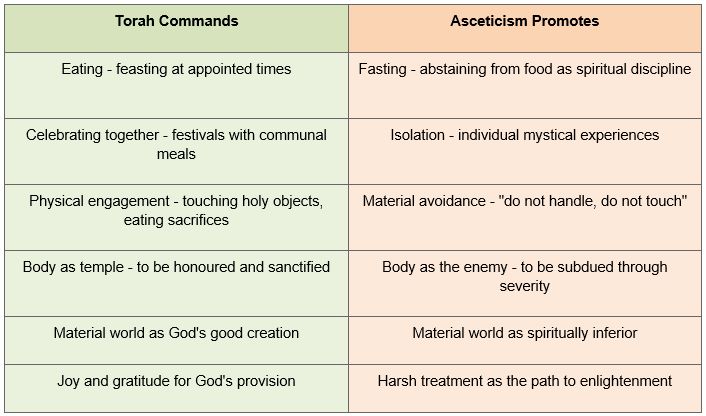
5D: Torah’s Character vs. Ascetic Character

Let’s make this even more explicit by comparing what Torah actually commands versus what asceticism promotes:
Torah vs Asceticism Table
These are opposite systems. Torah celebrates the material world as God’s good creation and establishes rhythms for holy engagement with it. Asceticism despises the material as spiritually inferior and promotes disengagement from it.

Conclusion: The judges in Colossians 2 were not promoting biblical obedience. They were condemning physical, embodied practices; including the biblical practices of eating, drinking, celebrating festivals, and observing Sabbaths, as inadequate for true spirituality.

Paul’s response: Don’t let them judge you for keeping these practices. These practices rightly point to Christ. Their system is “self-made religion” with no real power.

Section 6: Why This Makes Paul’s Argument Coherent

We’re now ready to see how all the pieces fit together. When we read Paul’s argument as a unified whole, a consistent logic emerges.

6A: The Internal Consistency Test

Here’s the test: Can Paul be saying in verse 16 “don’t let anyone judge you for NOT keeping food laws” and then in verse 21 condemn those who say “Do not taste, Do not touch”?

Under the traditional interpretation:

  • 16 would mean: “You’re free to abandon biblical food laws”
  • 21 would mean: “Don’t follow ascetic food prohibitions”
  • Problem: These would be encouraging and condemning the same basic action (not following food restrictions)

Under the contextual interpretation:

  • 16 means: “Don’t let ascetics judge you for keeping biblical practices of eating, drinking, festivals, Sabbaths”
  • 21 means: “Don’t submit to their ascetic prohibitions against handling, tasting, touching”
  • Result: Both verses defend physical engagement and condemn ascetic avoidance

The contextual reading makes Paul’s argument flow naturally. The traditional reading creates an internal contradiction.

6B: The “Therefore” Actually Works

Remember the logic Paul established:

  • Christ contains all the fullness (v.9)
  • You are complete in Him (v.10)
  • He cancelled the condemning certificate of debt (v.14)
  • He disarmed the powers that wielded condemnation (v.15)

Therefore (v.16): Don’t let anyone re-establish judgment over you.

Under what scenario does this “therefore” make sense?

Scenario A: You’re complete in Christ, condemnation is cancelled, therefore abandon biblical practices.

This doesn’t follow. Completeness in Christ doesn’t lead to abandoning God’s wisdom. It leads to freedom from performance-based acceptance.

Scenario B: You’re complete in Christ, condemnation is cancelled, therefore don’t let ascetics condemn you for engaging biblical practices that point to Him.

This follows perfectly. Christ’s sufficiency means:

  • The practices don’t save you (He does)
  • The practices don’t complete you (you’re already complete)
  • The practices point to Him (not to any; or in this case, ascetic additions)
  • No one can judge your standing based on these matters (the condemnation has been removed)

The “therefore” connects naturally when we understand Paul is defending freedom from judgment, and not advocating the abandonment of certain practices.

6C: The Chapter 2 → Chapter 3 Flow

This is perhaps the most compelling evidence that Paul’s argument has been misunderstood. If Colossians 2 teaches “you’re free from these obligations,” what happens in chapter 3?

Paul’s argument doesn’t stop at 2:23. Remember, these chapter divisions weren’t original, Paul wrote this as one continuous letter. Let’s trace the flow:

Colossians 3:1-4 – Your Life Is Hidden with Christ

“If then you have been raised with Christ, seek the things that are above, where Christ is, seated at the right hand of God. Set your minds on things that are above, not on things that are on earth. For you have died, and your life is hidden with Christ in God. When Christ who is your life appears, then you also will appear with him in glory.”

Is this ascetic detachment from the physical? No. Paul has just spent the end of chapter 2 condemning that very mindset.

What is it? Resurrection orientation. Your identity is secure in Christ. Your standing doesn’t depend on impressing anyone with your spiritual achievements. Your life is “hidden”; secure, protected, already determined, in Christ.

Notice also: “When Christ appears, then you will appear with Him in glory.” Future tense. The consummation hasn’t yet happened. The “already but not yet” tension is preserved. We live between Christ’s resurrection (already accomplished) and our full glorification (still to come).

Colossians 3:5-11 – Put to Death What Is Earthly

“Put to death therefore what is earthly in you: sexual immorality, impurity, passion, evil desire, and covetousness, which is idolatry…Put them all away: anger, wrath, malice, slander, and obscene talk from your mouth. Do not lie to one another, seeing that you have put off the old self with its practices and have put on the new self, which is being renewed in knowledge after the image of its creator.”

Is this body-denying asceticism? No. This is the transformation of how you use your embodied life.

What’s being put to death? Not the body, but sinful patterns: lust, greed, anger, lying.

What requires this? Actually engaging the body rightly, not escaping it. You can’t put off lying by retreating to a cave. You do it by speaking truth within the community. You can’t put off sexual immorality by hating the body. You do it by honouring the body and directing your desires rightly.

This is exactly the opposite of the ascetic system Paul condemned. The ascetics claimed severity to the body would restrain sin. Paul says their system “is of no value in stopping the indulgence of the flesh” (2:23). True transformation comes through our union with Christ and by walking in the Spirit, not through the punishment of the body.

Colossians 3:12-17 – Clothe Yourselves with…

“Put on then, as God’s chosen ones, holy and beloved, compassionate hearts, kindness, humility, meekness, and patience, bearing with one another and, if one has a complaint against another, forgiving each other; as the Lord has forgiven you, so you also must forgive. And above all these put on love, which binds everything together in perfect harmony. And let the peace of Christ rule in your hearts, to which indeed you were called in one body. And be thankful. Let the word of Christ dwell in you richly, teaching and admonishing one another in all wisdom, singing psalms and hymns and spiritual songs, with thankfulness in your hearts to God. And whatever you do, in word or deed, do everything in the name of the Lord Jesus, giving thanks to God the Father through him.”

Notice what Paul commands:

  • Compassion, kindness, humility, patience (embodied character qualities)
  • Bearing with one another, forgiving (community practices)
  • Love that binds together (relational engagement)
  • Teaching and admonishing one another (active discipleship)
  • Singing together with thankfulness (corporate worship)
  • Doing everything in Jesus’ name (a total life orientation)

These are all concrete, embodied, community-centred practices. Nothing here suggests “you’re now free from obedience” or “patterns for holy living are obsolete.”

If Paul’s point in chapter 2 was “Christ frees you from Torah obligations, so live as you choose,” chapter 3 would be incoherent. But if his point was “Christ frees you from condemnation, so now live in grateful, secure obedience,” chapter 3 flows perfectly as the positive outworking of that freedom.

6D: The Argument’s Unity

When we read 2:8 through 3:17 as Paul’s unified argument, here’s what we find:

2:8-15: Foundation – Christ’s sufficiency and accomplished work
2:16-17: Defence – Don’t let ascetics judge you about biblical practices
2:18-23: Expose – The ascetic system is powerless and false
3:1-4: Reorient – Your life is secure in the risen Christ
3:5-11: Negative – Put off sin patterns
3:12-17: Positive – Put on Christ-like character and practices

There’s no break in logic. There’s no “you’re free from obedience” interlude. There’s liberation from condemnation (2:14) leading to liberation from false spiritual systems (2:16-23) leading to secure, joyful obedience (3:1-17).

The traditional interpretation requires severing this flow, treating chapter 2 as about freedom from obligation and chapter 3 as a sudden return to commands. The contextual interpretation sees the whole as a seamless argument about living in the security and sufficiency of Christ against false spirituality.

Section 7: What Paul Actually Means by Freedom

We need to address this directly because it’s the core pastoral application of this passage, and where most of the confusion often arises.

7A: The Question That Must Be Answered

When Paul says “don’t let anyone judge you” (2:16), what kind of freedom is he granting?

OPTION A: Autonomy freedom – “You’re free to choose whether to follow God’s wisdom. These practices are optional. Your own conscience decides.”

OPTION B: Security freedom – “You’re free from condemnation regarding your standing before God. Nobody can judge your acceptance based on these matters.”

These are fundamentally different kinds of freedom, and the difference matters enormously.

7B: Why It Can’t Be Option A (Autonomy)

Several factors make Option A impossible:

  1. Colossians 3 immediately commands specific obedience. If Paul meant “you’re free to choose,” the sudden return to imperatives would be jarring and contradictory.
  2. Paul consistently affirms Torah as “holy, righteous, and good” (Romans 7:12). He says he “upholds the law” through faith (Romans 3:31). He would not tell believers that God’s wisdom is now optional.
  3. Paul himself continued practicing these things. Throughout Acts, Paul observes Sabbaths (13:14, 42, 44; 16:13; 17:2; 18:4), rushes to keep feasts (18:21; 20:16), takes vows (18:18), and undergoes temple purification (21:26). If he believed these practices were obsolete or optional, his behaviour makes no sense.
  4. Paul’s entire theological framework is “lordship transfer,” not autonomy. He speaks constantly of dying to self, being slaves of Christ, offering bodies as living sacrifices, being bought with a price. Autonomy theology; “live as you choose”, contradicts everything Paul teaches about discipleship.
  5. The grammar doesn’t support it. Paul doesn’t say “You’re free to keep or not keep these things as you prefer.” He says “Don’t let anyone judge you.” He’s addressing external judgment, not internal decision-making about obedience.

7C: What Freedom Actually Means in Context

Option B fits perfectly with everything Paul has said and everything that follows.

Think about what had just happened theologically:

Under the old covenant administration:

  • The law revealed God’s righteousness
  • We violated that law through sin
  • The law’s condemning power stood as a testimony against us
  • The certificate of debt accumulated
  • We were under judgment, rightly condemned

What Christ accomplished (2:14-15):

  • He cancelled (ἐξαλείψας) the certificate of debt
  • He took it out of the way (ἦρκεν ἐκ τοῦ μέσου)
  • He nailed it to the cross
  • He disarmed the powers that wielded that condemnation
  • He made a public display of their defeat

The result:

  • The condemning power is broken
  • The accusation is silenced
  • The jurisdiction of judgment is removed
  • We are complete in Him (2:10)
  • No one can successfully charge God’s elect (Romans 8:33)

Now the ascetics come along and try to re-establish judgment:

  • “You’re not spiritual enough”
  • “You need our system to be truly mature”
  • “Your physical practices show you’re not enlightened”
  • “You’re engaging the material world when you should transcend it”

Paul’s response: “Don’t let them place you back under judgment. The condemnation Christ removed cannot be re-established. Your standing before God is not based on whether you meet their standards or anyone else’s standards. You are complete in Christ.”

This is freedom from condemnation, not freedom from obedience.

7D: The Practical Difference

Here’s what this freedom looks like in practice:

Without gospel freedom (under condemnation):

  • I keep Sabbath to earn God’s acceptance
  • I celebrate feasts to prove I’m spiritual enough
  • I follow food laws to maintain my standing
  • I’m anxious about whether I’m doing it right
  • Others’ judgment determines my identity
  • Failure means condemnation

With gospel freedom (secure in Christ):

  • I keep Sabbath because it teaches me to rest in God’s provision
  • I celebrate feasts because they tell God’s redemptive story and point to Christ
  • I follow biblical wisdom about food because I trust God’s design
  • I’m free to learn and grow without fear of rejection
  • Others’ judgment doesn’t define me, Christ does
  • Failure is met with grace and sanctification, not condemnation

These are the same practices, but an entirely different motivation and security.

This is what Paul means: Don’t let anyone judge you regarding these matters. Not because the practices are wrong or obsolete, but because your standing is secure in Christ. Nobody’s judgment; ascetic, legalist, or otherwise, can place you back under condemnation.

You’re free to engage God’s wisdom from love, gratitude, and trust. You’re free to let these practices point you to Christ. You’re free from the performance treadmill and from spiritual intimidation.

This is freedom for obedience, not freedom from obedience.

And this is exactly the freedom Paul demonstrates in chapter 3, where he immediately commands concrete obedience, but now flowing from our secure identity in Christ, not our anxious striving for acceptance.

[ Article Continued on Next Page ]

PART 2: WHY THIS READING RESOLVES PROBLEMS

We’ve walked through Paul’s positive argument. Now let’s see how this interpretation resolves questions and tensions that the traditional reading struggles to address.

Section 8: The Question Solberg Never Answers

There’s an elephant in the room that the traditional interpretation consistently ignores. It’s a simple historical question with no simple answer under that framework.

8A: Why Were the Colossians Keeping These Practices?

According to the traditional interpretation::

  • The Colossians were former pagans in Asia Minor (1:21, 2:13)
  • They had no prior connection to Israel’s covenant or calendar
  • Yet they were observing Sabbaths, festivals, new moons, and food laws (2:16)

These aren’t practices you stumble into accidentally. Sabbath observance required complete restructuring of your weekly schedule. Festival observance meant learning an entirely new calendar with agricultural and historical significance potentially foreign to their previous culture. Food laws meant changing foundational dietary habits.

The question the traditional view must answer: Why would complete pagans with no prior connection to Israel’s covenant spontaneously adopt these demanding practices?

8B: The Traditional View’s Problem

Solberg claims: “The Colossians were being pressured to adopt these practices by false teachers.”

But this creates more problems than it solves:

Problem 1: If Torah observance was already understood as obsolete or inappropriate for non-Jewish Christians, why would pressure to adopt it even exist in Colossae? Why wasn’t this a non-issue?

Problem 2: Why do we see no similar controversy in Paul’s other letters to predominantly non-Jewish churches? If this was a widespread problem of Jewish Christians pressuring new believers to keep Torah, we’d expect it to appear prominently in Romans, Corinthians, Galatians, Ephesians. But it doesn’t.

Problem 3: The actual controversy in Acts 15 was about circumcision for salvation, and even there, Sabbath observance never comes up. The Jerusalem Council never says, “Believers from the nations don’t need to keep Sabbath.” Why not, if it was contentious?

Problem 4: Paul’s own behaviour. If he believed Torah observance was obsolete and inappropriate for the new covenant, why does he consistently practice it himself? We’re not talking about isolated incidents but a clear pattern running throughout Acts.

The traditional view has no satisfying answer to these problems. It requires us to believe:

  • New believers randomly adopted practices they were told were obsolete
  • Or false teachers successfully pressured them into practices the apostles said were unnecessary
  • But somehow this pressure left no trace in Paul’s other writings
  • And Paul fought against it while simultaneously practicing it himself

8C: The Contextual View’s Answer

The contextual interpretation provides a coherent explanation—and it doesn’t require any contested theology. It just requires reading the book of Acts.

What Acts Shows Us About Paul’s Pattern:

Throughout Acts, Paul’s consistent practice was to begin in the synagogues, where he reasoned with both Jews and God-fearing Greeks every Sabbath (Acts 13:14, 43; 14:1; 17:2, 4, 10, 12; 18:4, 8; 19:8). (For full documentation of Paul’s practice and its theological implications, see Section 11C.)

Who Did He Find There?

Not just Jews, but God-fearing Greeks as a major part of the synagogue community. These God-fearers were already:

  • Attending synagogue regularly
  • Observing Sabbath
  • Familiar with Torah
  • Keeping biblical food practices
  • Honouring Israel’s festivals
  • Worshipping Israel’s God

They were, in effect, already walking in Torah’s wisdom, fully integrated into synagogue life, just not ethnically Jewish.

So When Paul Preached Messiah and They Believed…

They didn’t “adopt” these practices. They continued to walk in them, now understanding them in light of Christ. They were already keeping Sabbath, festivals, and food laws. Nothing changed about their practices. What changed was their understanding of who Messiah is and what His work had accomplished.

This Makes the “Why Were They Keeping These Practices?” Question Trivial:

Traditional view assumption: Pagan converts with no connection to Judaism mysteriously adopted demanding Jewish practices

Simple Acts reading: Synagogue attendees who already kept these practices continued doing so after believing in Messiah

The second explanation requires no speculation. It’s just what Acts naturally leads us to conclude.

And This Explains Why Any Actual Pagans Would Adopt Them Too:

The assemblies likely consisted of:

  1. Jews (who had always kept Torah)
  2. God-fearing Greeks (who were already keeping Torah as synagogue attendees)
  3. A smaller number of actual pagans (new to these practices)

When someone joins a community, they naturally adopt that community’s practices. If you join a community where everyone observes Sabbath, celebrates biblical festivals, and follows food wisdom, you do too—not because you’re being “pressured by false teachers,” but because that’s what the community you’re joining does.

The community norm was Torah observance. New converts, whatever their background, would naturally participate in the life of the community they were entering. This isn’t mysterious. It’s just how communities work.

Now Let’s Turn Back to Colossians:

If the Colossian assembly was primarily composed of such God-fearers (which fits Paul’s established pattern perfectly), then:

Step 1: They were already keeping Sabbaths, festivals, new moons, and food laws before hearing about the Messiah

Step 2: When they believed in Christ, they understood themselves as now fully part of God’s people, no longer outsiders looking in, but “fellow citizens with the saints and members of the household of God” (Ephesians 2:19)

Step 3: The ascetic teachers judged them for these physical practices. “Why are you engaging these material, bodily observances? True spirituality transcends the physical. You need visions, angels, mystical experiences, harsh ascetic discipline.”

Step 4: Paul defends them. “Don’t let these teachers judge you. Your practices point to Christ. You don’t need their additions. Christ is sufficient.”

This explanation:

  • Accounts for why believers from the nations were practicing these things (many of them already were)
  • Explains who the judges were (ascetics condemning physical practices)
  • Makes sense of Paul’s defence (protecting biblical practices from ascetic criticism)
  • Aligns with Paul’s documented journeys and practices in Acts
  • Requires no contested theological framework, just a plain reading of the Acts account

8D: The Evidence Test

Which explanation better fits the historical evidence?

Traditional view requires:

  • Jewish legalists pressuring non-Jewish believers toward Torah (but described as ascetic mystics)
  • Paul defending freedom from Torah (but practicing it himself)
  • This controversy being unique to Colossae (unexplained why)
  • The early church maintaining a strong consensus on this (despite supposed widespread pressure)

Contextual view explains:

  • Believers from the nations naturally engaging or continuing in covenant patterns upon joining God’s people
  • Ascetic teachers condemning physical practices as inadequate
  • Paul defending biblical practices from ascetic corruption
  • Why this pattern appears nowhere else (it’s specific to Colossae’s particular heresy)
  • Why Paul’s practice matches his teaching

The contextual reading provides what any good interpretation should: coherent explanation of all the evidence without special pleading.

Section 9: The Grammatical Support

Beyond the contextual and logical arguments, the Greek grammar itself supports this reading. Let’s examine the key linguistic elements.

9A: The “Things to Come” (τῶν μελλόντων)

In verse 17, Paul writes: “These are a shadow of the things to come (τῶν μελλόντων)”

The phrase τῶν μελλόντων is a genitive plural present participle from μέλλω. This grammatical construction is significant:

What it indicates:

  • Present participle suggests ongoing relevance
  • Not a completed past action
  • Things that are “about to be” or “coming”
  • Emphasis on future events from a given perspective

What it doesn’t say:

  • Not aorist (simple past): “things that came”
  • Not perfect: “things that have been completed”
  • Not “things that came and are now finished”

The grammar preserves the forward-looking orientation. The shadows point toward realities that, from their own perspective, were “to come.” But the question is: have those realities fully arrived, or are they still in process?

9B: Paul’s Eschatological Framework

This is where understanding Paul’s theology becomes crucial. Paul consistently operates within an “already but not yet” framework:

Already accomplished:

  • Christ has come, died, risen, ascended
  • The Spirit has been poured out
  • The new covenant has been inaugurated
  • The kingdom has broken into history
  • We have been raised with Christ (Colossians 3:1)

Not yet consummated:

  • Christ has not yet returned in glory
  • Creation still groans (Romans 8:22)
  • We still await “the redemption of our bodies” (Romans 8:23)
  • Our life is “hidden with Christ” until He appears (Colossians 3:3-4)
  • We “see through a glass darkly” (1 Corinthians 13:12)
  • “What we will be has not yet appeared” (1 John 3:2)

This “already/not yet” tension pervades all of Paul’s eschatology. The age to come has been inaugurated in Christ’s resurrection, but it has not been consummated. We live in the ‘overlap of the ages’.

9C: The Grammatical-Theological Fit

Given this framework, what does τῶν μελλόντων (“things to come”) refer to?

Traditional interpretation: The “coming things” were Christ’s first advent. He came, so they’ve fully arrived. The shadows have served their purpose.

Problem with this: It collapses Paul’s “already/not yet” tension. It requires claiming that the reality is fully here, which Paul never says. In fact, he says the opposite; our full unveiling awaits Christ’s appearing (Colossians 3:4).

Contextual interpretation: The “coming things” include both:

  • What has been inaugurated in Christ’s first coming (the “already”)
  • What will be consummated in His return and the new creation (the “not yet”)

The shadows pointed forward to Messiah’s work; His incarnation, death, resurrection, ascension, reign, return, and the final restoration of all things. The first part is accomplished; the final part still awaits. The shadows continue their function of pointing forward to the full reality still to be revealed.

This explains why Paul can say:

  • “These are a shadow” (present tense – they still function as shadows)
  • “Of the things to come” (they point forward)
  • “The substance belongs to Christ” (He is the reality they’ve always pointed to)

The shadows don’t become obsolete at Christ’s first coming any more than David’s throne becomes obsolete when Jesus begins reigning from it. The shadows participate in and point to the eternal reality being progressively revealed.

9D: Supporting Evidence from Paul’s Usage

Paul uses similar “things to come” language elsewhere, and it consistently includes future eschatological realities:

Romans 8:18: “The sufferings of this present time are not worth comparing with the glory that is to be revealed to us”

1 Corinthians 3:22: “Whether the world or life or death or the present or the future (μέλλοντα) – all are yours”

Ephesians 1:21: Christ is “far above all rule and authority and power and dominion, and every name that is named, not only in this age but also in the one to come (μέλλοντι)”

In each case, Paul acknowledges the ongoing future expectation; realities not yet fully realised. This is his consistent pattern.

Therefore: The grammar and theology together support reading Colossians 2:17 as “These practices are shadows pointing toward Messiah and His complete work, a work that has been inaugurated but awaits its consummation. As long as we’re between the ‘already’ and ‘not yet,’ the shadows still serve their prophetic function.”

Section 10: The Coherence Test – Seven Ways This Reading Works

Let’s summarise why the contextual interpretation makes sense of the entire passage and surrounding evidence, while the traditional view struggles.

This interpretation coheres with:

1. Why Believers from the Nations Kept These Practices

Traditional view: Inexplicable or requires external pressure
Contextual view: Natural expression of covenant identity through Messiah

2. The Profile of the Heretics

Traditional view: Described as ascetic mystics but supposedly promoting Torah obedience
Contextual view: Actually ascetic mystics condemning physical practices

3. The V.16 + V.21 Relationship

Traditional view: Creates contradiction (affirming food law abandonment, condemning food prohibitions)
Contextual view: Both defend physical engagement against ascetic condemnation

4. The Use of the Jewish Triad

Traditional view: Uses sacred biblical formula to dismiss biblical practices
Contextual view: Uses biblical formula to establish biblical basis of practices being defended

5. The Chapter 2 → 3 Flow

Traditional view: Awkward break – freedom from practices, then immediate commands
Contextual view: Seamless flow – freedom from condemnation enables secure obedience

6. Paul’s Own Documented Behaviour

Traditional view: Paul practices what he supposedly tells others is obsolete
Contextual view: Paul models what he teaches – his practices flow from his secure identity

7. The “Already/Not Yet” Eschatology

Traditional view: Requires full arrival of reality, collapsing eschatological tension
Contextual view: Preserves tension – reality inaugurated, awaiting consummation

The principle: A good interpretation should make sense of all the evidence without special pleading or forced explanations. The contextual reading does this. The traditional reading requires explaining away substantial evidence.

[ Article Continued on Next Page ]

PART 3: WHERE ALTERNATIVE READINGS BREAK DOWN

We’ve established what Paul actually argues and shown how this reading resolves problems. Now let’s examine where alternative interpretations struggle, not to score points, but to demonstrate that the traditional reading creates difficulties it cannot easily resolve.

Section 11: The Traditional Reading’s Internal Contradictions

11A: The V.16 vs. V.21 Problem

We’ve already established this contradiction in Section 2, but it bears emphasizing as the fatal flaw in the traditional interpretation. The logic is mechanical:

If Paul tells believers in v.16 they’re free to abandon biblical food practices, he cannot then condemn in v.21-23 those who say “Do not handle, Do not taste, Do not touch.” Both would be forms of abstention from physical engagement.

The traditional reading tries to escape this by dividing the heresy into “Jewish legalism” (v.16) and “pagan asceticism” (v.21), but Paul never makes this distinction. The same judges, the same philosophy, the same “human commands” run throughout verses 8-23.

The contextual reading has no such problem: Paul consistently defends physical, embodied practices against ascetic condemnation throughout the passage.

11B: The Colossians 3 Problem (Revisited)

If chapter 2 establishes that believers are “free from Torah obligations,” what is chapter 3?

Immediate problems:

3:1-4: “Set your minds on things above, not on things on earth”

  • Is this ascetic detachment? No, Paul just condemned that
  • But the traditional reading offers no clear alternative interpretation

3:5-11: “Put to death… put them all away… put on the new self”

  • These are commands for transformation using embodied life
  • But we were just told we’re free from commandments?
  • How do we distinguish “obsolete commands” from “current commands”?

3:12-17: “Put on… bearing with one another… forgiving… teaching… singing… doing everything in the name of the Lord”

  • Comprehensive commands for concrete practices
  • Where’s the transition from “freedom from obligation” to “here are obligations”?

The traditional interpretation requires an unexplained logical break between chapters 2 and 3. The contextual interpretation sees a seamless flow: freedom from condemnation (2:14) → defence against false judgment (2:16-23) → secure obedience from love (3:1-17).

11C: Paul’s Behaviour Problem

This is perhaps the most devastating evidence against the traditional view. If Paul believed what Solberg claims he believed, his documented behaviour is inexplicable.

Acts 13:14: “They went into the synagogue on the Sabbath day”
Acts 13:42: “As they went out, the people begged them to speak about these things the next Sabbath”
Acts 13:44: “The next Sabbath almost the whole city gathered to hear the word of the Lord”
Acts 16:13: “On the Sabbath day we went outside the gate to the riverside, where we supposed there was a place of prayer”
Acts 17:2: “Paul went in, as was his custom, and on three Sabbath days he reasoned with them from the Scriptures”
Acts 18:4: “He reasoned in the synagogue every Sabbath, and tried to persuade Jews and Greeks”
Acts 18:21: “I must by all means keep this coming feast in Jerusalem”
Acts 20:16: “Paul had decided to sail past Ephesus… he was hastening to be at Jerusalem, if possible, on the day of Pentecost”

But Here’s What Makes This Absolutely Devastating:

Paul doesn’t just practice these things privately or for unclear reasons. He explicitly tells believers that his behaviour is the pattern they should follow. This is the Hebraic discipleship model; the rabbi models, the disciples imitate.

1 Corinthians 11:1: “Imitate me, as I also imitate Christ”

1 Corinthians 4:16: “I urge you, therefore, be imitators of me

Philippians 3:17: “Join in imitating me, brothers, and observe those who walk according to the example you have in us

Philippians 4:9: “What you have learned and received and heard and seen in mepractice these things

1 Thessalonians 1:6: “You became imitators of us and of the Lord”

2 Thessalonians 3:7-9: “You yourselves know how you ought to imitate us… we did this… to make ourselves a model for you to follow

Think about what this means:

Paul is telling believers: “Watch what I do and do the same.”

What does he do? He observes Sabbath, keeps festivals, takes vows, undergoes purification, rushes to Jerusalem for Pentecost; as was his custom.

If the traditional view is correct, Paul is:

  1. Telling the Colossians not to let anyone judge them for abandoning these practices
  2. While simultaneously modelling these practices himself
  3. And explicitly commanding believers to imitate his behaviour

This is beyond contradictory. It’s incoherent. You cannot tell people “imitate me” while living the opposite of what you’re teaching them.

The standard response: “Paul was just doing this for evangelism—to reach Jews where they were.”

Why this doesn’t work:

  1. Pattern, not exception: This isn’t occasional but consistent throughout his ministry
  2. Mixed audiences: Paul attends synagogue whether audiences are receptive or hostile
  3. With believers: Paul rushes to keep Pentecost with other believers, not as evangelism
  4. Language used: “as was his custom” (Acts 17:2) suggests personal practice, not strategy
  5. Voluntary actions: Paul voluntarily takes a Nazirite vow (Acts 18:18) and undergoes temple purification (Acts 21:26), these aren’t evangelistic
  6. The imitation command: Paul explicitly tells believers to imitate his behaviour, so even if he was “doing it for evangelism” (which the evidence contradicts), he’s still commanding others to do the same. The “evangelism excuse” doesn’t escape the problem; it makes it worse.

Here’s the unavoidable logic:

IF Paul believed these practices were obsolete shadows believers shouldn’t keep,
THEN his behaviour contradicts his teaching,
AND his command to “imitate me” becomes a trap that leads believers into obsolete practices,
AND his entire discipleship model collapses into incoherence.

BUT IF Paul believed these practices were God’s good wisdom that point to Messiah; valuable but not salvific, THEN:

  • His behaviour matches his teaching (coherent)
  • His “imitate me” command makes perfect sense (disciples following the rabbi’s pattern)
  • His defence in Colossians 2 is protecting practices he himself models (consistent)
  • His practice flows from secure identity in Christ, not from earning acceptance (grace-filled)

The second explanation requires no special pleading, no contradictions, no elaborate justifications. It’s just Paul living and teaching the same thing.

Section 12: The Theological Problems

Beyond internal contradictions in Colossians itself, the traditional interpretation creates broader theological difficulties.

12A: Making Paul Contradict the Rest of Scripture

If Solberg’s interpretation is correct, Paul is saying: “Don’t let anyone judge you for ignoring commandments that God Himself gave, called holy, and established as perpetual statutes.”

This contradicts:

Deuteronomy 4:2: “You shall not add to the word that I command you, nor take from it”
Deuteronomy 12:32: “Everything that I command you, you shall be careful to do. You shall not add to it or take from it”

Psalm 19:7-11: “The law of the LORD is perfect, reviving the soul… the commandment of the LORD is pure, enlightening the eyes… they are more to be desired than gold”

Psalm 119:89: “Forever, O LORD, your word is firmly fixed in the heavens”
Psalm 119:160: “The sum of your word is truth, and every one of your righteous rules endures forever”

Matthew 5:17-19: “Do not think that I have come to abolish the Law or the Prophets; I have not come to abolish them but to fulfil them… whoever relaxes one of the least of these commandments… will be called least in the kingdom of heaven”

James 1:25: “He who looks into the perfect law, the law of liberty, and perseveres… this one will be blessed in what he does”
James 2:8: “If you really fulfil the royal law according to the Scripture… you are doing well”

1 John 5:3: “For this is the love of God, that we keep his commandments. And his commandments are not burdensome”

The problem: The traditional reading makes Paul the lone voice saying God’s commandments have become obsolete and inappropriate. He would be contradicting Moses, David, Jesus, James, and John; every other biblical voice that speaks to this issue.

Paul explicitly denies this role. When he anticipates the objection “Do we then overthrow the law by this faith?”, his response is emphatic: “By no means! On the contrary, we uphold the law” (Romans 3:31).

12B: The “Forever” Problem

God uses specific language when establishing certain practices:

Exodus 31:16-17: “The people of Israel shall keep the Sabbath, observing the Sabbath throughout their generations, as a covenant forever. It is a sign forever between me and the people of Israel”

Leviticus 23:14, 21: Describes festivals as “a statute forever throughout your generations”

The traditional view must argue that “forever” (עוֹלָם, olam) doesn’t actually mean forever—it means “until Christ comes.”

But this creates the same problem we identified in Section 4C with David’s throne: 2 Samuel 7:16 uses the identical Hebrew word to describe the eternality of David’s throne. We’ve already shown that David’s throne doesn’t become obsolete when Messiah comes—it participates in Christ’s eternal reign.

The question remains: On what biblical principle do we decide which “forevers” are actually forever and which aren’t? Where does Scripture itself provide the hermeneutical key for making this distinction?

The contextual view has no such problem: practices God established as perpetual remain valuable because they participate in eternal realities in Christ, just as David’s throne does.

12C: The Covenant Inclusion Problem

Paul teaches explicitly that grafted believers are:

  • Grafted into Israel’s olive tree (Romans 11:17-24) – not a separate tree
  • Members of the commonwealth of Israel (Ephesians 2:12) – not a different commonwealth
  • Heirs according to the promise made to Abraham (Galatians 3:29) – not different promises
  • Brought near to the covenants (Ephesians 2:12-13, plural) – not excluded from them
  • Built on the foundation of apostles and prophets (Ephesians 2:20) – the same foundation

If believers from the nations are truly incorporated into God’s people, truly grafted into Israel’s story, truly made “fellow heirs” and “members of the same body” (Ephesians 3:6), then on what basis would God’s wisdom for holy living suddenly be inappropriate for them?

The traditional view requires this logic:

  1. Believers from the nations are brought into the people of God
  2. Therefore, the patterns God gave His people don’t apply to them

This is internally contradictory. Whereas the contextual view is coherent:

  1. Believers from the nations are brought into the people of God
  2. They naturally engage with the patterns of life God established for His people
  3. They do so from their secure identity in Christ, not to earn that identity

Section 13: Addressing Anticipated Objections

Let’s address the main scriptural objections typically raised against this interpretation.

13A: “But Hebrews Says the Old Covenant Is Obsolete”

The objection: Hebrews 8:13 says “In speaking of a new covenant, he makes the first one obsolete.” Doesn’t this mean all Torah practices are obsolete?

The response: This objection contains a category error that generates most of the confusion. Let me make the distinction explicit.

The Category Error

Most readers unconsciously assume: Torah = Mosaic Covenant

But biblically, that equation does not hold. What Scripture actually presents is:

Torah = God’s instruction / wisdom / moral order
Mosaic Covenant = One historical administration of Torah

The Mosaic covenant is how Torah was mediated to Israel in a specific time, place, and redemptive context, not the origin, essence, or limit of Torah itself.

Once you see this distinction, Hebrews, Colossians, and Paul stop contradicting themselves.

Torah Clearly Predates Sinai

This matters because it shows Torah is not synonymous with the Mosaic covenant:

Sabbath – Sanctified at creation, before Israel existed (Genesis 2:1-3)

Dietary distinctions – Operative with Noah, before any covenant with Israel (Genesis 7; clarified in Genesis 9)

Moral accountability – Assumed before Sinai (Cain judged for murder, Sodom for wickedness, Joseph resisting adultery as “sin against God”)

Abraham – “Kept My charge, My commandments, My statutes, and My laws” (Genesis 26:5)

That verse alone demonstrates that Torah existed and was binding before Moses, before Sinai, before the covenant at Horeb.

Sinai didn’t create Torah. It codified and administered it covenantally for a nation.

What Actually Became Obsolete (Precisely)

Hebrews 8:13 does not say “Torah is obsolete.”
It says the covenant is obsolete.

What did that covenant include?

  • A national priesthood (Levitical lineage)
  • A territorial sanctuary (tabernacle, then temple in Jerusalem)
  • A sacrificial economy (daily offerings, annual atonement)
  • Civil and cultic structures tied to land, tribe, and temple access

In other words: What became obsolete was a covenantal governance structure, not divine instruction itself.

This is exactly how administrations work. When a government changes, the laws it administered don’t necessarily become obsolete, but the administrative framework does.

The Clear Formulation

Here’s the distinction stated carefully:

The Mosaic covenant was not Torah itself, but a covenantal administration through which Torah was applied to Israel as a nation.
When Hebrews speaks of obsolescence, it is this administrative framework
; centered on the Levitical priesthood, sacrificial mediation, and temple access, that has reached its appointed end in Christ.
Torah, as God’s eternal instruction reflecting His character and wisdom, precedes the Mosaic covenant and continues beyond it.

What has changed is not the content of God’s instruction, but the covenantal structure through which it is mediated.

This Explains Why Hebrews Keeps Quoting Torah

Now the pattern makes perfect sense:

Hebrews 1:5-14 – Quotes Torah to establish Christ’s superiority
Hebrews 3:7-11 – Quotes Torah to warn believers
Hebrews 8:8-12 – Quotes Torah to explain the New Covenant
Hebrews 10:16-17 – Quotes Torah as God’s promise
Hebrews 12:5-6 – Quotes Torah to exhort believers
Hebrews 13:5-6 – Quotes Torah to encourage faithfulness

Throughout the letter, Torah functions as God’s authoritative word. The author doesn’t say “this used to be true” or “Moses said this but it’s obsolete.” He says “God says” (1:5), “the Holy Spirit says” (3:7).

This is the exact same logical pattern we saw in Colossians 2. You don’t invoke honoured biblical language to dismiss what it establishes. Paul uses the sacred triadic formula (festival/new moon/Sabbath) because he’s affirming these as biblical practices. The author of Hebrews quotes Torah constantly because he’s affirming it as God’s authoritative instruction.

As we noted earlier, this is exactly like quoting wedding vows reverently while claiming the vows are obsolete. It doesn’t work. You don’t cite something as God’s authoritative voice if you believe it’s become obsolete and inappropriate.

What Hebrews Actually Teaches

What’s obsolete: The covenant mechanism for dealing with sin; Levitical priests offering repeated animal sacrifices in an earthly temple

Why it is obsolete: Christ fulfilled it completely as the final High Priest offering the final sacrifice once for all

What remains authoritative: Torah as God’s instruction revealing His character, wisdom, and design for holy living

Why it remains: Because God’s character hasn’t changed, and His wisdom for life doesn’t expire when covenant administrations change

This is why:

  • Hebrews can declare the covenant obsolete (8:13)
  • While constantly quoting Torah as authoritative (throughout the letter)
  • And still teaching believers to pursue holiness (12:14), show hospitality (13:2), honour marriage (13:4), and reject greed (13:5); these are all rooted in Torah’s wisdom

The One-Sentence Summary

The Mosaic covenant did not create Torah; it administered Torah for Israel in a particular historical form. When that covenantal administration reached its fulfilment in Christ, it became obsolete, not because Torah failed, but because the administration’s redemptive purpose had been accomplished and God’s instructions now find expression within a new covenantal reality.

How This Resolves Colossians 2

With this clarity, Colossians 2:16-17 makes sense without any gymnastics:

  • The practices Paul names (Sabbath, festivals, new moons, food laws) belong to Torah, not to the Mosaic covenant exclusively
  • Their Mosaic administration is not the issue Paul is addressing
  • The problem is a rival interpretive system (asceticism) claiming these practices are spiritually inferior
  • Paul’s argument isn’t “These things are over”
  • Paul’s argument is: “These things already point where they’re supposed to point, to Christ. Stop letting ascetics hijack them with their false spirituality.”

Shadows don’t disappear when the covenant administration changes. They lose their gatekeeping function, not their meaning.

Under the Mosaic covenant, access to God was mediated through priests, sacrifices, and temple. Those things were shadows of Christ, and that mediating function is now obsolete; all access is now through Messiah.

But the practices themselves; Sabbath rest, sacred time, food wisdom, festival celebration, these reflect God’s eternal wisdom about creation, redemption, rest, and holiness. They continue to teach us, shape us, and point us toward the realities they’ve always signified.
They’re no longer required for covenant access (that’s obsolete). But they remain instructive for covenant living (that continues).

13B: “But Galatians Condemns Returning to Observance”

The objection: Galatians 4:9-10 says “How can you turn back again to the weak and worthless elementary principles of the world, whose slaves you want to be once more? You observe days and months and seasons and years!” Doesn’t this condemn keeping biblical calendar?

The response: Context is everything. What is Paul fighting in Galatians?

Galatians 2:16: “We know that a person is not justified by works of the law but through faith in Jesus Christ”
Galatians 3:1-3: “Did you receive the Spirit by works of the law or by hearing with faith?… Having begun by the Spirit, are you now being perfected by the flesh?”
Galatians 5:2: “Look: I, Paul, say to you that if you accept circumcision, Christ will be of no advantage to you”
Galatians 5:4: “You are severed from Christ, you who would be justified by the law”

The issue in Galatians is soteriological; it’s about how one enters and maintains right standing before God. The Galatian agitators were teaching that faith in Christ was not sufficient for justification; you also needed circumcision and Torah observance.

Paul’s response is absolute: Adding anything to Christ for justification means Christ “will be of no advantage to you.” If you think you’re justified by keeping Torah, you’ve “fallen from grace” (Galatians 5:4).

But notice what Paul does NOT say:

“Observing Sabbath”, or “Keeping festivals”, or “Following biblical wisdom about food”  is

  • sinful
  • wrong
  • inappropriate

What he DOES say: These things don’t justify you. They don’t save you. They don’t maintain your standing before God. Making them criteria for salvation is to abandon the gospel.

This is why Paul could:

  • Circumcise Timothy (Acts 16:3) – because it wasn’t for salvation
  • Take a Nazirite vow (Acts 18:18) – because it wasn’t for justification
  • Undergo temple purification (Acts 21:26) – because it wasn’t to earn right standing

The distinction:

  • Using practices to justify yourself = abandoning grace
  • Engaging practices from secure identity = legitimate discipleship

Galatians condemns the former. It says nothing about the latter.

When Paul says the Galatians were returning to “weak and worthless elementary principles” (Galatians 4:9), he’s not critiquing Torah practices themselves. He’s critiquing the attempt to use any system; whether pagan philosophy or misapplied Torah, to achieve standing before God apart from Christ.

The question is never “Can Torah practices save you?” The answer to that is definitively no.

The question is “Can Torah practices teach you wisdom for holy living as a saved person?” That’s an entirely different question, and Galatians doesn’t address it, because that wasn’t the Galatian problem.

13C: “But Romans 14 Says Each Person Should Be Fully Convinced”

The objection: Romans 14:5-6 says “One person esteems one day as better than another, while another esteems all days alike. Each one should be fully convinced in his own mind. The one who observes the day, observes it in honour of the Lord.” Doesn’t this mean these practices are optional, a matter of personal conscience?

The response: Romans 14 uses the exact same logic as Colossians 2. Once you see this, the objection dissolves.

The situation: The Roman church had both Jews (who had grown up keeping Torah) and grafted believers (who came from different backgrounds). They disagreed about:

  • Whether to eat meat that might have been offered to idols (14:2)
  • Which days to regard as special (14:5)
  • Whether to drink wine (14:21)

Paul’s instruction: Don’t break fellowship over these matters. Don’t judge one another. Each person should act according to their own conscience, doing everything from the right motivation; to honour the Lord.

What this passage is NOT saying:

  • “God’s commandments are now optional”
  • “There’s no wisdom in following biblical practices”
  • “All days are objectively the same”

What it IS saying:

  • In a mixed community with different backgrounds, don’t make these matters tests of fellowship
  • Each person should be convinced they’re honouring the Lord in their practice
  • Mutual acceptance matters more than uniformity in these areas

Notice Paul’s actual words: “The one who observes the day, observes it in honour of the Lord” (Romans 14:6). He affirms the practice as legitimate worship. He’s not saying “days don’t matter”, he’s saying “don’t judge each other about them.”

If we compare this passage with Colossians 2, both passages:

  1. Address judgment, not the validity of practices
  2. Affirm the practices themselves (“observes it in honour of the Lord”)
  3. Defend freedom from condemnation, not freedom from obedience
  4. Protect people keeping practices against those who would judge them

The problem is NOT the practices themselves
The problem is JUDGMENT about the practices

Colossians: Don’t let ascetics judge you for keeping biblical practices (they claim these are spiritually inferior)

Romans: Don’t let anyone judge each other about these matters (some keep them, some don’t, both can honour the Lord)

Both passages defend people from condemnation.
Neither passage says the practices are obsolete or meaningless.

Paul is saying “keep these practices free from condemnation and judgment; whether from ascetics who despise material practices or from legalists who make them salvific.”

The traditional reading makes both passages say: “You’re free to abandon these practices.”

But Paul’s actual words say: “Don’t let anyone put you back under condemnation about these things; whether you keep them or not, do it to honour the Lord, according to your conscience.”

This is pastoral wisdom for maintaining unity, not a declaration that God’s appointed times and wisdom have become obsolete.

Shadows of the Substance

Section 14: The Missing Framework Already But Not Yet

This isn’t just an academic debate about one passage. The way we read Colossians 2 depends on a foundational question the traditional view never adequately addresses:
Are we living in the full consummation of Christ’s work, or are we still waiting for it?

14A: The Eschatological Reality Paul Operates Within

Throughout his letters, Paul consistently operates within an “already but not yet” framework:

Already:

  • Christ HAS died and risen (Romans 6:9-10)
  • We HAVE been justified (Romans 5:1)
  • We HAVE received the Spirit (Romans 8:9)
  • The new creation HAS begun (2 Corinthians 5:17)
  • We HAVE been seated with Christ (Ephesians 2:6)

Not Yet:

  • “We await a Saviour, the Lord Jesus Christ, who will transform our lowly body” (Philippians 3:20-21)
  • “Creation waits with eager longing… we wait for adoption as sons, the redemption of our bodies” (Romans 8:19, 23)
  • “Your life is hidden with Christ in God. When Christ who is your life appears, then you also will appear with Him in glory” (Colossians 3:3-4)
  • “Now we see through a glass darkly, but then face to face” (1 Corinthians 13:12)

The kingdom has been inaugurated, but not consummated.
The age to come has broken into this present age, but hasn’t fully arrived.
We have the firstfruits, but we’re still awaiting the full harvest.

This tension is not incidental to Paul’s theology, it’s fundamental to it.

14B: Why This Matters for Understanding “Shadows”

The traditional view assumes: Christ came → shadows fulfilled → shadows obsolete

But Paul’s actual framework is: Christ came → the kingdom has been inaugurated → we await its full consummation → shadows still point forward (and therefore relevant)

Think about it this way:

Christ IS our resurrection and life (John 11:25). His work secured our resurrection bodies. But do we have resurrection bodies now?

No. We’re still in mortal bodies that decay, get sick, grow tired, and die.

So what do we do? We care for our bodies. We watch what we eat. We get proper rest. We don’t overwork ourselves. We may even seek medical care when sick.

Why? Because even though our resurrection is secured in Christ, we’re not living in the full reality of it yet.

Nobody says: “Christ is our resurrection, so caring for our physical bodies now implies He’s insufficient.”

We understand: We live between inauguration and consummation. The full reality is secured but not yet experienced.

The same principle applies to shadows.

14C: Passover as a Test Case

Christ IS our Passover (1 Corinthians 5:7). Paul states this explicitly. The sacrifice has been made. The lamb has been slain. This is accomplished, finished, complete.

But here’s the question: Has everything Passover pointed to been fully realised?

Look at what Passover signifies:

  • Redemption from slavery – We’ve been redeemed from sin (already), but creation still groans in bondage awaiting liberation (Romans 8:21, not yet)
  • The blood that protects – We’re protected by Christ’s blood (already), but we await the day when death itself is destroyed (1 Corinthians 15:26, not yet)
  • The exodus journey – We’ve begun our journey (already), but we’re still traveling toward the promised inheritance (Hebrews 4:1-11, not yet)
  • The feast of celebration – We celebrate Christ’s sacrifice (already), but we await the marriage supper of the Lamb (Revelation 19:9, not yet)

So does Passover still have something to teach us?

Absolutely. It’s a yearly reminder that we live between:

  • Egypt (slavery) – which we’ve left
  • Promised Land (full rest) – which we’re journeying toward
  • Wilderness (in-between) – which is where we currently are

When believers observe Passover, they’re not denying that Christ has been sacrificed. They’re rehearsing the redemptive story they’re living within:

  • Remembering the deliverance that’s already happened
  • Celebrating the freedom that’s already secured
  • Anticipating the consummation that’s still coming
  • Teaching their children God’s redemptive timeline
  • Living as wilderness people who’ve been redeemed but aren’t yet home

The practice doesn’t compete with Christ being our Passover it trains us to live in the story of redemption while we await its consummation.

Or consider Firstfruits (Leviticus 23:10-14):

Paul explicitly calls Christ “the firstfruits of those who have fallen asleep” (1 Corinthians 15:20). His resurrection is the firstfruits, the guarantee and preview of the full harvest.

But do we have resurrection bodies yet? No. We’re still waiting.

So what does Firstfruits teach?

  • The harvest has begun (Christ’s resurrection)
  • The harvest is guaranteed (if the firstfruits are raised, the full harvest will follow)
  • The harvest is not yet complete (we’re still waiting for our resurrection)

The feast doesn’t deny Christ’s resurrection. It celebrates it as the firstfruits while anticipating the full harvest we’re still awaiting.

This is exactly what shadows are supposed to do in the “in-between” time.

14D: The Traditional View’s Unspoken Assumption

The traditional interpretation quietly assumes: When Christ accomplished His work, all realities became fully present.

But Paul never teaches this.

Paul teaches:

  • Christ’s work is finished (accomplished, complete, sufficient)
  • But we’re waiting for its full manifestation (Romans 8:23, Philippians 3:20, Colossians 3:4)
  • We have the guarantee (the Spirit) but not the fullness (2 Corinthians 1:22, 5:5)

If the consummation isn’t here yet, shadows haven’t completed their function yet.

They continue pointing us toward realities that are:

  • Inaugurated (begun in Christ)
  • Guaranteed (secured by His work)
  • Not yet consummated (still awaited)

14E: How This Resolves the Colossians 2 Question

The traditional view says: Shadows pointed to Christ. Christ came. Shadows are now obsolete.

Paul’s actual framework says: Shadows pointed to realities inaugurated in Christ’s first coming and consummated at His return. We live between the two. Shadows still function(in their fullness) to teach us about and point us toward the coming fullness.

Examples:

Passover: Points to Christ’s sacrifice (already) AND the marriage supper of the Lamb (not yet)

Firstfruits: Points to Christ’s resurrection (already) AND our resurrection (not yet)

Sabbath: Points to Christ’s finished work (already) AND eternal rest in new creation (not yet)

The shadows don’t become obsolete when the first part is accomplished. They keep pointing toward the full reality we’re still waiting for.

14F: Why We Still Need Instruction About Physical Life

Even though Christ secured our resurrection, we still need wisdom about caring for our current bodies.

The same applies to all of life:

Even though:

  • Christ is our true food (John 6:35)
  • We still need wisdom about what to eat

Even though:

  • Christ gives eternal life (John 10:28)
  • We still need instruction about how to live now

Even though:

  • Christ sanctified us (Hebrews 10:10)
  • We’re still commanded to pursue holiness (Hebrews 12:14)

Even though:

  • Christ is our peace (Ephesians 2:14)
  • We’re still taught how to maintain peaceful relationships (Romans 12:18)

The pattern is consistent: Christ’s work is complete, but we’re not yet living in its full consummation, so we still need wisdom and practices that teach us how to live in light of what’s coming.

Torah’s wisdom about time, rest, food, relationships, justice, and holiness doesn’t compete with Christ. It teaches us how to live as His people between the inauguration and the consummation.

14G: The Core Difference

Traditional view:
Christ’s coming = full reality present now = shadows obsolete = practices no longer needed

Biblical framework:
Christ’s coming = kingdom inaugurated = awaiting consummation = we live in the “in-between” = shadows still teach us about coming realities

The first view assumes we’re living in the fully consummated kingdom.

The second view recognises we’re living between the ages – already saved, not yet glorified; already justified, not yet perfected; already in Christ, not yet in resurrection bodies.

This isn’t a minor theological detail. It’s the framework within which the entire New Testament operates.

And once you see it, the question “Do shadows still matter?” answers itself:

If we’re not yet living in the full consummation, yes, shadows still point us toward what’s coming. They train us. They teach us. They shape our hope. They pattern our lives around God’s redemptive timeline.

They’re not required for access to God (that’s what became obsolete with the Mosaic covenant administration).

But they remain instructive for living as God’s people while we await the fullness of what Christ accomplished.

Section 15: A Pastoral Word

15A: Why This Matters

This isn’t about winning theological debates. It’s about:

  • Honouring the whole counsel of Scripture – not forcing Paul to contradict Moses, Jesus, James, and John
  • Understanding what Christ accomplished – freedom from condemnation, not from obedience
  • Knowing how to live as His people – from secure identity, not anxious striving
  • Maintaining unity – not creating divisions where God hasn’t

15B: What We Should Agree On

Regardless of our interpretation of Colossians 2, all Bible-believing Christians should affirm:

  • Christ’s atoning work is finished and sufficient
  • We are saved by grace through faith, not works
  • No practice earns or maintains salvation
  • Love is the fulfilment of the law (Romans 13:10)
  • The Holy Spirit empowers obedience we couldn’t achieve by effort
  • Our standing before God is secure in Christ alone

These are not negotiable. These are gospel essentials.

15C: Where We Differ

The disagreement is not about salvation. It’s about:

  • Whether God’s wisdom for holy living changes between covenants
  • Whether “shadow” means obsolete or prophetic pointer
  • Whether “fulfilled” means discontinued or given full meaning
  • Whether grafted believers are truly incorporated into Israel’s story or join something entirely separate
  • Whether freedom means autonomy or security for obedience

These are important questions, but they’re not the gospel itself. We can disagree about these matters while affirming our unity in Christ.

15D: The Invitation

Rather than declaring one side definitively right and the other definitively wrong, here’s what I invite:

Read Colossians 2:8 through 3:17 as a unified argument. Ask yourself:

  • Does Paul sound like someone dismantling God’s commandments?
  • Or does he sound like someone protecting them from human additions?
  • Does his argument flow naturally from chapter 2 into chapter 3?
  • Does his teaching match his documented practice in Acts?

Consider the historical context:

  • Why would former pagans keep these practices if they were obsolete?
  • Does the heresy described fit Jewish legalism or ascetic mysticism?
  • Which interpretation creates fewer contradictions?

Examine your assumptions:

  • Have you assumed “shadow” means “obsolete”?
  • Have you assumed “fulfilment” means “discontinuation”?
  • Have you tested whether the traditional interpretation actually fits the text?

The goal here is to understand what Paul actually said and let that shape our theology rather than forcing our theology onto Paul.

CONCLUSION

The Bottom Line

Solberg’s claim: Paul told believers to abandon biblical practices because they were shadows now obsolete in Christ.

What Paul actually says: Don’t let ascetics judge you for engaging biblical practices that point to Christ, because:

  • You are complete in Him (2:10) – not incomplete, needing their system
  • The condemnation is cancelled (2:14) – not the instruction
  • Christ is the substance to which these shadows point (2:17) – not needing their embellishments
  • Their ascetic system has no power (2:23) – while God’s wisdom does

The Practical Difference

Under the traditional reading:

  • The gospel frees us from obedience to God’s patterns
  • Following biblical practices implies Christ isn’t sufficient
  • Freedom means autonomy – live as your conscience directs
  • Chapter 2 and chapter 3 have an awkward logical break

Under the contextual reading:

  • The gospel frees us for obedience from love, security, and wisdom
  • Following biblical practices means letting them point to Christ
  • Freedom means security – obey without fear of condemnation
  • Chapter 2 and chapter 3 flow seamlessly

The Final Question

Which reading better honours:

  • Christ’s sufficiency?
  • Scripture’s internal consistency?
  • Paul’s documented practice?
  • The unity of God’s character across covenants?
  • The text’s actual flow and logic?

I’ve presented the evidence as fairly as I can. The contextual interpretation resolves contradictions, explains historical puzzles, preserves eschatological tension, matches Paul’s behaviour, and flows naturally through the passage.

The traditional interpretation requires:

  • Separating the heresy into convenient categories
  • Explaining away Paul’s practice
  • Creating a logical break between chapters 2 and 3
  • Making Paul contradict the rest of Scripture’s witness
  • Assuming “shadow” means “obsolete” without biblical warrant

The Invitation (Closing)

Read the passage again. Read it slowly. Read it as Paul’s unified argument from 2:8 through 3:17. Ask yourself: Does this sound like someone telling believers to abandon what God established? Or does it sound like someone protecting God’s wisdom from human corruption?

What Colossians 2 actually teaches:

Paul wasn’t telling believers to stop keeping God’s commandments. He was telling them to stop letting false teachers weaponize them.

The problem was not Sabbath. It was asceticism.
The problem was not the feasts. It was human judgment and spiritual intimidation.
The problem was not Torah. It was the counterfeit that claimed to improve on it.

Paul doesn’t abolish God’s rhythms – he protects them from distortion.
The Messiah is the substance.
The Torah’s rhythms are the shadow.
And the shadow still points forward until the day dawns and the Morning Star rises in our hearts.

For God, who said, ‘Let light shine out of darkness,’ has shone in our hearts to give the light of the knowledge of the glory of God in the face of Jesus Christ.” (2 Corinthians 4:6)


את

PROJECT GERAR

FIELD REPORTS

PG Logo

LIVING WORD


<b>Trust in Yehovah</b><br/>


The Hebrew word batach means “to cling to, to lean on completely.” Trusting God isn’t passive, it’s an active reliance, refusing to depend on your own limited understanding (binah – insight). He makes your path (orach) straight, guiding you with precision….<br/>


<b>Proverbs 3:5-6</b>

THE LIVING WORD

Thank You

Many thanks for your support.
Even a little helps us to continue this mission, sharing the wisdom of Torah.
and encouraging those seeking truth.

את

PROJECT GERAR

FIELD REPORTS

PG Logo

LIVING WORD


<b>Trust in Yehovah</b><br/>


The Hebrew word batach means “to cling to, to lean on completely.” Trusting God isn’t passive, it’s an active reliance, refusing to depend on your own limited understanding (binah – insight). He makes your path (orach) straight, guiding you with precision….<br/>


<b>Proverbs 3:5-6</b>

THE LIVING WORD

Thank You

Many thanks for your support.
Even a little helps us to continue this mission, sharing the wisdom of Torah.
and encouraging those seeking truth.

Leave a Reply

Your email address will not be published. Required fields are marked *

More Articles Like This

Project Gerar

We believe much of the Hebraic roots and Jewish context that shaped the early Christian faith has been buried under layers of tradition and misinterpretation. We explore the original meaning of Biblical Hebrew words, study Torah as God’s instruction (not law), understand how Sabbath, biblical feasts (moedim), and covenant formed first-century believers. Seeking to remove centuries of accumulation to learn to walk ‘the way’ of the first disciples; following Yeshua (Jesus) the Messiah, empowered by the Spirit.

We’re not adding Jewish flavour to Christianity. This is a work of restoration; a return to the ancient paths. The water is still flowing.

Let’s dig together to uncover those wells.

Stay Connected

Sign up to receive teachings, updates, and resources by email. You can unsubscribe at any time using the link in our emails. By submitting this form, you acknowledge our Privacy Policy.
Your information is securely stored and processed through our email service provider (Mailchimp).
We never sell or share your personal data.

© 2026 Project Gerar. All Rights Reserved

Contact Form

Please complete the form below to contact us or email: contact@projectgerar.com

By submitting this form, you acknowledge our Privacy Policy.