Have you ever been reading a familiar Bible passage and suddenly realised that you might have been missing something?
Perhaps you stumble across a phrase that doesn’t quite fit, or a teaching from Jesus that seems oddly out of place. You’re not alone in sensing this, and there’s a reason for it.
A few years ago a book stopped me in my tracks. Misreading Scripture with Western Eyes by E. Randolph Richards and Brandon J. O’Brien didn’t teach me something new about the Bible. It did something more unsettling than that. It made me realise I had been reading it from a completely different reference point to the people who wrote it and that I had never once noticed.
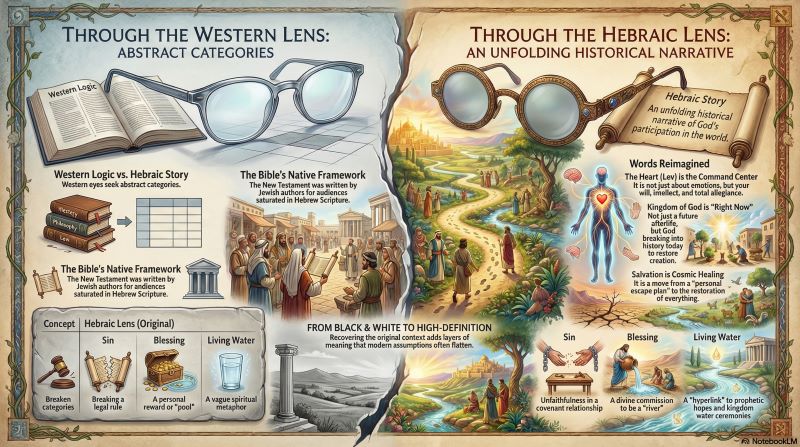
Richards and O’Brien identify three levels at which modern Western readers misread Scripture. The first is mores: the social conventions and moral assumptions we carry without examining them, things like attitudes toward honour and shame, community and individualism, wealth and status, that go without being said in our culture but would have been completely foreign to the biblical world. The second is ethnicity: the fact that the ancient world was ethnically complex and that much of the drama in the text turns on ethnic tensions and identities we simply don’t see because we don’t know to look for them. The third is language and this is where their argument cuts deepest.
Language, they argue, is never just words. It is culture made visible. The vocabulary a culture develops reflects what that culture considers important, what it has concepts for, what it takes for granted. The ancient Hebrews had a single word ‘chesed‘, for a kind of covenant loyalty that is simultaneously tender, faithful, active, and relentless. English has no equivalent. We circle around it with phrases like “lovingkindness” or “steadfast love,” but we never quite land. That isn’t a translation inconvenience. It’s a signal that the conceptual world behind the word is one we haven’t fully entered.
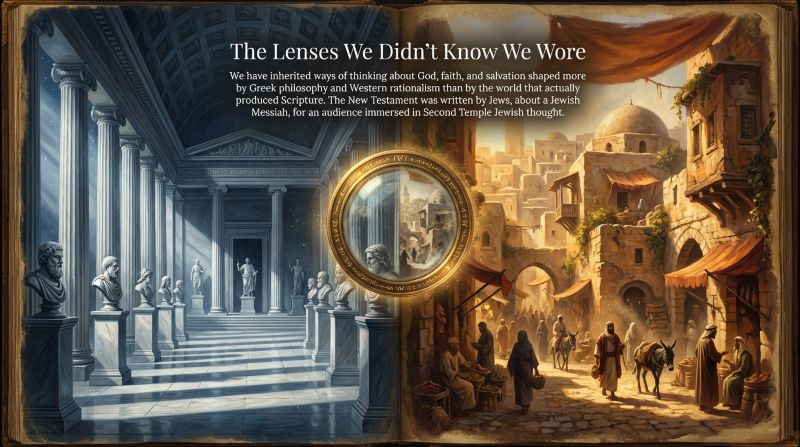
And that is precisely the problem Project Gerar exists to address. Because for those of us shaped by the Western Christian tradition, there is a specific and profound version of this linguistic gap. The lenses we read through weren’t forged and polished in Jerusalem. They were fashioned in Athens, in Rome, in Geneva, in the lecture halls of Western universities. Over centuries, a Hebrew conceptual framework was gradually displaced by Greek philosophical categories, and that displacement became so embedded in our translations, our theology, and our instincts as readers that we stopped noticing it was there.
The New Testament wasn’t written by Western theologians. It was written by Jews, primarily about a Jewish Messiah, for audiences who were either Jewish themselves or deeply connected to the Hebrew Scriptures and Second Temple Jewish thought. When we forget that, we end up flattening passages that were originally multi-layered, imposing later theological debates onto ancient conversations, and missing references that would have been completely obvious to the original readers.
Recovering a Hebraic lens isn’t about adding some “Jewish flavour” to our faith or getting interested in Hebrew words as a novelty. It’s about returning to the native framework of Scripture itself; the conceptual world the biblical authors actually inhabited. It’s the difference between reading the text and actually understanding what the authors intended to communicate. To put it bluntly, we need to relearn how to read the Bible.
The ancient Israelites viewed the world holistically. They didn’t think in terms of abstract philosophical categories or systematic theology in the way we do. For them, God wasn’t a concept to be analysed but a Person who acts in history, who speaks through His prophets, who makes covenants with real people in real time. Theology wasn’t something you studied in a classroom separate from life. It was the lived interpretation of Israel’s story, worked out in community, in the rhythm of Sabbaths and feasts, in the constant wrestling with what it means to be faithful to the covenant.
Consider something as simple as the word “heart.” When Jesus says, “Love the Lord your God with all your heart,” most Western Christians hear that as primarily about emotion and feeling. We think of the heart as the seat of our affections. But in Hebrew thought, the lev; the heart, is primarily your will, your decision-making center, the part of you that chooses loyalty or disloyalty. It’s where you make the fundamental choice about who you will serve.
That’s not just a semantic difference. It changes how we read Jesus’ teaching entirely. He’s not asking for warm feelings. He’s asking for a fundamental reorientation of your loyalties, your choices, your entire direction in life.

One of the most beautiful aspects of reading with a Hebraic lens is discovering that Scripture is designed as a tapestry. Every phrase echoes earlier passages. Every parable reflects known stories. Every argument sits inside a larger narrative that stretches from Genesis to Revelation. The biblical authors assumed their readers would catch these connections, and when we miss them, we miss much of the richness they intended.
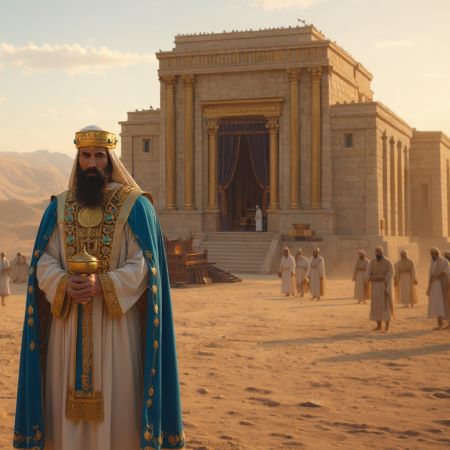
Take Jesus’ words in John 7 about “living water.” For most modern readers, that sounds like a nice spiritual metaphor, vaguely comforting but not particularly specific. But a first-century Jew hearing those words would immediately think of Isaiah 12:3, “With joy you will draw water from the wells of salvation.” They’d remember Ezekiel 47, where the prophet sees a river flowing from the Temple, bringing life wherever it goes. And if they were present at the Feast of Sukkot when Jesus said this, they’d be watching the water-drawing ceremony happening around them, a climactic moment when the priests would declare their hope for the coming kingdom.
Jesus wasn’t speaking in vague abstractions. He was inserting Himself directly into Israel’s prophetic expectations in real time, making an extraordinary claim about who He was and what He was bringing. When we miss that context, we lose the power of the moment entirely.
Sometimes the difference isn’t just about depth but about the basic meaning of what’s being said. When Jesus announced that “the kingdom of God is at hand,” most modern Christians hear that as “Heaven is coming soon.” It sounds like an announcement about the afterlife.
But to ancient Jews, the kingdom of God wasn’t about escaping earth for heaven. It meant God was acting decisively in history right now. It meant Israel’s long exile was finally ending. It meant the promises made to Abraham were being fulfilled. It meant the nations would witness Yahweh’s reign breaking into the world. When Jesus said those words, He was making a claim that was simultaneously political, prophetic, and messianic. It was explosive in a way we can barely grasp if we only hear it as “you’re going to heaven when you die.“
The Way Forward
What does this mean for us?
Learning how to read the Bible from a more Hebraic lens isn’t about looking backward for the sake of it or trying to recreate a first-century Jewish lifestyle or culture. It’s about reading Scripture on its own terms, honouring the specific context and cultural logic in which it was given. It’s about taking seriously that the Bible is a record of God speaking to specific people in specific times and places, and that understanding it from that perspective helps us to hear what they understood and what He was actually saying.
The Bible was not written from our worldview, our cultural framework, or our modern biases. To understand it rightly, we must do the humble, and often diligent work of entering the world that produced it. We must learn to think as ancient Israelites thought, to hear the echoes they would have heard, and to see the connections that they would have naturally seen.
This isn’t a complete solution to everything Richards and O’Brien identify; the cultural assumptions we carry as modern Western readers run deep, and that work of self-examination is ongoing. But recovering the Hebraic framework is perhaps the most foundational step, because it addresses the specific conceptual displacement that has most profoundly shaped how Western Christianity reads and understands Scripture.
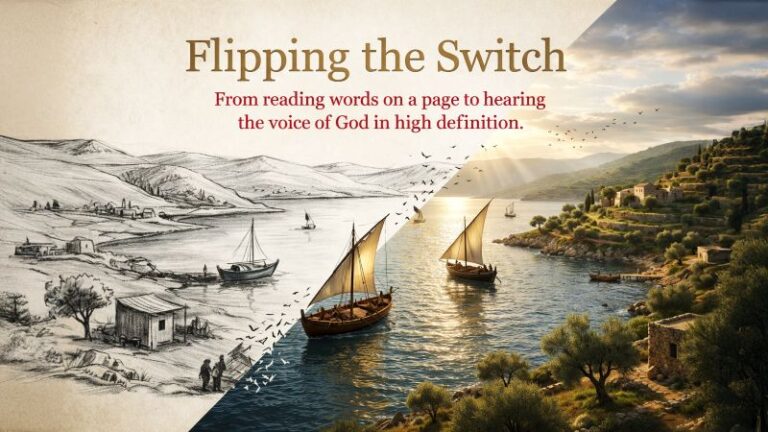
This isn’t simply a scholarly preference for those who like ancient languages and history. It’s the difference between reading words on a page and hearing the voice of God through them.
The good news is that this journey of recovery is endlessly rewarding. Every time you start to read Scripture through a more Hebraic lens, passages you’ve read a hundred times suddenly come alive with new meaning. You see connections you never saw before. You hear depths you never knew were there. You discover that the Bible is far richer, far more unified, and far more relevant than you ever imagined.
That’s what we’re here to explore together. Not to replace your faith with something foreign, but to help you discover the original native soil from which your faith grew. To make the transition from reading Scripture through borrowed lenses, to seeing it through the eyes of those who first heard these words and those who originally penned them, as life-changing, world-shaking truth.
Welcome to the journey.