Prince of Peace & Warrior King

Prince of Peace & Warrior King

Prince of Peace & Warrior King

Prince of Peace & Warrior King

Shalom: A Covenant of Wholeness

‘Consider this troubling paradox’.

We call Jesus the “Prince of Peace,” especially at Christmas. We picture Him as the gentle baby in the manger, meek and lowly, the embodiment of tranquillity and non-violence. The angels announced His birth with the declaration, “Glory to God in the highest, on earth peace, good will towards men” (Luke 2:14).

But the Book of Revelation presents us with a radically different image; a Warrior-King returning to make war, leading the armies of heaven on a white horse, His robe dipped in blood. John writes: “I saw the heaven opened, and behold, a white horse, and he who sat on it is called Faithful and True. In righteousness he judges and makes war” (Revelation 19:11).

How do we reconcile these two images? Is one of them wrong? Should we favour the gentle Jesus of the Gospels over the warrior of Revelation, or accept that God is somehow inconsistent, loving in one moment, violent in the next?

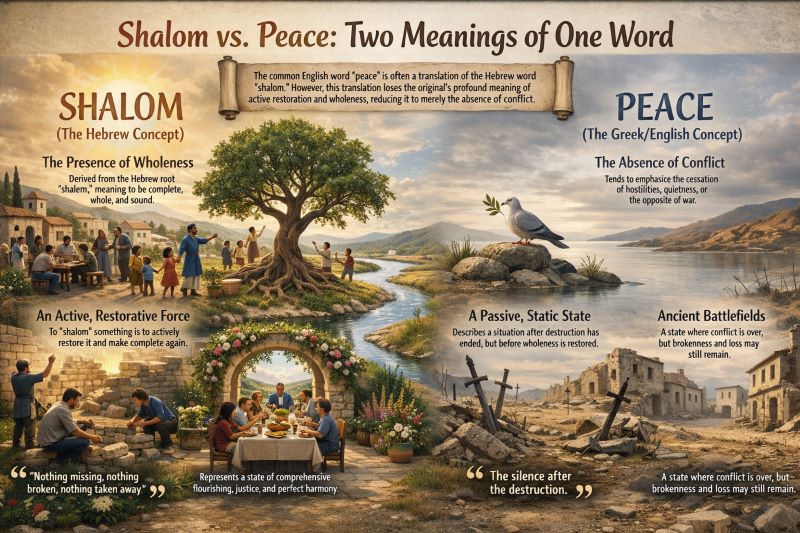
The answer isn’t about choosing between these images. It’s about understanding what the Hebrew word for peace; שָׁלוֹם (shalom), actually means. Our English word “peace” has led us badly astray, narrowing a rich, comprehensive biblical concept into something far too small. We’ve reduced peace to mean merely the absence of conflict, the opposite of war, a state of calm and quietness.

But that’s not shalom. That’s not even close!

The Window of Saint-Denis

Chartres, France, 1194.

The Cathedral of Notre-Dame de Chartres possessed what many considered the finest stained glass window in all of Christendom. Master Guillaume de Sens had spent seven years creating it, 847 individual pieces of coloured glass displaying the majesty of Christ. When the morning sun struck the rose window, the entire cathedral blazed with light. Pilgrims travelled from across Europe to see it and they wept when the light poured through.
This was shalom.
Completeness. Wholeness. Everything as it should be.
On the night of September 17th, 1194, fire consumed the cathedral’s wooden roof. In the chaos, looters broke in. They smashed treasure chests, tore down tapestries…and they hurled stones at the rose window. Seven years of work was destroyed in moments. Glass shattered across the stone floor. Some pieces scattered into darkness, lost forever. Others lay in fragments, their edges jagged and sharp. By the morning, the fire was out. The stone walls had survived. Many townsfolk gathered, exhausted and grateful that the worst was over. Some were heard saying, “Thank God the violence has ended. Now we have peace, once more.” But the Bishop stood before the shattered window; gaping holes where there should have been glory, empty sky where there should have been the face of Christ. “This is not peace,” he said quietly. “This is simply silence after the destruction.” He sent word across France. Six weeks later, master glazier Pierre de Montfort arrived from Rouen. He was seventy-three, with gnarled hands and failing eyes, but there was no finer craftsman in the land. Pierre did not pray for a miracle. He got to work, searching the cathedral floor on his hands and knees, collecting every fragment he could find. Then he began the painstaking restoration; examining each piece, cleaning away soot, cutting new glass where originals were lost, grinding down edges for a perfect fit. Months became a year. A year became two. Then, in the spring of 1196, word came that the looters had been spotted nearby, moving from town to town. The Bishop called the council: “Pierre cannot complete his work if this wanton destruction continues. We cannot complete the work while this vandalism goes unchecked.” So, they posted guards. They reinforced the doors. And Pierre continued his work. On Easter morning, 1197, the rose window caught the dawn light once more. Not every piece was original, but the image was complete. Christ in glory, radiant and whole…and the pilgrims wept again. This, too, was shalom. Not the passive absence of conflict, but the active work of restoration. Making whole what was broken. Returning beauty to its intended glory. And the guards remained at their posts. True peace; true shalom, requires both the restoration of what was broken and the confrontation of what seeks to break it again.

The Hebrew Word: Shalom

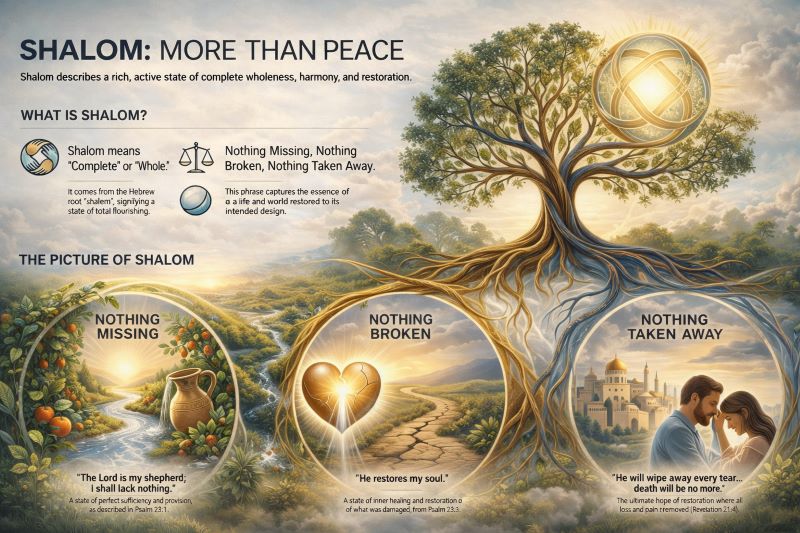
The Hebrew word שָׁלוֹם (shalom) comes from the root שָׁלֵם (shalem), which means to be complete, whole, sound. At its most basic level, shalom describes something in a state of completeness; nothing missing, nothing broken, everything functioning as it should.

Gideon - Yahweh Shalom

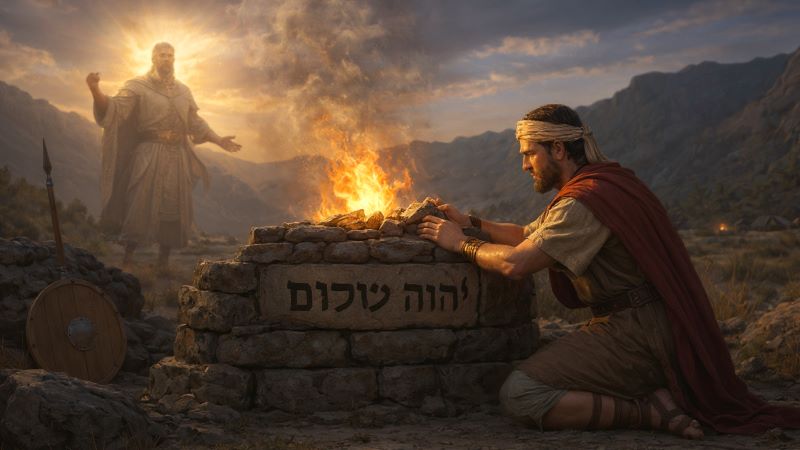
We see this active, comprehensive meaning of shalom in an unexpected place: a terrified farmer cowering in a winepress, hiding from raiders, convinced his nation is under God’s judgment. When the angel of the LORD appears to Gideon in Judges 6, the young man is certain he’s about to die. “I have seen the angel of the LORD face to face!” he cries in terror (Judges 6:22). But the LORD’s response is reassuring: “Shalom to you. Do not fear; you shall not die” (Judges 6:23). And Gideon builds an altar there, naming it Yahweh-Shalom, “Yahweh is Peace.”

Here’s what makes this passage remarkable, when seen through our Western Greek lens: Gideon isn’t receiving peace as an alternative to conflict. He’s receiving it as the foundation for entering conflict. In the very same encounter, God commissions him as a warrior to deliver Israel from Midian’s oppression. Israel’s circumstances haven’t changed, they’re still hiding in caves, still being raided, still living in fear and brokenness. The shalom God gives Gideon isn’t the absence of trouble; it’s the presence of God Himself in the midst of the calling to restore what’s broken. The peace comes first. The warfare follows. Because true shalom; comprehensive wholeness and right relationship with God, is what enables the warrior to do the work of restoration. Gideon doesn’t fight instead of having peace; he fights from the peace God has given him, bringing God’s declared word of restoration into reality.

When we look at the ancient Paleo-Hebrew pictographs that form this word, we see something very interesting. The letters suggest: teeth (destruction), a shepherd’s staff (guidance or control), and water (chaos or might). Read together, they paint a picture of bringing order and wholeness through guidance and control over chaos and destruction. Shalom isn’t achieved through passive avoidance; it’s accomplished through active restoration.

Remarkably, shalom functions not just as a noun but as a verb. To “shalom” something literally means to make it complete, to restore it. When Solomon completes the temple that David left unfinished, he brings shalom to it; he makes it whole. When your animal accidentally damages your neighbour’s field, you shalom them by making complete restitution. You take what was damaged and restore it to wholeness.

This helps us understand biblical passages that might otherwise seem confusing. When David visits his brothers on the battlefield and asks about their shalom (1 Samuel 17:18), he’s not simply asking if they’re experiencing an absence of conflict. He’s enquiring about their comprehensive well-being, is everything right with them in all respects? When Job speaks of his tents being in shalom (Job 5:24), he means everything is accounted for, nothing is missing, all is complete.

The priestly blessing captures this beautifully: “The Lord bless you, and keep you. The Lord make his face to shine on you, and be gracious to you. The Lord lift up his face towards you, and give you peace” (Numbers 6:24-26). The shalom invoked here is the culmination of God’s blessing; comprehensive well-being that flows from being in right relationship with Him.
Nehemiah: Shalom in Action

Nehemiah Rebuilding Jerusalem

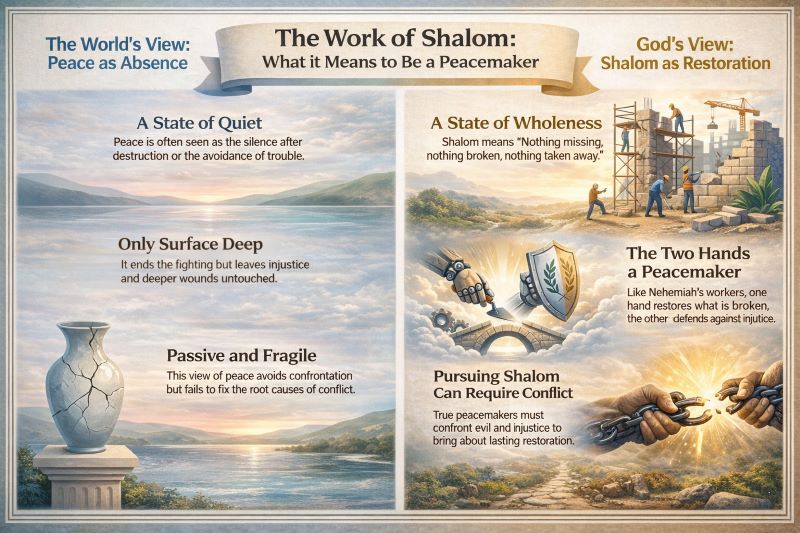
If we want to see what pursuing shalom actually looks like in practice, we need look no further than Nehemiah rebuilding Jerusalem’s walls.The city lay in ruins. The walls Jerusalem’s protection, its dignity, its very identity, had been broken down for decades. The gates had been burned. The people lived in “great trouble and disgrace” (Nehemiah 1:3). This wasn’t merely a building problem; it was a shalom problem. Jerusalem was incomplete, broken, vulnerable. The city could not fulfil its calling. The image was shattered.

When Nehemiah heard this report, he didn’t respond with contemplation or passive prayer alone. He wept, he mourned, he fasted, he prayed, but then he acted. He approached the king, secured resources, travelled to Jerusalem, and began the work of restoration. “Come, let’s build up the wall of Jerusalem, that we won’t be disgraced” (Nehemiah 2:17).

Notice what happens next. The moment Nehemiah begins rebuilding; the moment he starts pursuing shalom, opposition arises. Sanballat, Tobiah, and Geshem mock the work, then threaten it, then conspire to attack. The pursuit of wholeness provokes confrontation with those who profit from brokenness.

Nehemiah’s response is instructive. He doesn’t abandon the work. He doesn’t try to negotiate with the vandals. He doesn’t pretend that the absence of actual fighting means they have peace. Instead, he does both things simultaneously: he builds and he defends.

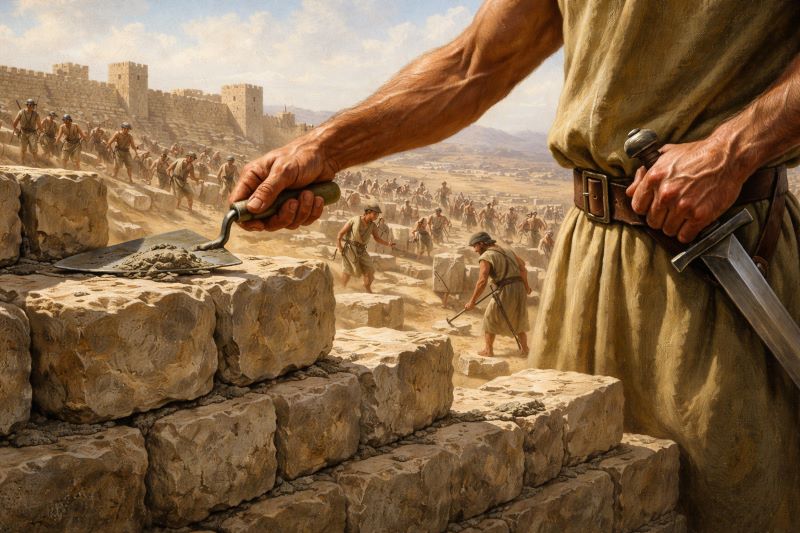
Those who built the wall, and those who bore burdens loaded themselves; everyone with one of his hands did the work, and with the other held his weapon. Amongst the builders, everyone wore his sword at his side, and so built” (Nehemiah 4:17-18).

This is the biblical picture of peacemaking. One hand builds. The other holds a sword. Not because Nehemiah is violent or aggressive, but because restoration cannot happen whilst destruction continues. The work of shalom requires both construction and confrontation, both restoration and resistance.

The enemies try everything, mockery, threats, conspiracy, deception, intimidation. But Nehemiah persists: “I am doing a great work, so that I can’t come down. Why should the work cease whilst I leave it and come down to you?” (Nehemiah 6:3). The restoration of shalom was too important to be distracted by those who wanted the city to remain broken.

And in the end? “So the wall was finished” (Nehemiah 6:15). Shalom was restored. Not through avoiding conflict, but through persisting in restoration despite conflict. Not through passive waiting, but through active rebuilding. Not by making peace with the vandals, but by completing the work they tried to prevent.

This is what it means to pursue shalom. This is what peacemakers do.

את

PROJECT GERAR

FIELD REPORTS

PG Logo

LIVING WORD


<b>Trust in Yehovah</b><br/>


The Hebrew word batach means “to cling to, to lean on completely.” Trusting God isn’t passive, it’s an active reliance, refusing to depend on your own limited understanding (binah – insight). He makes your path (orach) straight, guiding you with precision….<br/>


<b>Proverbs 3:5-6</b>

THE LIVING WORD

Support Us

Upholding the Word: your support helps us to continue this mission, sharing the wisdom of Torah and faith with those seeking truth.

Shalom Video

The Greek Narrowing: From Wholeness to Quietness

When the Hebrew Scriptures were translated into Greek in the Septuagint (LXX), the translators faced a significant challenge. How could they capture the rich, comprehensive meaning of shalom in Greek? The primary word they chose was εἰρήνη (eirēnē), which does mean “peace” or “harmony.”

But here’s the problem: eirēnē tended to emphasise the absence of conflict rather than the presence of wholeness. Greek thought often worked in negatives; peace as the opposite of war, rest as the opposite of labour. The concrete, active, restorative dimension of shalom began to fade.

By the time we reach English translations, this narrowing has become nearly complete. When we hear “peace,” we think of quietness, calm, the cessation of hostilities. We think of something passive, something static. A peaceful scene is one where nothing is happening, where everything is still and silent.

But shalom is never static. It’s dynamic, active, robust. It’s not the stillness after destruction—it’s the vigorous work of restoration. It’s not the silence of oppression; it’s the thriving of comprehensive flourishing.

This matters enormously when we read the New Testament. When Jesus says, “Peace I leave with you. My peace I give to you; not as the world gives, I give to you” (John 14:27), He’s not offering a feeling of inner calm. He’s offering shalom, the comprehensive wholeness that comes from being rightly related to God and to one another. The peace the world gives is thin, temporary, surface-level. The shalom Jesus offers addresses root causes, restores what’s broken, completes what’s lacking.

When Paul writes that Christ “made peace through the blood of his cross” (Colossians 1:20), he’s not saying Christ simply stopped a fight. He’s declaring that through the cross, God is reconciling all things to Himself, restoring comprehensive wholeness to all creation. The cross was the means by which broken relationships; between God and humanity, between people, and between humanity and the created order itself, was made whole again.

This is why Jesus guarantees His followers will have trouble in this world (John 16:33). The presence of conflict doesn’t mean the absence of shalom. His disciples can have shalom; wholeness, completeness, confident trust in God’s ultimate restoration, even whilst experiencing the struggle. Because shalom isn’t about our circumstances; it’s about God’s faithful work to make all things whole.

Nothing Missing, Nothing Broken, Nothing Taken Away

Shalom - More Than Peace

Perhaps the clearest way to express the full meaning of shalom is this phrase: nothing missing, nothing broken, nothing taken away.

Think of the stained glass window again. When it’s complete; when every piece is in place, when no fragment is missing, when no crack mars its surface, when no section has been stolen, that’s shalom. It’s the state God intended from the beginning, the flourishing He designed into creation.

The Psalmist captures this: “The Lord is my shepherd; I shall lack nothing” (Psalm 23:1). Nothing missing. “He restores my soul” (Psalm 23:3). What was broken is made whole. “Goodness and loving kindness shall follow me all the days of my life” (Psalm 23:6). Nothing taken away, God’s favour pursues us, sustains us, keeps us.

Or consider the vision in Revelation 21: “He will wipe away every tear from their eyes. Death will be no more; neither will there be mourning, nor crying, nor pain any more. The first things have passed away” (Revelation 21:4). This is ultimate shalom; everything that mars human flourishing removed, everything that was lacking restored and everything that was broken made whole.

But here’s the crucial point: we live between the “already” and the “not yet.” Christ has secured shalom through His death and resurrection. The decisive victory is won. The new creation has begun. But the fullness of shalom still awaits. We live in the restoration period, like Nehemiah’s workers, building the walls whilst the rubble still surrounds us, holding our tools in one hand and our defence in the other.

This is why shalom-making is such hard work. We’re not simply waiting for God to zap everything so it’s all fixed. We’re participating in His restoration project. We’re searching for the scattered pieces. We’re fitting them back together. We’re defending the work against those who would vandalise it again. And we’re trusting that the Master Craftsman will complete what He started.
Why the Prince of Peace Must Be a Warrior

Now we can return to our original question: How can the Prince of Peace return as a warrior?

The answer is that He must. Because true, lasting shalom cannot coexist with the forces that actively destroy it. You cannot restore the window whilst vandals keep smashing it. You cannot heal the body whilst the disease continues to spread. You cannot make peace whilst evil wages war against everything good.

When Revelation 19 shows us Christ returning as a warrior, it’s not contradicting His mission as Prince of Peace, it’s completing it. The cross was the decisive battle where Christ absorbed the violence of sin and death into Himself and rose victorious. His return is the enforcement of that victory, the final removal of everything that vandalises shalom.

Consider what happens after the warfare of Revelation 19. Chapter 21 shows us the New Jerusalem, where “God’s dwelling is with people, and he will dwell with them, and they will be his people, and God himself will be with them as their God” (Revelation 21:3). Complete shalom. Comprehensive wholeness. Nothing missing, nothing broken, nothing taken away. The image fully restored.

The warfare serves the peace. The confrontation enables the restoration. The judgment removes the vandals so the Master’s work can be completed without further interference.

This is why Isaiah could prophesy about the coming Messiah: “For to us a child is born. To us a son is given; and the government will be on his shoulders. His name will be called Wonderful, Counselor, Mighty God, Everlasting Father, Prince of Peace. Of the increase of his government and of peace there shall be no end” (Isaiah 9:6-7).

The titles aren’t contradictory. He’s the Mighty God precisely because He’s the Prince of Peace. His peace; His shalom, is powerful, active, uncompromising with evil. It’s not the fragile peace of negotiated truces. It’s the robust wholeness that comes when everything opposed to God’s good creation is finally defeated.

Living as Shalom-Makers

The Work of Shalom

So what does this mean for us, caught between the already and the not yet, living in the time of restoration?First, it means we recognise that peacemaking is active, not passive. Jesus calls peacemakers blessed (Matthew 5:9) not because they avoid conflict, but because they pursue restoration. Like Nehemiah, we build with one hand and hold our weapon with the other. We work for healing in relationships, justice in communities, wholeness in systems, and we resist the forces that seek to keep things broken.

Second, it means we understand that pursuing shalom will often bring us into conflict.
When we stand against injustice, when we challenge systems that exploit the vulnerable, when we insist that broken relationships must be restored rather than simply papered over, we’ll face opposition. That’s not a sign we’re doing it wrong. It’s a sign we’re doing it right. Nehemiah faced mockery and threats precisely because he was rebuilding what others wanted to keep in ruins.

Third, it means we trust that God is the ultimate restorer of shalom. We’re not ultimately responsible for completing the work, Christ is. Our calling is faithfulness, not success. We build. We defend. We persist. And we trust that the Master Glazier will complete His window, that the Prince of Peace will finish what He started.

Paul puts it beautifully: “If it is possible, as much as it is up to you, be at peace with all men” (Romans 12:18). We pursue shalom “as much as it is up to us,” recognising that sometimes, despite our best efforts, conflicts will remain. But our calling stands: work for restoration, resist destruction, trust God’s ultimate victory.

And we remember that we’ve been given the ministry of reconciliation (2 Corinthians 5:18-20). We’re ambassadors of the Prince of Peace, announcing that through Christ, shalom is possible, that broken relationships can be healed, that what was shattered can be restored, and that comprehensive wholeness is God’s design and His ultimate promise.


Conclusion: When You Change the Meaning, You Lose the Message

When we reduce shalom to merely “the absence of conflict,” we lose the transformative power of what God promises and what Christ accomplished. We end up with a thin, anaemic peace that asks nothing of us except that we avoid rocking the boat. We tolerate injustice because confronting it would disturb the calm. We leave wounds unhealed because addressing them might create tension. We settle for silence when we should pursue restoration.

But when we recover the true biblical meaning; when we understand that shalom means comprehensive wholeness, active restoration, nothing missing, nothing broken, nothing taken away, everything changes.

We see that the Prince of Peace and the Warrior-King are not two different Saviours but one Lord on a single mission: to restore all things, to make creation whole again, to defeat everything that vandalises God’s good world.

We understand why pursuing peace so often requires entering into conflict, not because we love fighting, but because we love wholeness more.

We grasp that ‘peacemaking’ is not a passive calling but an active one, requiring both the builder’s trowel and the defender’s sword, both the restorer’s patience and the protector’s courage.

The stained glass window awaits its final restoration. The Master Glazier is at work. Some pieces have already been fitted into place. Others are still being searched for, cleaned, prepared. The image is beginning to emerge again, though the work is far from complete.

And one day; on the day when the Prince of Peace returns as the Warrior-King, when every vandal has been stopped, when every opposing force has been defeated, the final piece will be placed. The light will stream through unhindered. The image will be complete in all its glory. And we will see what we were always meant to see: comprehensive shalom and perfect wholeness.

This is the peace that passes understanding. This is the shalom for which we were made.

Shalom.

Leave a Reply

Your email address will not be published. Required fields are marked *

More Articles Like This

Project Gerar

We believe much of the Hebraic roots and Jewish context that shaped the early Christian faith has been buried under layers of tradition and misinterpretation. We explore the original meaning of Biblical Hebrew words, study Torah as God’s instruction (not law), understand how Sabbath, biblical feasts (moedim), and covenant formed first-century believers. Seeking to remove centuries of accumulation to learn to walk ‘the way’ of the first disciples; following Yeshua (Jesus) the Messiah, empowered by the Spirit.

We’re not adding Jewish flavour to Christianity. This is a work of restoration; a return to the ancient paths. The water is still flowing.

Let’s dig together to uncover those wells.

Stay Connected

Sign up to receive teachings, updates, and resources by email. You can unsubscribe at any time using the link in our emails. By submitting this form, you acknowledge our Privacy Policy.
Your information is securely stored and processed through our email service provider (Mailchimp).
We never sell or share your personal data.

© 2026 Project Gerar. All Rights Reserved

Contact Form

Please complete the form below to contact us or email: contact@projectgerar.com

By submitting this form, you acknowledge our Privacy Policy.