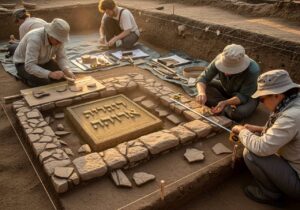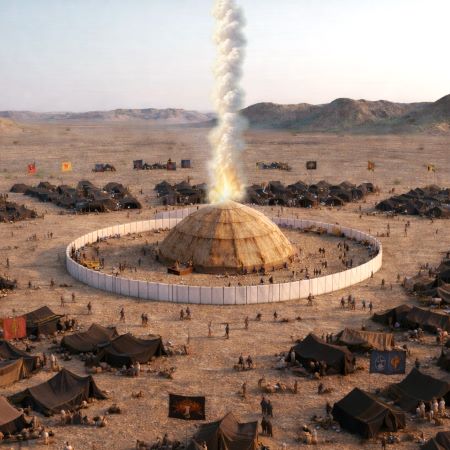
High Priest and Temple

Set Apart or Sacred?

Set Apart or Sacred?

Set Apart or Sacred?

Set Apart or Sacred?

Recovering Hebrew Holiness

The Problem We’ve Inherited

When you hear the word ‘holy’, what’s the first thing that comes to mind?
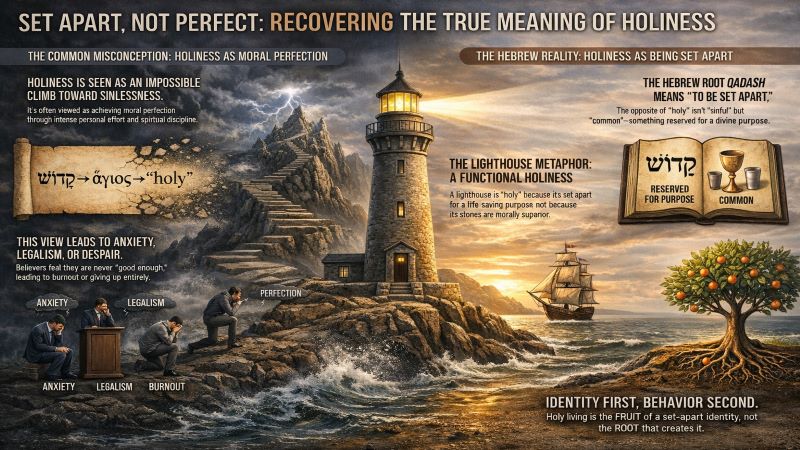
For most of us, it conjures up images of moral perfection, of spiritual discipline, of personal piety; the idea of being good enough, sinless enough, spiritual enough. We speak of holiness as if it’s a moral mountain that we have to climb through sheer effort and determination. And when we inevitably fall short, as all of us do, we feel the weight of that failure pressing down on us.

But what if this entire framework is missing the point?

When God declares to Israel, “You shall be holy, for I the Lord your God am holy” (Leviticus 19:2), He isn’t primarily issuing a call to moral perfection. He’s announcing something far more profound, an identity, a purpose, a calling that transforms everything about how we understand ourselves and our relationship with Him.

The difficulty is that our English word ‘holy’ has picked up centuries of Greek philosophical baggage along the way, and that baggage quietly obscures what the Hebrew term qadosh was actually communicating. We’ve turned holiness into an abstract moral quality, when it was always meant to be something far more tangible; a matter of purpose, of presence, and of belonging.

Let me illustrate this with a story.

The Keepers of St. Anthony's Light

Picture the scene. It’s Cornwall, England, in 1871. For thirty years, the merchants of Penzance had watched ships founder on the Black Rocks. The jagged reef lurked just beneath the surface at high tide, invisible in fog or darkness, waiting. Sixteen vessels had been lost there. Seventy-three souls claimed by the sea.

The Board of Trade finally authorised construction of a lighthouse in the spring of 1871. Local stonemasons cut granite from the cliffs. Engineers surveyed the highest promontory overlooking the reef. Through summer and autumn, the tower rose; forty feet of dressed stone, crowned with an iron gallery and lamp room.

By December, it stood complete. Just a building. Stone and iron and glass, no different from a dozen other structures along that coast.

On the morning of December 18th, 1871, two men stood at the base of that tower as officials from Trinity House gathered for the dedication. Thomas Wren, forty-six, a former fisherman who knew those waters better than his own face. And young Samuel Hodge, nineteen, who’d buried his father and two brothers in the churchyard after they’d drowned on the Black Rocks five years earlier.

The Deputy Master read the commission: “Henceforth this station shall be known as St. Anthony’s Light, dedicated to the preservation of life at sea.” He turned to Wren and Hodge. “You are charged with the keeping of this light. In storm and calm, in sickness and health, the light must not fail. Upon your faithfulness, lives depend.”

They affixed the brass plate to the tower’s entrance. They handed Wren and Hodge the great iron key. And in that moment, everything changed.

The building was no longer simply stone and glass. It was set apart for a singular purpose. The door that had stood open now bore a lock; this was not a place for casual visitors or Sunday picnics. Every item carried up those spiral stairs; oil, wicks, cleaning cloths, the leather-bound log, existed for one reason only.

And Wren and Hodge? Their lives were no longer their own. When the January gales came shrieking in from the Atlantic, they could not abandon their post, could not seek shelter in the village below. When Wren’s wife fell ill that winter, he could not leave; not until his relief arrived. When Hodge’s hands cracked and bled from the cold, from the endless polishing of the great Fresnel lens, he did not stop. Their behaviour wasn’t arbitrary. It flowed from the identity of the place they inhabited, from the charge they had accepted.

Saint Anthony's Light

On the night of February 3rd, 1872, a winter storm struck. Winds tore at the tower. Rain lashed the glass. Through the darkness, Wren and Hodge watched a schooner fighting the tempest, driven steadily toward the Black Rocks.

The ship’s captain saw the light. He saw it pierce the darkness, marking the reef, showing him where death waited. He hauled the wheel hard to starboard. The schooner’s timbers groaned. She came about, missing the rocks by twenty yards.

At dawn, when the storm broke, the schooner limped into Penzance harbour, all her crew accounted for.

They didn’t say, “We saw a building with a lamp.”

They said, “St. Anthony’s Light saved us.”

The lighthouse’s very existence as a lighthouse; its set-apartness, its dedication to a singular, sacred purpose, had made it capable of saving lives.

This is the meaning behind the Hebrew word qadosh.

Not the moral perfection of the stones. Not the spiritual superiority of the keepers. But designation, commission, consecration to a single purpose. The lighthouse shows us what qadosh looks like in practice something withdrawn from common use, designated for a singular purpose, and functioning exactly as commissioned. And the keepers embodied the same pattern, their lives reoriented around a charge they had accepted.
The Hebrew Word: Qadosh

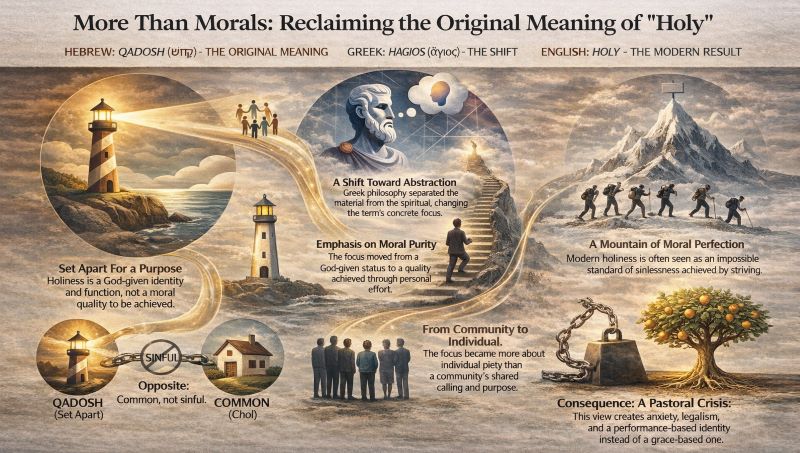
The Hebrew root qadosh (קָדוֹשׁ) fundamentally means to be set apart; to be distinct, consecrated, withdrawn from ordinary use. Now, that phrase ‘set apart’ can easily make us think of isolation, of something being removed from the world entirely. But that’s not what qadosh is describing at all. The separation is always purposeful. Something isn’t being pushed away from life, it’s being withdrawn from ordinary use so that it can be dedicated to God’s use and purpose. Set apart from the common, for the holy.

But here’s the crucial thing to understand: qadosh isn’t primarily about moral quality. A clay pot can be qadosh. The Sabbath is qadosh. The temple utensils are qadosh. These things aren’t morally pure or spiritually superior, they’re simply set apart for God’s purposes. They belong to Him. They’re designated for specific functions in His service.

The opposite of qadosh isn’t ‘sinful’ or ‘unclean’, it’s chol, meaning ‘common’ or ‘ordinary’. Something that is chol isn’t evil; it simply belongs to everyday, mundane use. But when God claims something as qadosh, He withdraws it from common use and designates it for Himself. But ‘set apart’ alone doesn’t capture the full picture. Scripture consistently shows that when God makes something holy, three distinct movements are consistently present throughout the text.

The first is badal (בָּדַל) – separation and distinction. The word means to divide, to distinguish, to set apart. This is the moment something is withdrawn from common use and marked as belonging to God. But badal doesn’t describe isolation. It describes designation. The thing hasn’t been removed from the world; it’s been claimed for a purpose within it.

The second is malé (מָלֵא) – filling. Separation creates a vessel, but a vessel is not yet holy simply by being empty and set apart. The Tabernacle was constructed and consecrated; set apart, designated, but it only became the dwelling place of the Holy One when God’s glory came and filled it (Exodus 40:34). The priests were designated for sacred service, but they were filled with the Spirit for the task (Exodus 28:3). In Hebrew thought, holy space is always filled space. The act of separation makes room; the filling gives it its sacred character.

The third is avad (עָבַד) – service. This word means to work, to serve, to minister, and it is used interchangeably for labour and worship, because in the Hebrew mind there was no meaningful distinction between the two. The set-apart, filled vessel becomes fully qadosh when it is functioning according to its divine purpose. Without avad, the separation and the filling have no direction. The light must shine. The priest must minister. The covenant people must embody God’s character before the nations.

These three together; badal, malé, avad, constitute what qadosh actually means in its fullness. To call something holy is to say: it has been set apart, it has been filled for a purpose, and it is serving that purpose. Remove any one of the three and something essential is missing. A separated but unfilled vessel is an empty shell. A filled but purposeless vessel is mere containment. Separation and filling without service is potential that never becomes reality.

If we go back to St. Anthony’s Light for a moment, we will see how this works in practice. The building wasn’t set apart simply by being closed off and locked up. It needed to be separated from common use (badal); the keepers were appointed and equipped to inhabit it, Wren and Hodge were given the commission, the key, the oil and wicks, the leather-bound log (malé); and they served faithfully through the storms (avad). Separation alone would have left an empty, locked building on a cliff. Purpose without equipping would have produced good intentions but no light. It was all three together that made St. Anthony’s Light not just a building with a lamp but something genuinely set apart for a specific purpose.

The Greek Shift: From Concrete to Abstract

More Than Morals

The Hebrew concept of qadosh was concrete, relational, and vocational. But something shifted when the Hebrew Scriptures were translated into Greek, and that shift has had a profound effect on the way we think about holiness ever since.

The Greek word most commonly used to translate qadosh is hagios (ἅγιος), which does mean ‘holy,’ ‘sacred,’ or ‘set apart.’ So far, so good. The semantic overlap is real. But Greek philosophy had a very different way of thinking about such categories. Greek thought tended toward abstraction. It loved to separate concepts; body from soul, material from spiritual, physical from metaphysical. And increasingly, Greek-influenced Christianity began to think of holiness primarily in moral and spiritual terms, detached from the embodied, communal, covenant reality that the Hebrew Scriptures presented.

Where Hebrew emphasised belonging and purpose, Greek emphasis drifted toward moral purity. Where Hebrew saw holiness as a status granted by God’s claim, Greek thinking leaned toward holiness as a quality achieved through personal effort. Where Hebrew holiness was fundamentally about relationship with the Holy One, Greek categories made it increasingly individualistic and internal.

By the time we get to English, this drift has become nearly complete. When we hear ‘holy,’ we think ‘morally perfect’. We think ‘spiritual’ rather than ‘set apart for service’. We think ‘individual piety’ rather than “covenant community called to embody God’s ways.”

The question, then, is how we go about recovering the Hebrew understanding? And the answer is to return to Scripture itself and see how holiness actually functions, beginning with the holiness of God Himself, and further back still, with the very structure of creation.

The Pattern at the Beginning

If the threefold movement of badal, malé, and avad sounds like a priestly or Sinai-era concept, it’s worth going back to look again. Because the pattern isn’t confined to the Tabernacle or to the Mosaic covenant. It’s woven into the very fabric of creation itself, long before Israel ever existed, long before Sinai, long before the Tabernacle or the priesthood.

If we read Genesis 1 carefully, we find that the creation account unfolds in two distinct phases. In the first three days, God makes distinctions. Light is separated from darkness. The waters above are separated from the waters below. Dry land is distinguished from the sea. The Hebrew word used repeatedly is badal; God divides, distinguishes, orders. He’s creating structure from formlessness, drawing boundaries that give each realm its own identity and definition. Everything is being set apart from everything else.

But separated space is not yet complete. The second phase; days four through six, brings a different movement entirely: the separated realms are filled. The sky receives the sun, the moon, and the stars. The waters receive fish and sea creatures. The land receives animals, and finally humanity, with the explicit commission to fill the waters, to fill the earth. The Hebrew word is malé. What was ordered and structured is now inhabited, furnished, alive with its proper contents. And the mandate given to humanity to exercise dominion, to serve as God’s representatives in His creation, that is avad, the purposeful, worshipful engagement with the world that God has made.

At each stage God evaluates what has been made and calls it tov – good. This wasn’t about complimenting its beauty. It was a declaration of ‘functional alignment’. What has been made is doing what it was made to do, ordered rightly, filled appropriately and working just as it should.

And then comes the seventh day.

God doesn’t call the seventh day tov. He does something categorically different. He ceases from His work, He blesses the day, and He pronounces it qadosh – holy. Why? Not because the seventh day is morally superior to the others, but because by the seventh day, the whole creation is complete. The separation has been accomplished, the filling has been done, the function is fully aligned with His divine purpose. Everything is as God intended it to be.

The sanctification of the seventh day isn’t a late religious addition to the creation account. It’s the declaration that the whole process is complete. Qadosh arrives at the very moment when badal, malé, and avad are all fully present. It is the word that marks completion; when creation is entirely what it was supposed to be, set apart, filled, and functioning according to God’s purposes.

What this means is that holiness is woven into the structure of the universe from the very beginning. The priestly rituals of Israel didn’t create this pattern, they ritualised and embodied what was already true of creation itself.

God's Holiness: The Foundation

Before we can understand what it means for people or objects or times to be holy, we need to grasp what it means that God Himself is holy. And here we have to be careful not to import our moralistic categories back into the text.

When the Scriptures declare “Holy, holy, holy is the Lord of hosts” (Isaiah 6:3), it isn’t primarily making a statement about God’s moral perfection; though He is certainly that. It’s proclaiming His absolute uniqueness, His transcendent otherness, His incomparability. There is no other category that contains God. He is utterly distinct from everything that He has made.

This is why Hannah prays, “There is none holy like the Lord, for there is none besides you” (1 Samuel 2:2). God’s holiness is bound up with His oneness, with His singularity. He is not one god among many, not one being among others of a similar kind. He is wholly other, completely set apart in His very being.

When Moses encounters God at the burning bush and is commanded to remove his sandals because “the place on which you are standing is holy ground” (Exodus 3:5), the soil itself hasn’t changed its composition. It’s ordinary desert sand. But God’s presence has transformed its identity; it is now a place where the Holy One has chosen to manifest Himself, and it therefore demands a completely different kind of approach.

God’s holiness, then, is foundational. It isn’t derived from anything external, it simply is who He is. He is the source of all holiness, the reference point for all set-apartness. Nothing is holy except in relation to Him.

The Burning Coal: Isaiah's Encounter

Isaiah’s vision in the temple gives us one of Scripture’s most vivid and arresting pictures of what it actually looks and feels like to encounter the holiness of God. The prophet sees the Lord seated on His throne, the train of His robe filling the temple, and the seraphim crying out, “Holy, holy, holy is the Lord of hosts; the whole earth is full of his glory!” (Isaiah 6:3).Coal of holiness
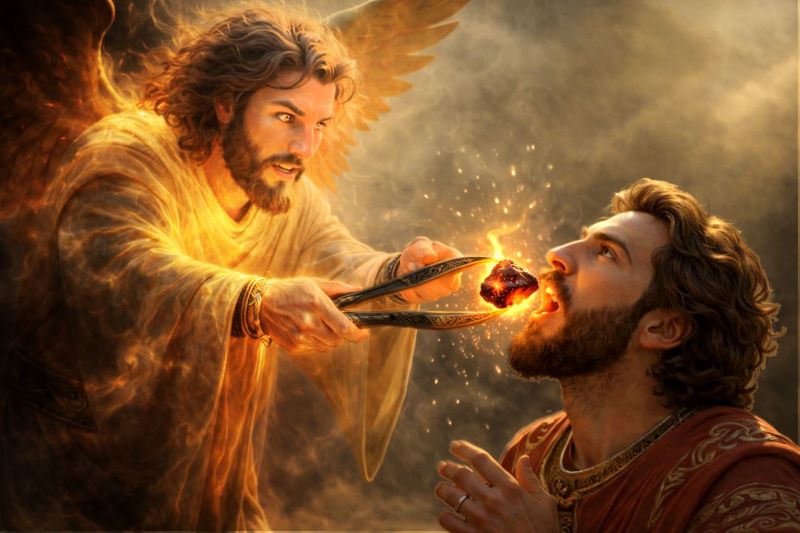
Notice the backdrop for the vision. The temple itself is filled with smoke. The whole earth is declared full of His glory. The holiness we encounter here is not a quality confined to some sacred inner chamber, it is expansive, overwhelming, pressing outward into every space, and Isaiah finds himself standing inside it with nowhere to go.

And Isaiah’s response is immediate and visceral: “Woe is me! For I am undone, because I am a man of unclean lips and I live among a people of unclean lips; for my eyes have seen the King, the Lord of hosts!” (Isaiah 6:5). Let’s take a moment to consider what Isaiah is saying here. In Hebrew thought, the lips are the outward expression of the heart; what comes out of the mouth reveals what lies within (Matthew 15:17-20). So, Isaiah is confessing that not only does he feel inadequate to address the people on God’s behalf but that he’s actually no better than anyone else. The encounter is forcing us to see the clear distinction that exists between qadosh and chol; the set apart and the ordinary. Isaiah doesn’t need to be told that he doesn’t belong there. He’s like a fish out of water.

But the vision doesn’t end there. One of the seraphim takes a burning coal from the altar and presses it to Isaiah’s lips. “Your iniquity is taken away, and your sin forgiven” (Isaiah 6:7). What is taking place here? Is the coal holy? Yes, most certainly. It’s taken from the brazen altar. From the very throne room of God. But this isn’t about the transfer of something sacred or mystical. Throughout the Hebrew scriptures, fire is presented as the great purifier. It burns away what is unclean. So, what happens to Isaiah is that his lips (and by implication, his heart) are cleansed from their impurity, setting him apart for God and separating him from the people.

And immediately following this, we see his commissioning: “Whom shall I send, and who will go for us?” Then Isaiah responds, from his newly given identity: “Here am I. Send me” (Isaiah 6:8). The service flows directly and necessarily from the separation and the filling that preceded it, and this is the crucial point. The purification was never an end in itself. It was always the necessary preparation for Isaiah to fully participate in God’s purposes.

One thing worth reiterating is that, although it is holy, the burning coal carries no moral quality by itself. It doesn’t choose to obey or strive to be set apart, and yet it is the instrument that God uses to achieve this purification. So, holiness is not moral perfection and neither is it something that accumulates through its contact with sacred objects or relics.

Similarly, Isaiah doesn’t try to climb towards or draw closer to God. We don’t witness his attempts to morally prepare himself or achieve readiness through his own efforts. He falls to his knees, and the seraph comes to him with the fiery coal. God selected Isaiah as the prophetic agent of His message and there in that place of brokenness and humility he experiences the cleansing, filling and commissioning for service. This is the direction in which holiness consistently flows in Scripture; not from human achievement upward, but from God’s initiative outward, to what He claims and designates for His purposes.


Strange Fire: When Common Meets Holy

Before we look at what happened with Nadab and Abihu, we need to be honest about how we naturally read this story. When we hear that “fire came out from the presence of the Lord and consumed them” (Leviticus 10:2), our instinct is almost always to assume that they did something morally wrong, that they broke the rules, and that God responded with harsh punishment.

That reaction is almost inevitable given the cultural framework we bring to the text. Western thinking operates on a guilt and innocence axis, where the fundamental question is always whether someone is guilty or innocent, whether a rule has been broken and whether punishment is therefore deserved. So, when we encounter divine judgment anywhere in the text, we automatically reach for a courtroom verdict.

And here’s the real test: When you hear something described as ‘unholy,’ what do you think? Be honest. Do you think ‘wicked,’ ‘evil,’ or ‘sinful.’
We’ve made ‘unholy’ the opposite of moral purity. And if that’s what unholy means, then naturally holy must mean morally pure, and Nadab and Abihu must have committed some moral offense deserving of severe judgment. But remember what we established earlier: the opposite of qadosh isn’t wicked, it’s chol. And that radically changes what actually happened here.

Nadab and Abihu “offered unauthorised fire before the Lord, contrary to his command” (Leviticus 10:1). The Hebrew word translated “unauthorised” is zar (זָר), which means foreign, strange, outside the boundary. What they brought was chol fire; common, ordinary fire from an everyday source, into the holy space where only the fire from the altar was authorised.

Was this about moral failure? Yes, in the sense that the sons of Aaron disobeyed a command, but there’s something much more going on here. The fire wasn’t evil fire or wicked fire. It was just regular fire, fire from the chol realm, perfectly fine for cooking or for warmth or for light, however, it wasn’t fire that had been set apart for ministry in God’s presence.

Moses’ words to Aaron reveal the actual issue: “By those who come near me I will be treated as holy” (Leviticus 10:3). The primary violation wasn’t breaking a rule, it was collapsing the distinction between qadosh and chol. They treated as common what God had designated as set apart. They decided that ordinary fire was good enough for sacred service. They treated the boundary as negotiable; the distinction as unimportant, the set-apartness as something they could determine for themselves.

Think of it this way. The text isn’t trying to tell us that God decided to punish Nadab and Abihu for breaking a command. The two sons walked headfirst into the inherent consequence of crossing a boundary that God Himself had established between the common and the holy. The consequence wasn’t imposed from the outside, it was built into the nature of the boundary itself. You don’t step off the curb into the path of a moving car and get punished. You simply encounter what was always going to happen.

And Aaron understood this. His response is striking: silence (Leviticus 10:3). He didn’t protest. There was no apparent display of grief or questioning of God’s justice. Just silence. Because Aaron he knew full well that the holiness of God isn’t safe to trivialise. Not because he believed God to be harsh or petty, but because reality itself is structured around the distinction between the Holy One and what He has made. When that boundary line is treated as negotiable, when chol is substituted for qadosh, when human authority presumes to override divine designation, the collision is catastrophic.

This isn’t about God being a stern judge demanding perfect rule-following. It’s about the inherent danger of confusing categories when one of those categories is the presence of the Holy One Himself.

את

PROJECT GERAR

FIELD REPORTS

PG Logo

LIVING WORD


<b>Trust in Yehovah</b><br/>


The Hebrew word batach means “to cling to, to lean on completely.” Trusting God isn’t passive, it’s an active reliance, refusing to depend on your own limited understanding (binah – insight). He makes your path (orach) straight, guiding you with precision….<br/>


<b>Proverbs 3:5-6</b>

THE LIVING WORD

Support Us

Upholding the Word: your support helps us to continue this mission, sharing the wisdom of Torah and faith with those seeking truth.

Qadosh Video Overlay

Functional Holiness: Being Set Apart

If God’s holiness is who He is in His very nature, then functional holiness is what happens when God claims something or someone for His purposes. And this is the emphasis that we most urgently need to recover.

When God tells Israel at Sinai, “You shall be to me a kingdom of priests and a holy nation” (Exodus 19:6), He isn’t saying, “Try really hard to be morally perfect.” He is declaring their identity and their purpose. Israel has been set apart from the nations (badal), filled with His presence and His Torah (malé), and commissioned to represent His character to the world (avad). The full movement of qadosh is present in a single sentence.

And notice the sequence: God doesn’t say, “If you become holy, then you’ll be my kingdom of priests.” He says, “You are a kingdom of priests and a holy nation.” The identity comes first. The calling precedes the behaviour. They are holy because God has claimed them, consecrated them, set them apart for His purposes.

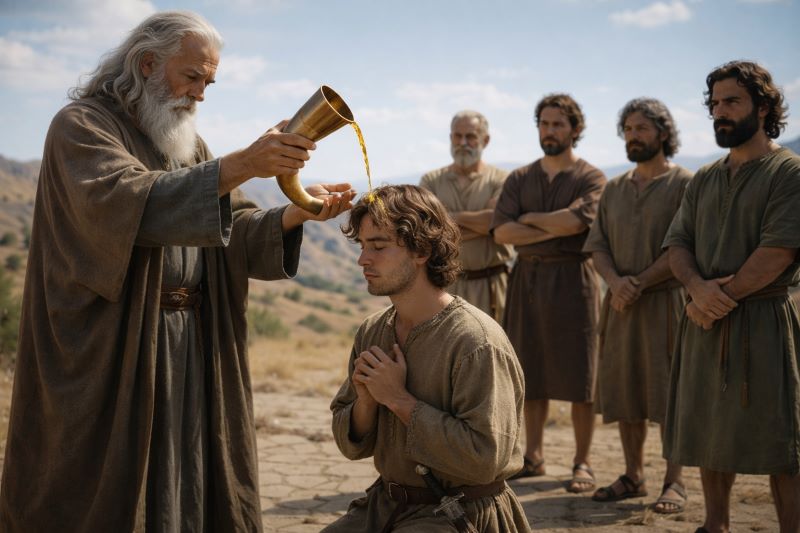
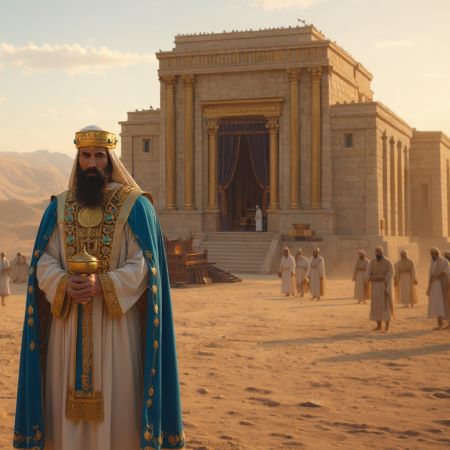
This is why priests are anointed before they perform any service. The anointing oil doesn’t make them morally superior to everyone else, it marks them as designated for their sacred duty. The high priest wears a plate on his forehead engraved with the words “Holy to the Lord” (Exodus 28:36), not because he has achieved some state of moral perfection, but because he has been appointed to stand in God’s presence on behalf of the people. His holiness is functional, vocational, purposeful.

The same principle applies to the objects of the Tabernacle. The furnishings aren’t holy because gold is spiritually superior to copper, they’re holy because they’ve been dedicated to God’s service. The Sabbath isn’t holy because Saturday has different properties to Thursday, it’s holy because God has set it apart as sacred time, a weekly reminder that all of time ultimately belongs to Him. In every case, the pattern is the same: separated, filled, serving.

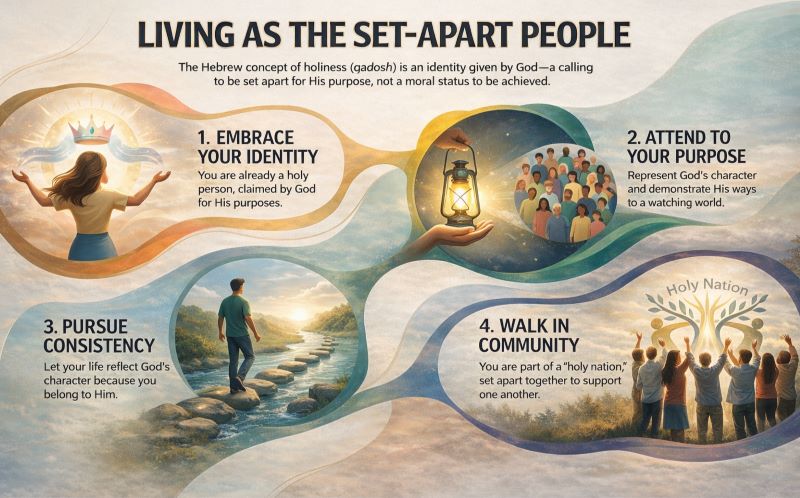
And what this understanding does is take holiness out of the realm of impossible idealism and place it squarely in the realm of identity and calling. You’re not holy because you’ve achieved some mystical state of sinlessness. You’re holy because God has claimed you and set you apart for His purposes.

Moral Holiness: The Fruit, Not the Root

Samuel Anoints David as King

Having said all of that, let’s be absolutely clear about something: God does care deeply about how His people live. The moral dimension of holiness is real and important, and we shouldn’t minimise it. But it is the fruit of holiness, not the root of it. It flows from our identity, it doesn’t create it.

Leviticus 19 provides us with a perfect example of how this works. Right after declaring “You shall be holy, for I the Lord your God am holy” (v.2), God doesn’t hand Israel a list of spiritual exercises designed to help them achieve holiness. Instead, He gives them detailed instructions about how holy people should live: don’t harvest the corners of your fields, pay your workers promptly, don’t put stumbling blocks before the blind, use honest weights and measures, love your neighbour as yourself.

These aren’t conditions for becoming holy. They are descriptions of how holy people; people who belong to the Holy One, are actually supposed to conduct themselves. And the sequence matters enormously. You’re not holy because you do these things. You do these things because you’re holy, because you’ve been set apart to reflect the character of the God who claimed you.

Think of it this way: the lighthouse keepers didn’t maintain the light in order to become lighthouse keepers. They maintained the light because they already were lighthouse keepers. Their identity shaped their behaviour. Their calling determined their conduct. If they had stopped maintaining the light, they wouldn’t have ceased to be keepers, they would simply have become unfaithful keepers, keepers who had abandoned their post. Their identity flowed from their commission, not the other way around.

Peter understands this perfectly when he writes to scattered believers: “But you are a chosen race, a royal priesthood, a holy nation, a people for God’s own possession, that you may proclaim the excellence of him who called you out of darkness into his marvellous light” (1 Peter 2:9). Notice the sequence: you are these things; chosen, royal, priestly, holy. That’s their identity.
Why? So that you may live accordingly, proclaiming God’s excellence. Their purpose flows from it.

When Jesus says, “Therefore you shall be perfect, just as your Father in heaven is perfect” (Matthew 5:48), He’s not introducing a new and impossible standard of sinless perfection. He’s echoing the Levitical call to holiness; be complete, whole, consistent with your Father’s character. Live as His image-bearers. Let your lives display His nature. Not in order to earn acceptance, but because you have already been accepted, claimed, set apart, and filled for exactly this purpose.
Holiness and Community

One of the most significant things we lose when holiness becomes a matter of individual moral performance is its communal dimension. In Hebrew thought, holiness is never purely about the individual. Israel is called to be a holy nation. The priesthood is a corporate body. Even individual holiness always exists within the context of the covenant community.

What this means is that your holiness and mine are interconnected. We aren’t isolated individuals each trying to achieve a personal state of spiritual superiority. We are members of a body, stones in a temple, branches in a vine, each set apart together for God’s purposes. Your faithfulness encourages mine. My failure affects you. We bear one another’s burdens, we confess our sins to one another, we build one another up in the calling we share.

The lighthouse, staying with that analogy for a moment, doesn’t fulfil its purpose in isolation either, it functions as part of a wider network of beacons that together make the coastline navigable for sailors. Each keeper’s faithfulness serves not just their own station but the entire maritime community that depends on those lights being kept.

This has real and important pastoral implications. When I’m struggling, when I’m failing to live consistently with who I am in God, I don’t need to pretend that everything is fine or to hide away in shame. I need the community that God has set apart alongside me, fellow keepers who can help me maintain the light when my own strength is failing. Wren and Hodge worked in pairs for a very good reason. The task was too demanding, and the stakes were too high, for anyone to carry alone. I need the body functioning as it was designed to, with each member contributing to the others.

The Pastoral Crisis and the Path Forward

Living As Set Apart People

The loss of this Hebrew understanding of holiness has created a genuine pastoral crisis in much of Western Christianity. When holiness becomes primarily about moral performance, several devastating consequences follow, and we can see all of them playing out in the church today.

The first is perpetual anxiety. When holiness becomes primarily about moral performance, believers end up measuring themselves against a standard that always seems just out of reach; never quite holy enough, never quite there and condemned by their own failings. The second, closely related, is that this pressure tends to produce one of two responses: a crushing legalism that doubles down harder on rules in an attempt to manufacture what only God can declare, or a despairing antinomianism that gives up entirely, concluding that holiness is simply impossible and therefore irrelevant. The third consequence is that we lose sight of our true vocation, ceasing to see ourselves as God’s commissioned people and coming instead to see ourselves as moral projects in permanent need of improvement. And the fourth is that we completely miss the point of the moral commands themselves. What were always God’s instructions for how His image-bearers flourish together become arbitrary hoops to jump through, disconnected from the wisdom that they were always meant to convey.

When we recover the Hebrew framework, all four of these shift. The anxiety lifts, not because the standard is lowered, but because our identity no longer depends on our performance. We are already set apart, already claimed (1 Peter 2:9), already holy people learning to live consistently with who we are. The legalism and the despair both dissolve because the question changes. Instead of asking “am I holy enough?” we begin to think differently about a shared identity as a set-apart people.

We are to represent His character to a watching world. To embody His ways in our communities. To demonstrate what human flourishing looks like under His rule. To play our part as the light in the darkness and the salt that preserves and flavours everything around it (Matthew 5:13-16). And God’s commands stop being arbitrary rules and start being what they always were: the wisdom of the Creator about how His people thrive in relationship with Him and one another.

The burning coal from the altar doesn’t try to become hot. It simply is hot, because of where it has been and what it has been near. That same truth applies to us. Because we belong to the Holy One, because we carry His name, because we are marked as His possession, our lives should reflect His character, not from fear of losing His favour, but from love for the One who claimed us.

And when we fail; and we will all fail, we don’t lose our identity. A lighthouse keeper who falls asleep on watch doesn’t cease to be a keeper. He’s simply an untrustworthy keeper who needs to wake up and return to his post. Our calling remains. God’s claim on us stands firm. We confess, we repent, we return to our purpose (1 John 1:9). The coal that falls from the altar can be placed back in the fire.

The shift isn’t from one theological system to another. It’s a change in the very soil of our identity. It moves us from the anxious, isolated striving of the individual; forever condemned by failure, to the grateful, corporate calling of a people. Our focus turns outward, from self-improvement to the divine mission.

But What About "Be Holy"?

The obvious and perhaps inevitable question is, if holiness is something that God declares over us; if it flows from His act of setting us apart and commissioning us, rather than through our own efforts of self-improvement, then how do we reconcile this with the command, “Be holy, for I the Lord your God am holy”? Doesn’t that sound suspiciously like the framework of moral achievement that we’ve been dismantling?

Once again, if we examine the original Hebrew, we find another example of something significant being lost in translation. First, let’s take a look at Leviticus 19:2 where the phrase is qedoshim tihyu (תִּהְי֑וּ קְדֹשִׁ֣ים). The verb tihyu comes from hayah; simply, ‘to be’, and in its Hebrew imperfect form it has a dual function, both as the declarative future, “You will be holy” and as the imperative “be holy”. These two are simultaneously held together in the single verbal form in the Hebrew. But as the text moved through the Greek Septuagint into Latin and then into English, translators were forced to choose one or the other and they chose the imperative. And with that necessary choice, the declarative was lost, and with it the whole framework quietly collapsed into the command we have today.

Now let us turn to the first occurrence of this phrase in Leviticus 11:44. Here, the Hebrew gives us two verbs, rather than one, spelling this whole sequence out more fully. The text reads; vehitqadishtem vihyitem qedoshim (וְהִתְקַדִּשְׁתֶּם֙ וִהְיִיתֶ֣ם קְדֹשִׁ֔ים) – “You shall make yourselves holy, and you shall be holy.” The first verb is in the reflexive (or Hitpael) form, which calls for an active, willing response. So in this context, it means to actively align yourself, to present yourself consistently with your set-apart (qadosh) identity. The second verb (again with hayah – to be), provides us with the resulting state; and you will be holy. The two stage process that we identified in Chapter 19 is spelt out for us in Chapter 11. First the call to live consistently with what they already are; this is responsive alignment. Secondly, the effect is that they manifest their holy status; it becomes their living reality.
In other words, “You shall actively make yourselves holy (through ongoing obedient choices), and as a result, you shall exist in a holy state (conforming to your true covenant identity)”.

This isn’t something foreign to the New Testament. Both Peter and Paul understood Leviticus in this way. In his first letter Peter quotes directly from this passage, stating; “but just as he who called you is holy, you yourselves also be holy in all of your behavior; because it is written,You shall be holy; for I am holy” (1 Peter 1:15-16). But this is written to people that, at the beginning of the letter, he had already described as; “the chosen ones… according to the foreknowledge of God the Father, in sanctification of the Spirit” (1 Peter1:2). From the outset, Peter declares that they have been made holy before he arrives at the imperative for them to ‘be holy’. And later, in the same letter, he returns to this status, declaring; “But you are a chosen race, a royal priesthood, a holy nation, a people for God’s own possession, that you may proclaim the excellence of him who called you out of darkness into his marvelous light:” (1 Peter 2:9). In a single letter Peter, expresses the sequence we previously discussed. You are a holy nation, royal priests, so live accordingly.

Paul also understood this perfectly, although he frames it in a slightly different way. To the believers in Colossae he opens chapter 3 by establishing their positional reality: “If then you were raised together with Christ”; by using the aorist indicative passive form of συνεγείρω (sunegeirō – raise up together) Paul is declaring the reality of something that happened to them in the past, they were raised. He goes on to affirm this; “For you died”, another declaration, although this time it is something they were actively involved with (aorist indicative active form of ἀποθνῄσκω – apothnēskō). And “your life is hidden with Christ in God”, this is a present state resulting from a completed past action (perfect indicative passive of κρύπτω – kryptō). And then, having established what is true for the Colossian believers he calls them to align their lives to this reality. He encourages them to put away “anger, wrath, malice, slander, and shameful speaking”. Why? Because “you have put off the old man with his doings, and have put on the new man” (Colossians 3:9-10).

In his letter to the Ephesians, this same pattern is made even more explicit. Paul take the first half of the letter to establish who they are; chosen, redeemed, sealed, made alive, seated with Christ in heavenly places. Three chapters of declared reality before a single ethical imperative arrives. Then comes the hinge of the whole letter: “I beg you to walk worthily of the calling with which you were called” (Ephesians 4:1). What is Paul saying here? You were called, ἐκλήθητε (eklēthēte – the aorist indicative passive of καλέω – kaleō – to call) by God at some time in the past. Therefore, walk appropriately – ἀξίως περιπατῆσαι (axiōs peripatēsai). Paul uses the aorist active infinitive to say, that they are to conduct their whole lives (walk) in a manner that is worthy of the calling they have received. God has called you and commissioned you, now live your lives as those people.

This isn’t a new pattern for us. We encountered it before in Genesis. When God looked at each stage of creation and declared it tov (good), He wasn’t just admiring the beauty of the scenery. It was a statement of ‘functional alignment’. Everything was doing what it was created to do; ordered rightly, filled appropriately and working exactly as He had intended. At the precise moment that alignment was complete, the seventh day, God declared it ‘qadosh’. That same call is now being declared over God’s people. ‘Be holy!’ ‘Live as the ‘qadosh’, the set-apart people that I have made you’. Actively participate in aligning your whole lives with the covenant identity that God has already declared over you.

Conclusion: When You Change the Meaning, You Lose the Message

The English word ‘holy’ has drifted so far from the Hebrew qadosh that it now often obscures rather than illuminates the biblical reality. We’ve turned a concrete, relational, vocational term into an abstract moral ideal. We’ve made holiness about what we achieve rather than what God declares over us. We’ve shifted the focus from a corporate calling to our individual performance.

But the Hebrew concept is clear. Holiness is what happens when something has been set apart from ordinary use to be dedicated for God’s use and purpose (badal), filled and equipped for that purpose (malé), and is actively serving in that purpose (avad). It isn’t a moral mountain to be climbed. It is a creational pattern, woven into the fabric of the universe before Sinai ever happened, before the Temple was built, before the priesthood was established; present in the very structure of a creation that God separated and filled and declared good, before ceasing from His work and pronouncing the seventh day holy as the seal and the completion of the whole.

When we recover this understanding, everything begins to shift. The crushing burden of impossible moral achievement starts to lift. The anxiety about whether we are good enough begins to dissolve. We find ourselves not as moral projects in need of constant improvement, but as commissioned servants; set-apart people, claimed by the Holy One, filled by His Spirit, and called to serve His purposes in the world.

The lighthouse doesn’t stand on its rocky promontory because it is morally superior to every other building along that coastline. It stands there because it has been claimed, equipped, and commissioned for a specific purpose. And when the storms rage and the darkness falls, that steady beam cuts through the chaos and offers hope and direction to all who can see it.

This is what God has made His people to be. Not perfect performers but set-apart witnesses. Not those who anxiously strive, but filled and faithful servants. Not isolated individuals each working out their private salvation, but a holy nation, claimed by the Holy One, filled with His presence, and called to be a light in the darkness.

Badal. Malé. Avad… Set apart. Filled. Serving.

This is who you are.

Leave a Reply

Your email address will not be published. Required fields are marked *

More Articles Like This

Project Gerar

We believe much of the Hebraic roots and Jewish context that shaped the early Christian faith has been buried under layers of tradition and misinterpretation. We explore the original meaning of Biblical Hebrew words, study Torah as God’s instruction (not law), understand how Sabbath, biblical feasts (moedim), and covenant formed first-century believers. Seeking to remove centuries of accumulation to learn to walk ‘the way’ of the first disciples; following Yeshua (Jesus) the Messiah, empowered by the Spirit.

This is not about adding Jewish flavour to the Christian faith. We’re seeking to restore the Hebraic roots of Christianity. This is a work to return us to the ancient paths.

The water is still flowing.

Let’s dig together to uncover those wells.

Stay Connected

Sign up to receive teachings, updates, and resources by email. You can unsubscribe at any time using the link in our emails. By submitting this form, you acknowledge our Privacy Policy.
Your information is securely stored and processed through our email service provider (Mailchimp).
We never sell or share your personal data.

© 2026 Project Gerar. All Rights Reserved

FacebookYoutubeInstagram

Contact Form

Please complete the form below to contact us or email: contact@projectgerar.com

By submitting this form, you acknowledge our Privacy Policy.