The Textual Dig
The Textual Dig
The Textual Dig
Unearthing the Hebrew Substrate
There’s a misconception that gets repeated so often it’s become almost universally accepted: the New Testament is a different kind of book from the Old Testament. We tend to think of them as two separate libraries, maybe loosely connected by some prophecies, but fundamentally distinct in character, purpose, and message. The Old for Jews and the New for the Church.
Nothing could be further from the truth.
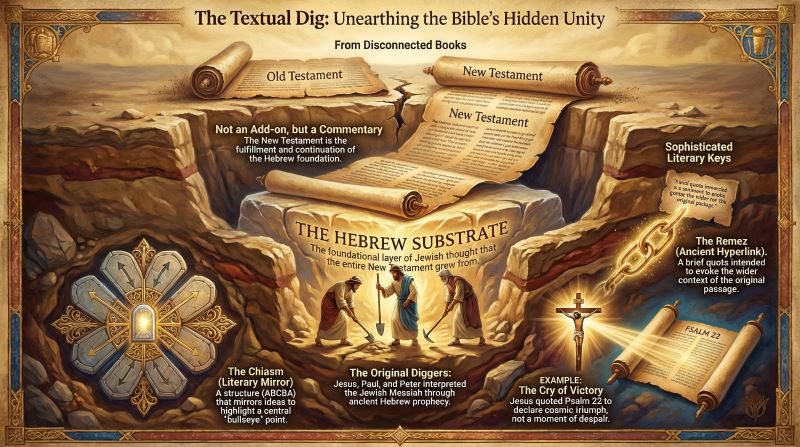
The New Testament isn’t a replacement for the Hebrew Scriptures. It’s not even a supplement to them. It is commentary on them, fulfilment of them, and continuation of them. Every page of the New Testament is built on top of a Hebrew foundation. But unless we’re willing to dig down and see that substrate beneath the surface, we’ll miss the depth and unity that ties the entire Bible together as one continuous story.
Jesus didn’t launch a new religion separate from Israel’s faith. The apostles didn’t wake up one morning and invent a new theology from scratch. Paul didn’t abandon the Torah he loved. They all spoke as Jews, using Jewish interpretive methods, quoting Jewish texts constantly, assuming Jewish patterns of thought in everything they wrote. To read their words at surface level only is to miss at least half of what they’re actually saying.
Consider Proverb 25; “It is the glory of God to conceal a thing, but the glory of kings is to search out a matter” (Proverbs 25:2). God doesn’t hide truth because He’s playing games with us. He conceals His wisdom and knowledge intentionally, creating the conditions for genuine seeking. The concealment itself separates those who are content with a surface-level understanding from those whose hearts compel them to dig deeper. And here’s what’s remarkable: when we do that digging, when we search out what God has layered into His word, we’re not being overly academic or missing the point. We’re fulfilling exactly what we’re designed to do as restored image-bearers. The king’s honour; humanity’s calling, is to search out what God has purposefully concealed. That searching is itself an act of worship, a relational pursuit of the One who hides treasure in a field so that the finding of it brings explosive joy.
A textual dig isn’t optional. It’s responsible reading.
Jesus Builds Everything on Torah's Foundation
When Jesus taught, He wasn’t making up new ideas. He was using teaching methods that would have been immediately recognizable to any educated Jewish listener of His day. He used midrash, remez (allusion), parable, hyperbole, and prophetic patterns; all techniques deeply rooted in how the rabbis interpreted Torah.
Take the Sermon on the Mount. Most modern readers hear it as beautiful moral teaching, perhaps the highest ethical standard ever articulated. And it is that. But a Jewish listener would have heard something else happening. They would have heard Sinai revisited. When Jesus says, “You have heard it said… but I say to you,” He’s not contradicting Moses. He’s offering authoritative midrash, going deeper into what the commandments were always meant to accomplish. The blessings He pronounces echo the blessings and curses of Deuteronomy 28. His image of a city on a hill recalls Isaiah’s prophetic vision of a restored Zion. When He addresses anger, lust, oaths, and how to treat enemies, He’s not discarding Torah, He’s intensifying it, internalising it, revealing its truest heart-level intention.
This is Jesus as the ultimate Torah teacher, not Jesus as the founder of a new religion that leaves Torah behind.
Paul Never Stops Thinking Like a Pharisee
Here’s something that will surprise many Christians: Paul never stops arguing like the Pharisee he was trained to be under Gamaliel. His letters are saturated with Scripture from beginning to end. He layers citations upon citations, compounds quotations from multiple passages, builds elaborate midrashic structures. He never creates theology ex nihilo; out of nothing.
Consider Galatians 3, which many Christians assume is Paul’s great argument against Torah. But read it carefully, and you’ll see Paul doing something far more nuanced. He’s showing that Abraham believed before Sinai ever happened. He’s demonstrating that covenant precedes commandment. He’s explaining how the nations get grafted into Israel’s story through their Messiah. His entire logic depends on you knowing Genesis, Deuteronomy, and Isaiah inside and out. If you don’t have that Hebrew foundational understanding in your mind, Paul’s argument doesn’t just lose depth, it becomes incomprehensible.
Paul isn’t writing as someone who has abandoned his Jewish heritage. He’s writing as someone so deeply formed by that heritage that he can’t think any other way. And that’s exactly as it should be, because he’s interpreting the Jewish Messiah’s fulfilment of Jewish prophecy for a world that desperately needs to understand Israel’s God.
Peter Preaches from the Hebrew Scriptures Alone
Read Peter’s sermons in Acts 2 and 3 with fresh eyes sometime. Notice something remarkable: Peter barely says anything original. His entire proclamation is a carefully woven tapestry of Hebrew Scripture.
“This is that which was spoken by the prophet Joel“. “You crucified Him, but God raised Him up, as David said in Psalm 16“. “You acted in ignorance, as Moses and the prophets said“. “Times of refreshing shall come, as Isaiah promised.” “The Lord will raise up a prophet like Moses“.
Peter isn’t inventing a new message. He’s showing how everything that just happened with Jesus is exactly what Israel’s Scriptures said would happen. The early church didn’t build its theology from Greek philosophy or Roman religion. They built it entirely from the Tanakh, the Hebrew Bible.
That’s not incidental to their message. That is their message. And if we don’t understand the Scriptures they’re constantly referencing, we can’t fully understand what they’re proclaiming.
Jewish Literary Techniques Reveal Hidden Treasure
The biblical authors used literary structures and techniques that we often miss entirely because we’re not trained to see them. But once you learn to recognise these patterns, whole new dimensions of meaning open up.
Take a chiasm (from chiasmus), for instance. It’s a literary structure where ideas are presented in one order and then repeated in reverse order, creating a mirror effect with the most important idea right in the middle (e.g. ABCBA). Paul uses chiastic structures constantly. The book of Hebrews is brilliantly chiastic And when you start looking you find that the Tanakh is replete with them. But one of the clearest and most beautiful examples is in Matthew 18:10-14, the parable of the lost sheep.
The passage forms a perfect mirror structure around its central point:
A (v.10): Warning – “Do not despise one of these little ones”
B (v.12): The shepherd leaves the ninety-nine to search
C (v.13): The center – “He rejoices more over that one sheep”
B’ (v.13b): The search was successful
A’ (v.14): The Father’s will – “Not willing that one should perish”
The structure itself forces you to see that the entire passage is about one thing: the joy of restoration. But here’s where it gets even more profound. In the Hebrew (or Aramaic) text that likely underlies Jesus’ teaching, there’s a stunning wordplay. The warning “do not despise” uses a word (בּוּז – buz) that means to treat as worthless. The conclusion “should not perish” uses a word (אָבַד – avad) that means to be lost or destroyed, but it also carries the connotation of having lost its value or purpose and therefore being worthless.
Jesus is creating a cause-and-effect link: when you despise someone, treating them as worthless, you’re actively contributing to their being lost. You’re aligning yourself with destruction rather than with the Father’s mission of rescue. The chiastic structure isn’t just literary artistry, it’s theology embedded in the very architecture of the text.
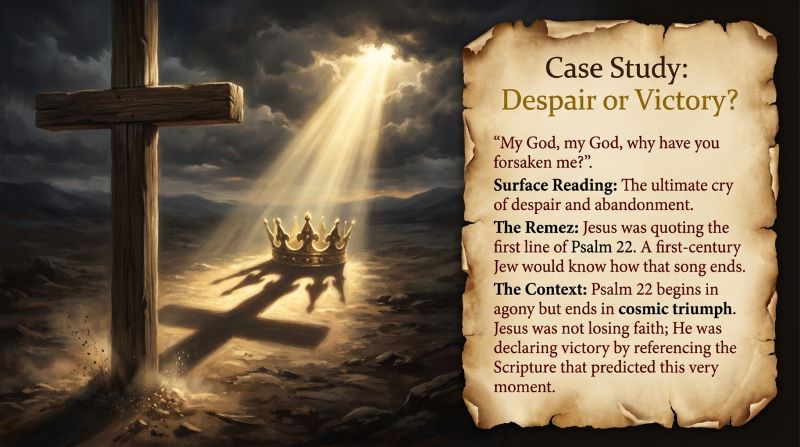
Imagine hearing this first line and then arriving at verse 8: “All those who see me mock me. They insult me with their lips. They shake their heads, saying, “He trusts in Yahweh. Let him deliver him. Let him rescue him, since he delights in him” (Psalms 22:7-8). And then hearing these very words from the mocking religious leaders and thieves; “He trusts in God. Let God deliver him now, if he wants him” (Matthew 27:43f).
And then continuing to verse 14: “I am poured out like water. All my bones are out of joint. My heart is like wax; it is melted within me. My strength is dried up like a potsherd. My tongue sticks to the roof of my mouth. You have brought me into the dust of death. For dogs have surrounded me. A company of evildoers have enclosed me. They have pierced my hands and feet. I can count all of my bones. They look and stare at me. They divide my garments among them. They cast lots for my clothing” (Psalms 22:14-18).
And yes, it begins with that anguished question, but it ends with triumph: “All the ends of the earth shall remember and turn to Yahweh. All the relatives of the nations shall worship before you. For the kingdom is Yahweh’s. He is the ruler over the nations…Future generations shall be told about the Lord. They shall come and shall declare his righteousness to a people that shall be born, for he has done it” (Psalms 22:27-31). Jesus isn’t expressing doubt. He’s pointing to a specific Scripture that describes exactly what’s happening and where it’s all heading. And John confirms this, declaring that Jesus’ final words on the cross were “It has been accomplished (τετέλεσται – tetelestai)”.
Then there’s gezerah shavah, a rabbinic technique where you link two passages together because they share a key word or phrase. Paul does this constantly, connecting passages in ways that seem random to us but would have been immediately recognised as legitimate rabbinic argumentation by his contemporaries.
When we miss these techniques, we miss the artistry, the depth, and often the actual meaning of what’s being communicated.

The Bible as One Unified Story
Here’s what happens when we don’t do the textual dig: Jesus’ teachings look innovative and new. Paul looks contradictory, sometimes affirming Torah and sometimes rejecting it. The apostles look inconsistent in their theology. And the New Testament looks disconnected from the Old, as if there’s been a fundamental break in God’s plan.
But when we excavate the Hebrew substrate beneath every New Testament page, something entirely different emerges. Jesus becomes the climax of Israel’s story, not the start of a different story. Paul becomes fiercely loyal to Torah, not its opponent. The apostles become the restorers of Israel’s ancient hope, not the inventors of a new religion. And Scripture from Genesis to Revelation becomes one coherent narrative about God’s faithful love for the world He created.
This isn’t just academically interesting. It changes how you read your Bible every day. Passages that seemed disconnected suddenly fit together. Teachings that seemed harsh or arbitrary suddenly make perfect sense in their context. And the entire sweep of Scripture begins to feel like what it actually is: one magnificent story of God pursuing His people and His world, told in many voices but with one ultimate Author.
The Reward of Digging Deeper
Honestly, this kind of reading takes work. It requires humility to admit that maybe we haven’t understood everything as well as we thought. It requires patience to learn about ancient Jewish culture, literary techniques, and the historical context of Second Temple Judaism. It requires a willingness to read slowly, to look up cross-references, to sit with passages until the connections start to emerge.
But the rewards are extraordinary. Every passage has layers you haven’t seen yet. Every idea has roots that go deeper than you realised. Every teaching echoes something ancient and true. When you start seeing how tightly woven the Scriptures are, how every thread connects to every other thread, your confidence in the Bible’s divine authorship actually increases. This isn’t a collection of random religious writings. This is a masterfully constructed tapestry that could only come from the mind of God. And when we excavate that soil carefully, patiently, reverently, the text comes alive in ways we never imagined possible.
That’s the journey we’re on together. Not to make the Bible more complicated, but to discover just how magnificently unified it actually is. To see that from beginning to end, it’s all one story, all one message, all one revelation of who God is and what He’s doing in the world.
The deeper you dig, the more treasure you find.
Read Our Blog Articles
Project Gerar
We believe much of the Hebraic roots and Jewish context that shaped the early Christian faith has been buried under layers of tradition and misinterpretation. We explore the original meaning of Biblical Hebrew words, study Torah as God’s instruction (not law), understand how Sabbath, biblical feasts (moedim), and covenant formed first-century believers. Seeking to remove centuries of accumulation to learn to walk ‘the way’ of the first disciples; following Yeshua (Jesus) the Messiah, empowered by the Spirit.
We’re not adding Jewish flavour to Christianity. This is a work of restoration; a return to the ancient paths. The water is still flowing.
Let’s dig together to uncover those wells.
Stay Connected
We never sell or share your personal data.
© 2026 Project Gerar. All Rights Reserved