
To understand why biblical translation is so challenging, we must first grasp a profound truth: Ancient Hebrew and modern English don’t just use different words, they operate from fundamentally different frameworks for understanding reality itself.
The Greek Philosophical Inheritance
Western civilization, including the English language, has been profoundly shaped by Greek philosophical thought. Plato taught us to think in terms of abstract “forms” or “ideals”; perfect versions of concepts that exist in a realm beyond the physical. When we speak of “justice,” “love,” or “truth,” we instinctively treat them as abstract concepts that can be defined, categorized, and contemplated independently of any physical manifestation.
Aristotle refined this further, teaching us to think in categories and essences. We ask, “What is the essential nature of X?” We create hierarchies of abstraction. We’re comfortable discussing ideas divorced from action. This Greek philosophical heritage is so deeply embedded in Western thought that we don’t even notice it; we assume everyone thinks this way.
The Hebrew Concrete Reality
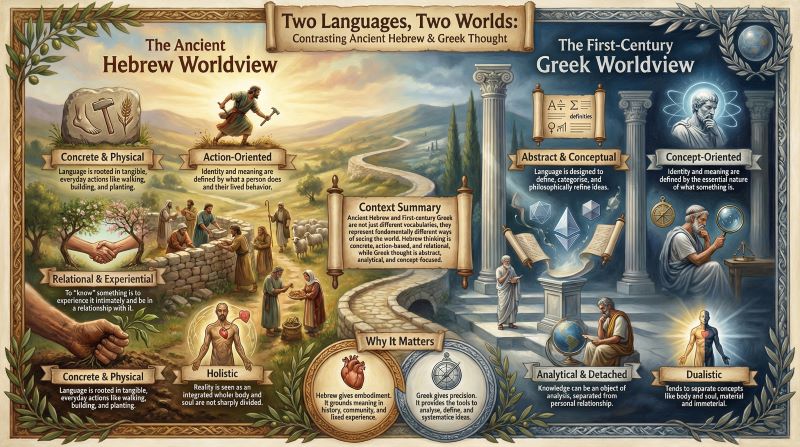
Ancient Hebrew operates from a completely different foundation. It is a concrete, action-oriented language that builds its meaning from the tangible, physical world. Where Greek thought abstracts upward toward ideals, Hebrew thought remains grounded in the visible, touchable, experiential world.
Hebrew is a “verb-centric” language, deeply rooted in the senses. Its structure is more akin to languages like Navajo, which are rich in descriptive action and physicality. In the ancient Hebrew mind, reality was not something to be contemplated in the abstract but something to be experienced and acted upon. You didn’t define love, you showed it. You didn’t philosophise about justice, you enacted it.
This fundamental difference creates translation challenges at the most basic level. When a Hebrew writer uses a word, they’re describing an observable phenomenon. When that word enters English through a Greek filter, it often becomes an abstract concept. Let’s see how this works in practice.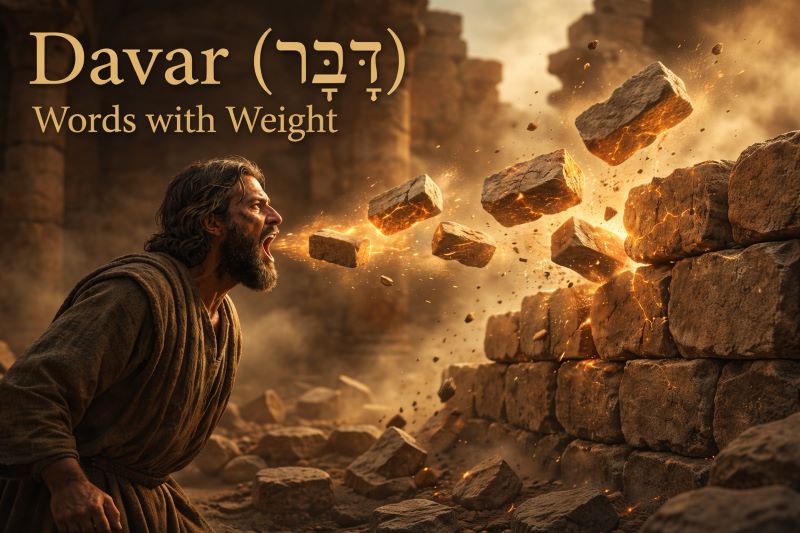
Davar (דָּבָר): The Concrete Word
In English, davar is almost always translated as “word.” But in Hebrew, davar also means “thing,” “matter,” or “event.” This is not linguistic confusion, it’s the Hebrew worldview. A “word” was not an abstract symbol for a thing; it was the thing itself, in audible form. Words had substance and power because they were events, not just sounds.
When Genesis 11:1 speaks of humanity having “one language” (literally “one davar“), it implies a shared reality and purpose, not just vocabulary. When God speaks the “ten davarim” (Ten Commandments) in Exodus 20:1, these are not abstract moral principles but world-shaping events released into creation. The Greek-influenced English reader thinks “words about things.” The Hebrew thinks “words as things.”
Why This Matters Theologically: This concrete understanding of davar is crucial for understanding the opening of John’s Gospel. “In the beginning was the Word (Greek: Logos, Hebrew concept: Davar), and the Word was with God, and the Word was God.” John, a Hebrew thinker writing in Greek, is bridging two worldviews. To the Greek reader, Logos means rational principle or abstract reason. To the Hebrew reader hearing davar, this means God’s creative, powerful, substantial word that accomplishes what it says; not just a concept, but active reality itself.
Lev (לֵב): The Thinking Heart
We translate lev as “heart,” and in English, this word primarily signifies the seat of emotion. We “love with all our heart” or feel “heartbreak.” It’s where feelings live.
In Hebrew, lev is the centre of a person’s entire being; the control room of human existence. It encompasses not only the emotions but also the intellect, will, moral decision-making, and consciousness. The lev thinks, plans, understands, and decides. When Proverbs 23:7 says “As a man thinks in his heart (lev), so is he,” it’s not about feelings, it’s about the very core of his reasoning and character.
When the Bible commands one to ‘love God with all their lev‘ (Deuteronomy 6:5), it is a call to align one’s thoughts, decisions, feelings, and very essence toward Him; a far more comprehensive idea than our modern emotional concept of “heart.”
Why This Matters Theologically: Misunderstanding lev has led to a false dichotomy between “head knowledge” and “heart knowledge” in modern Christianity. This Greek-influenced split wasn’t in the original Hebrew. The lev includes both. Loving God with your lev means your intellect, emotions, and will functioning in unified devotion. It’s not about choosing between thinking and feeling, it’s about integrating them.
Nephesh (נֶפֶשׁ): The Embodied Self
The translation of nephesh as “soul” is one of the most significant examples of the Greek abstraction effect. Influenced by Platonic philosophy, Western thought often imagines the soul as an immaterial, spiritual entity separate from and superior to the body; a ghost in the machine that can exist independently.
The Hebrew nephesh refers to the whole “living being.” It is life, breath, the throat, appetite, and the essence of a person as a physical, living entity. It includes their desires, passions, and hungers. When God breathes into Adam in Genesis 2:7, he becomes a “living nephesh“, not a body that receives a soul, but a living person, an integrated unity. Leviticus 17:11 states that the “life (nephesh) of the flesh is in the blood.” Nephesh is not a disembodied soul, but the tangible, breathing, desiring, feeling life force of a creature.
Why This Matters Theologically: The Greek soul/body dualism has profoundly shaped; and in some cases distorted, Christian theology. It contributed to Gnostic heresies that viewed the body as evil and the soul as good. It makes us think salvation is about “souls going to heaven” rather than the Hebrew concept of resurrected bodies on a renewed earth. Understanding nephesh as “whole person” restores the biblical emphasis on bodily resurrection and the goodness of physical creation.
Ruach (רוּחַ): The Breath You Can Feel
Perhaps no Hebrew word better demonstrates the concrete-versus-abstract divide than ruach. This word can mean “wind,” “breath,” or “spirit”, and Hebrew speakers understood these as interconnected realities, not separate concepts.
In English, “spirit” has become thoroughly abstract; a disembodied, ethereal, ghostly presence. The Greek pneuma similarly meant “spirit” in an increasingly abstract sense. But the Hebrew ruach never lost its connection to the physical experience of wind and breath. When Ezekiel 37 describes the valley of dry bones, the same word ruach appears as “breath” (v. 5), “wind” (v. 9), and “Spirit” (v. 14). These aren’t three different things, they’re one reality experienced in different manifestations.
Why This Matters Theologically: Translating ruach as the abstract “Spirit” creates a false separation between the spiritual and physical worlds. The Hebrew concept is far more dynamic and immanent. The Holy Spirit is not a wispy, invisible force, it’s as real and powerful as the wind that fills your lungs and moves the trees. This understanding should transform how we think about the Spirit’s presence and work. When Genesis 1:2 says the ruach of God was “hovering over the waters,” ancient readers felt the rush of divine breath across creation—not an abstract concept, but tangible power.
This divide between concrete Hebrew thinking and abstract Greek philosophy extends beyond individual words into entire conceptual frameworks that shape how we read Scripture.
Beyond the concrete-versus-abstract divide lies an even greater challenge: many key Hebrew words do not have a single definition but represent a vast conceptual territory, a rich semantic range. These words function like spotlights illuminating different facets of a complex reality, while English words function more like labelled boxes with defined boundaries.
Translating these words forces an impossible choice: the translator must select one facet of a multi-faceted diamond while the others remain hidden in English translation. This is where one-to-one equivalence becomes a fantasy, and the reader must trust the translator’s difficult; and often totally inadequate, decision.

Chesed (חֶסֶד): Covenant Love in Action
No single English word can capture chesed. It has been translated as “mercy,” “loving-kindness,” “steadfast love,” and “grace,” yet it is all of these and more. Chesed is a fusion of love, loyalty, compassion, and covenant faithfulness. It is not mere feeling or obligation; it is an active, enduring commitment rooted in relationship.
The word carries immense theological weight, describing the foundational nature of God’s unbreakable, loyal love for Israel. But English forces us to choose, and “mercy” suggests pity, “loving-kindness” sounds sentimental, “steadfast love” misses the loyalty dimension, and “grace” loses the covenant context.
Why This Matters Theologically: Understanding chesed as covenant-loyalty transforms how we read the Old Testament. When God shows chesed, He’s not just being nice, He’s keeping His promises with rugged faithfulness even when His people break theirs. This reframes debates about law versus grace. God’s chesed doesn’t replace His justice; it’s His loyal commitment to work through both justice and mercy to fulfil His covenant promises. The entire book of Hosea becomes a drama of chesed; God’s stubborn, loyal love pursuing an unfaithful partner.
Emet (אֱמֶת): Truth You Can Stand On
In English, “truth” often refers primarily to factual accuracy; propositions that correspond to reality. The Hebrew emet carries far deeper connotations. Its root letters (aleph, mem, tav) are the first, middle, and last letters of the Hebrew alphabet, suggesting completeness and stability.
Emet means trustworthiness, reliability, faithfulness, and stability. It’s not just something that is correct; it’s something that is solid, dependable, and unshakeable, a foundation you can build your life upon. It combines truth with faithfulness.
Why This Matters Theologically: When the Bible speaks of God’s emet, it refers not just to His factual statements but to His absolute faithfulness and the reliable nature of His promises. Truth, in Hebrew thought, isn’t primarily philosophical or propositional; it’s relational and covenantal. Jesus saying “I am the way, the truth (emet), and the life” (John 14:6) means more than “I speak accurately.” It means “I am utterly reliable, completely trustworthy, the solid foundation for existence itself.”
Chokmah (חָכְמָה): Wisdom as Skilful Living
The English word “wisdom” often suggests abstract philosophical knowledge or intellectual understanding. The Hebrew chokmah is far more practical and embodied. It refers to skill, expertise, and the art of living well.
Chokmah is the wisdom that enables a craftsman to build the Tabernacle (Exodus 31:3), the discernment to govern justly (1 Kings 3:28), and the practical knowledge to navigate relationships successfully (Proverbs). It combines intellectual, moral, and practical dimensions, it’s wisdom you can see demonstrated, not just discussed.
Why This Matters Theologically: The biblical emphasis on chokmah challenges the Greek tendency to separate knowledge from practice. James echoes this Hebrew concept when he insists that “faith without works is dead” (James 2:26). Wisdom isn’t about accumulating correct information, it’s about skilfully living in alignment with God’s created order. The book of Proverbs isn’t abstract philosophy; it’s a manual for skilful living in God’s world.
Derek (דֶּרֶךְ): The Way You Walk
English translates derek as “way” or “path,” which sounds simple enough. But derek carries rich connotations that our translation masks. It doesn’t just mean a road or direction—it encompasses a manner of life, a pattern of behaviour, a comprehensive approach to living.
When the Psalmist speaks of God’s derek (Psalm 25:4), he’s not asking for GPS directions but for instruction in a whole way of living. When Proverbs warns about the derek of the wicked versus the derek of the righteous, it’s contrasting entire life orientations, not just moral choices.
Why This Matters Theologically: Jesus’s claim to be “the way (derek), the truth, and the life” takes on deeper meaning. He’s not just showing a path to follow but embodying a comprehensive way of being human; a whole life orientation, a pattern of existence, a manner of relating to God and others. Early Christianity was called “The Way” (Acts 9:2) because it was understood as a complete lifestyle, not just a set of beliefs.
These individual words carry entire worlds of meaning, but that meaning becomes even more precarious when it depends on the unspoken assumptions of an ancient culture—a context almost completely lost to most modern readers.
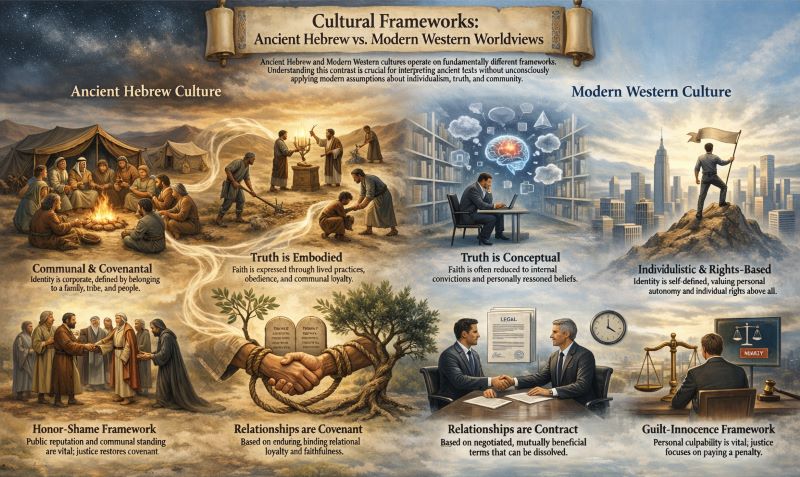
Every word is an artefact of its culture. To truly translate a word, one must somehow translate the cultural framework that gives it meaning, an often-impossible task. Many Hebrew concepts are embedded in a system of social, ethical, and religious assumptions that are completely foreign to a modern Western reader. When these invisible frameworks are lost, the word’s original power is diminished or distorted.
Honour-Shame vs. Guilt-Innocence Cultures
Perhaps the most foundational cultural gap lies in the difference between honour-shame cultures (like ancient Israel) and guilt-innocence cultures (like the modern West). Western readers approach the Bible through a guilt-innocence lens: we focus on rule-breaking, individual conscience, and personal responsibility. We ask, “Did I break a rule? Do I feel guilty?”
Ancient Mediterranean culture, including Israel, operated primarily on honour-shame dynamics. The central questions were: “Have I brought honour or shame to my family/community? What do people think of me? Have I acted in a way worthy of respect?” Honour wasn’t pride, it was having a good reputation and fulfilling social obligations. Shame wasn’t guilt, it was loss of face and social standing.
Why This Matters for Reading Scripture: This framework reinterprets countless passages. When Jesus addresses tax collectors and sinners, he’s not just dealing with “guilty people” but with those who’ve lost honour and been socially marginalised. When he restores them, he’s not just forgiving guilt, he’s restoring honour and community standing. The parable of the Prodigal Son isn’t just about a guilty son but about a son who has shamed his family and then experiences remarkable restoration of honour.
Understanding honour-shame dynamics transforms how we read the Sermon on the Mount, Paul’s letters, and virtually every social interaction in Scripture.
Communal vs. Individual Identity
Modern Western culture is fiercely individualistic. We think in terms of “my personal relationship with God,” “my individual salvation,” “my faith journey.” This lens is so pervasive we assume it’s universal.
Ancient Hebrew culture was fundamentally communal. Identity was corporate. You were, first and foremost, part of a family, a tribe, a people. Individual identity was inseparable from group belonging. When God makes a covenant, it’s with a people, not just individuals. When judgment falls, it affects families and communities, not just isolated persons. The concept of “Israel” as God’s corporate son precedes any individual relationship with God.
Why This Matters for Reading Scripture: This changes how we understand election, covenant, sin, and salvation. When God calls Abraham, He’s not just saving one man’s soul, He’s creating a people through whom all nations will be blessed. When Paul talks about being “in Christ,” he’s describing corporate identity and belonging to a new humanity, not just individual salvation. The Western question “What must I do to be saved?” already reveals our individualistic bias. The biblical question is more like “How do I become part of God’s covenant people?”
Tzedakah (צדקה): When Justice Requires Generosity
Translating tzedakah as “charity” is one of the most common and significant cultural mistranslations, revealing both linguistic and cultural gaps. In English, charity is a voluntary act of kindness or generosity; something extra, optional and praiseworthy.
But tzedakah is fundamentally about justice and righteousness. It’s the same root as tzedek (justice). In the ancient Hebrew worldview, caring for the poor and vulnerable was not optional generosity but a moral and legal obligation rooted in covenant community. It was an act of restoring fairness and balance, rooted in the belief that everything ultimately belongs to God and we’re merely His stewards.
Why This Matters Theologically: Understanding tzedakah as justice rather than charity transforms the prophetic literature. When Amos thunders against Israel, he’s not asking them to be nicer, he’s exposing their injustice. When Proverbs praises those who give to the poor, it’s describing righteousness, not charity. This reframes modern debates about social justice and personal generosity. From a Hebrew perspective, these aren’t separate categories. Justice includes economic equity; righteousness includes caring for the vulnerable. It’s not optional benevolence, it’s our covenant obligation.
Mitzvah (מִצְוָה): Commands as Connection
While mitzvah does mean “commandment,” the English word carries a cold, authoritarian tone; rules imposed from above that constrain our freedom. In its Hebrew cultural context, a mitzvah is much warmer and richer.
A mitzvah is also a good deed, an act of kindness, a connection point with God. Performing a mitzvah wasn’t primarily about avoiding punishment for disobedience, it was about participating in God’s work in the world, maintaining covenant relationship, and bringing goodness into creation. It was an opportunity for connection, not just a constraint on behaviour.
Why This Matters Theologically: This reframes the entire law-versus-grace debate. When modern Christians read about “keeping the commandments,” we often hear legalism and earn-your-salvation works-righteousness. But ancient Jews heard “opportunities to connect with God and participate in His purposes.” Paul’s critique wasn’t of mitzvot themselves but of the belief that performing them could earn covenant status rather than express it.
Understanding mitzvah as relational rather than legal language helps us read both testaments more faithfully.
Yirah (יִרְאָה): When Fear Means Awe
The phrase “fear of God” can be unsettling for modern readers, evoking images of terror before a divine tyrant. The Hebrew word yirah holds a much richer and more complex meaning that our cultural context fails to capture.
Yirah encompasses fear, yes, but also awe, reverence, wonder, and deep respect. It’s the overwhelming feeling of standing in the presence of something infinitely greater than oneself, like standing at the edge of the Grand Canyon or in the presence of royalty. It combines recognition of power with wonder at majesty, awareness of danger with delight in beauty. It’s what you feel when you realise you’re dealing with something vast, holy, and utterly beyond you.
Why This Matters Theologically: Translating yirah simply as “fear” has distorted how Western Christians understand their relationship with God. Many believers swing between two extremes: either they’re terrified of God (unhealthy fear) or they’ve domesticated Him into a cosmic buddy (no fear at all). The Hebrew concept of yirah provides the biblical balance: God is not safe, but He is good. He should inspire awe, not terror; wonder, not casual familiarity. The “fear of the Lord is the beginning of wisdom” (Proverbs 9:10) isn’t about being scared into compliance; it’s about recognising the awesome reality of who God is as the foundation for understanding anything else.
Covenant as Kinship, Not a Contract
Perhaps no cultural framework is more fundamental; or more lost in translation, than the Hebrew understanding of covenant. Modern Western readers, steeped in legal contracts and business agreements, naturally read “covenant” as a formal legal arrangement between parties who maintain separate identities. It’s transactional: “I do this, you do that, we both agree to these terms.”
Ancient Hebrew covenant was far closer to kinship bonds than legal contracts. Covenant created family relationship, not just mutual obligations. When God makes covenant with Abraham or Israel, He’s not entering a business deal, He’s creating familial bonds. Covenant was how unrelated parties became family. It was more like adoption or marriage than a commercial agreement.
Why This Matters Theologically: This transforms our entire understanding of the Old and New Testaments (literally “covenants”). God’s covenant isn’t primarily a legal agreement we keep or break, it’s a family relationship He establishes and maintains. When Israel breaks covenant, it’s not a contract violation, it’s a family betrayal. When Jesus institutes a “new covenant,” He’s not replacing one contract with another; He’s inaugurating a new way of being part of God’s family. Understanding covenant as kinship helps us grasp why God’s commitment persists through Israel’s unfaithfulness; it’s not a business relationship He can simply terminate. It’s family, and God doesn’t abandon His children.
These invisible cultural frameworks shape meaning in ways that resist translation. But the challenge compounds when we recognise that the biblical text itself has travelled through multiple languages, each narrowing the original meaning further.










The journey of the biblical text from its original language to our hands can be pictured as a great funnel. It began in Hebrew, with its rich, concrete, and culturally embedded words. It was then poured into the Greek of the Septuagint (the Greek Old Testament, translated around 250 BCE) and the New Testament (written in Greek but by predominantly Hebrew-thinking authors). Finally, it was poured from Greek into Latin, then into early English, and into our modern translations.
At each stage, some of the original breadth and nuance was inevitably narrowed, filtered, or altered. The funnel effect is cumulative and, in many cases, theological.
Case Study 1: The Funnelling of Shalom
Hebrew (Shalom): The starting point is a vast concept encompassing wholeness, well-being, harmony, prosperity, safety, completeness, and flourishing in every dimension of life, physical, relational, spiritual, and communal.
Greek (Eirēnē): When translated into Greek as eirēnē (εἰρήνη), the meaning narrows significantly. Eirēnē primarily means “peace” in the sense of absence of conflict or war. It can carry positive connotations of tranquillity, but it loses the holistic, multi-dimensional flourishing inherent in shalom. Greek eirēnē is more political and less relational than Hebrew shalom.
English (“Peace”): The English word “peace” solidifies this narrower meaning, almost exclusively referring to the cessation of hostility or internal calm. The positive, active dimensions of wholeness and prosperity are completely lost. An abusive relationship can come to an end and with it the conflict but both parties remain broken and in need of shalom.
Theological Impact: This progressive narrowing has profound consequences. When Isaiah prophesies the coming of the “Prince of Shalom” (Isaiah 9:6), Hebrew readers understand a king who will bring complete restoration and flourishing. Greek readers hear “Prince of Eirēnē“, a peacemaker who stops wars. English readers hear “Prince of Peace”; often in a Christmas context, where the Messiah is a baby in a manger, and then struggle when this same prince returns as a warrior-king in Revelation 19, ready to do battle..
But there’s no contradiction in the Hebrew. To bring true, lasting shalom; complete wholeness and harmony, may require forceful confrontation with everything that opposes it. Evil, injustice, and chaos must be defeated for shalom to be established. The narrow English “peace” makes this seem paradoxical; the broad Hebrew shalom makes it perfectly coherent.
Similarly, when Paul writes about “the peace of God which surpasses understanding” (Philippians 4:7), English readers think of inner calm; a subjective emotional state that soothes their anxiety. However, the original concept is far richer. Paul acknowledges that the Philippians’ anxiety makes sense given their current circumstances; the threats, uncertainty, and pressure are very real. But he’s inviting them to change their perspective. To see that their circumstances don’t have the final word; God’s kingdom reality does.
When they turn toward God through prayer and thanksgiving, they’re not performing religious coping techniques, they’re re-aligning themselves with the new-creation order inaugurated in Messiah: a kingdom focused on wholeness, completeness, and restoration, where creation flourishes, justice and mercy rule, and everything works in harmony with His purposes. In that alignment, God’s shalom; not a feeling but a cosmic order made personal, stands guard over their hearts and minds, not by explaining away their troubles but by relocating them within a larger kingdom narrative where they can see beyond their present circumstances and trust in His goodness and faithfulness.
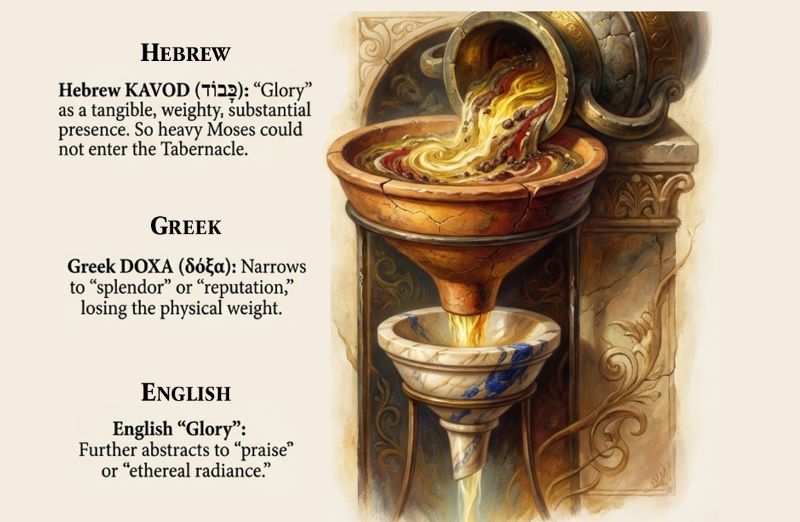
Case Study 2: The Funnelling of Kavod
Hebrew (Kavod): The original word for “glory,” kavod (כָּבוֹד), carries crucial, tangible connotations. Its root meaning is “weight” or “substance.” When used of God, kavod refers to His manifest, weighty presence—glory so real and substantial it’s almost physically heavy. In Exodus 40:34, the kavod of the Lord filled the Tabernacle so overwhelmingly that Moses could not enter. The people could see it as a cloud by day and fire by night. This was visible, palpable, weighty divine presence.
Greek (Doxa): The Greek translation, doxa (δόξα), captures the idea of “glory,” “honour,” or “splendour,” but it loses the physical sense of weight and substance. Doxa focuses more on reputation, opinion, or abstract majesty. While it can describe God’s brightness or magnificence, the concrete, weighty, filling-a-space quality is diminished.
English (“Glory”): Our English word “glory” reinforces this abstract sense. We think of glory as praise, honour, brightness, or ethereal radiance. The Hebrew physical dimension; the idea of a presence so substantial it has weight, is entirely lost. Glory becomes something you give (praise) or see (brightness), not something that weighs on a place.
Theological Impact: The shift from the weighty presence of kavod to the abstract splendour of “glory” subtly changes how believers perceive God’s immanence. The Hebrew concept anchors God’s presence in perceivable, awesome reality, something that changes the atmosphere, something you can feel. The Greek and English concepts allow glory to remain more distant, more metaphorical; something to contemplate or praise but not something that makes you physically unable to enter a space.
This affects our worship, our theology of God’s presence, and our expectations of divine encounter. When the Bible speaks of God’s glory filling the temple or the earth, Hebrew readers expected (and experienced) a tangible manifestation. While modern English readers may think of it as poetic language for God’s general awesomeness.
Case Study 3: The Funnelling of Ruach
Hebrew (Ruach): As we’ve seen, ruach means wind, breath, and spirit as interconnected realities; the tangible force you feel on your face, the air in your lungs, and the life-giving presence of God. These aren’t metaphors; they’re different manifestations of the same substantial reality.
Greek (Pneuma): The Greek pneuma (πνεῦμα) also means breath, wind, and spirit, but Greek philosophical tradition increasingly abstracted pneuma toward the spiritual realm, separating it from physical breath and wind. By the time of the New Testament, pneuma could mean the immaterial part of a person or divine spiritual reality, distinct from the physical.
English (“Spirit”): In modern English, “spirit” has become thoroughly abstract. We think of spirits as non-physical entities; ghosts, essence, the opposite of matter. “Spirit” and “wind” seem like completely unrelated words. The Holy Spirit becomes an invisible, ethereal presence rather than the breath of God rushing through creation.
Theological Impact: This abstraction contributes to an unbiblical split between “spiritual” and “physical” realities. It makes the Holy Spirit seem ghostly and distant rather than immediate and powerful. It loses the Hebrew understanding that God’s Spirit is as real and forceful as the wind that fills your lungs; not abstract, but dynamically present. When Jesus tells Nicodemus that “the wind (pneuma) blows where it wishes” and “so it is with everyone born of the Spirit (pneuma)” (John 3:8), the original wordplay connecting physical wind and spiritual birth is lost in English, where they seem like different concepts.
These case studies reveal a consistent pattern: the Hebrew concrete action becomes a Greek abstract concept that becomes an English distant idea. The cumulative narrowing has shaped theology in ways we often miss entirely.
Even with a perfect understanding of Hebrew vocabulary, grammar, and culture, translation requires thousands of interpretive decisions that are invisible to the final reader but can significantly alter the meaning of a passage. Revealing these critical decision points shows that no translation can be purely “objective”, every translation is already an interpretation.
The Challenge of a Voweless Text
Ancient Hebrew was written without vowels, using only consonants. Vowel markings (called “pointing” or “niqqud”) were added by Jewish scribes called Masoretes between the 6th and 10th centuries CE, over a thousand years after much of the text was written.
This means that a single string of consonants can sometimes be read in multiple ways, depending on which vowels you supply. For example, the consonants DVD could be read with vowels as “David” (דָּוִד), the name of the king. But with different vowels, it could also be read as “beloved” (דּוֹד). This isn’t mere academic curiosity—it creates genuine ambiguity in certain passages.
Example: Psalm 22:16 contains one of the most debated cases. The Hebrew consonants are K-R-V. The Masoretic tradition vowelizes this as ka-ari, meaning “like a lion” (“like a lion, my hands and feet“). But many ancient manuscripts and the Septuagint suggest it should be vowelized as ka-aru, meaning “they have pierced” (“they have pierced my hands and feet”).
The theological stakes are obvious: Christians have traditionally read this as a prophecy of crucifixion. The alternate reading doesn’t support that interpretation. Modern translators must make a choice based on manuscript evidence, context, and theological understanding—but it’s an interpretive choice nonetheless.
Why This Matters: Readers need to understand that some translation decisions involve genuine ambiguity in the original text, not translator incompetence or bias. The consonantal nature of Hebrew means multiple readings are sometimes possible, and footnotes in study Bibles that mention “alternate readings” aren’t minor technicalities—they’re pointing to real uncertainty about the original meaning.
The Power of a Comma
Greek manuscripts didn’t have punctuation marks, verse divisions, or even spaces between words. All of these were added centuries later by translators and editors. A single comma can change theology.
Example: In Luke 23:43, Jesus speaks to the criminal on the cross. Where should the comma go?
“Truly I tell you, today you will be with me in paradise.” This reading suggests the man would enter paradise that very day—implying immediate conscious existence after death.
But “today” (sēmeron) could be part of the oath formula: “Truly I tell you today, you will be with me in paradise.” This second reading implies the promise was made today, but its fulfilment comes later, at the resurrection.
The Hebrew idiom “I tell you today” appears throughout Scripture as a solemn emphasis formula (see Deuteronomy 4:26, 8:19, 30:18). The translator’s punctuation choice directs the reader’s entire theological understanding of the afterlife, resurrection, and intermediate state.
Why This Matters: Punctuation seems minor, but it embeds theological interpretation into the text itself. Modern readers rarely realize these aren’t original features but translator decisions. When two translations differ on a comma, they’re making different theological judgments; and both may be legitimate possibilities.
Choosing a Translation Philosophy
Translators align with different philosophies that represent fundamentally different approaches:
Formal Equivalence (Word-for-Word): Sticks as closely as possible to the original sentence structure and word order (e.g., ESV, NASB, NKJV). The advantage is precision and ability to see the original text structure. The disadvantage is sometimes awkward English and missed idioms.
Dynamic Equivalence (Thought-for-Thought): Prioritizes conveying the original meaning in natural-sounding English, even if it requires restructuring sentences (e.g., NIV, NLT, CSB). The advantage is readability and capturing the intended impact. The disadvantage is more interpretation baked into the translation.
Paraphrase: Rephrases meaning in contemporary language with significant freedom (e.g., The Message). The advantage is immediate accessibility. The disadvantage is distance from the original text.
Example: Consider 1 Kings 20:11’s Hebrew idiom:
Formal (ESV): “Let not him who straps on his armour boast himself as he who takes it off.”
Dynamic (NIV): “One who puts on his armour should not boast like one who takes it off.”
Paraphrase (The Message): “Think about it—it’s easier to start a fight than end one.”
Each captures something true, but they give readers very different experiences. The ESV preserves the metaphor but requires interpretation. The NIV clarifies the metaphor while keeping it. The Message extracts the principle and applies it directly.
Why This Matters: There is no “best” translation for everyone. Formal equivalence is better for detailed study; dynamic equivalence is better for reading comprehension; paraphrase is better for grasping the big picture. The wisest approach is using multiple translations in dialogue with each other, allowing them to triangulate the meaning the original conveys.
Deciding “Who Is Speaking?”
Quotation marks didn’t exist in ancient Greek manuscripts. This creates significant ambiguity about where quotations begin and end.
Example: The most famous case is John 3:16. Where do Jesus’s words to Nicodemus end?
In some translations (NIV, NRSV), the quotation marks end at verse 15. This makes verse 16:”For God so loved the world…” a commentary by John, not words spoken by Jesus.
In other translations (NKJV, ESV), the quotation continues through verse 21, attributing all these words, including verse 16, directly to Jesus.
Both are legitimate interpretations of the punctuation-free Greek text. But it matters! If John 3:16 is Jesus speaking, we’re hearing the Son explain the Father’s love. If it’s John narrating, we’re hearing the apostle’s theological reflection.
Why This Matters: Readers should know that quotation marks are editorial decisions, not original features. When translations differ on who’s speaking, they’re making interpretive calls about the structure and flow of the original text. Neither is necessarily “wrong”, they’re highlighting the ambiguity inherent in translating ancient manuscripts into modern conventions.
The Compounding Effect
These challenges compound. A translator must:
- Decide what the consonants mean
- Choose which facet of a multi-faceted word to emphasise
- Determine cultural context
- Apply or resist their own theological framework
- Follow a translation philosophy consistently
- Make punctuation and quotation decisions
Each decision closes off other possibilities. By the time we read an English Bible, we’re reading the result of thousands of interpretive choices, most of which are invisible to us. This doesn’t make translation unreliable, but it does mean translation can never be neutral or purely mechanical.
Understanding these immense challenges of translation; the gap between concrete and abstract thought, the vastness of single words, the invisible cultural frameworks, the historical “funnel” effect, and the thousands of interpretive choices, does not diminish the value of our English Bibles. On the contrary, it should fill us with a profound appreciation for the incredible scholarship they represent and the remarkable accessibility they provide.
The goal of this exploration is not to create anxiety or undermine confidence in Scripture. Rather, it’s to invite you into a richer, more three-dimensional engagement with the biblical text. Translation gaps don’t reveal weakness in the Bible, they reveal depths of meaning waiting to be discovered.
This is not a checklist for finding errors but a map for finding treasure. When you see a footnote about a Hebrew word, you’re standing at the doorway to a richer conceptual world. When you compare translations and notice differences, you’re not finding mistakes, you’re triangulating the position of an idea far bigger than any single English phrase can contain.
Practical Steps Forward
This journey can continue through a few simple practices:
- Read the footnotes. Many study Bibles include notes that explain difficult translations, mention alternate renderings, or point to the original Hebrew or Greek word. These aren’t distractions, they’re windows into the depths behind the English surface.
- Compare translations. Place a formal equivalence translation (like the ESV or NASB) next to a dynamic equivalence one (like the NIV or NLT) when reading a favourite passage. Notice the differences and ask what each choice reveals about the possible meanings. The differences aren’t problems—they’re different angles on the same reality.
- Use accessible tools. Online resources like Blue Letter Bible, Bible Hub, or BibleProject allow anyone to look up the Hebrew or Greek word behind an English translation, revealing its range of meanings and how it’s used elsewhere in Scripture. These tools democratize access to the original languages.
- Study cultural context. Read introductions to biblical books that explain the historical and cultural setting. Understanding honour-shame dynamics, covenant relationships, or ancient Near Eastern customs will transform how passages land on your heart and mind.
- Embrace the complexity. Don’t be discouraged by ambiguity or multiple possible meanings. The Bible’s depth is a feature, not a bug. Wrestling with translation questions often leads to richer understanding than if everything were simple and flat.

The Invitation
Recognising these hidden layers transforms Bible reading from a simple act into a profound journey of discovery. It invites us to slow down, ask questions, and marvel at the depth and complexity of a text that has travelled across millennia, through multiple languages and cultures, to reach us today.
We’re not just reading words on a page. We’re encountering ancient Hebrew prophets, poets, and storytellers who thought in pictures, spoke in actions, and lived in a world profoundly different from ours. We’re hearing Greek-speaking apostles trying to capture the explosive reality of a Hebrew Messiah in the philosophical language of the Roman Empire. We’re receiving the faithful work of countless translators who’ve wrestled with impossible choices to give us access to this text in our native tongue.
The fact that so much meaning survives the journey; that we can still encounter God through these translated words, is itself a kind of miracle. But we honour that miracle most when we read with eyes wide open to both what translation gives us and what it can’t fully capture.
Read with curiosity. Read with humility.
Read with new eyes, greater wonder, and a deeper sense of invitation.
The worlds within these words are waiting to be discovered, one Hebrew concept at a time.