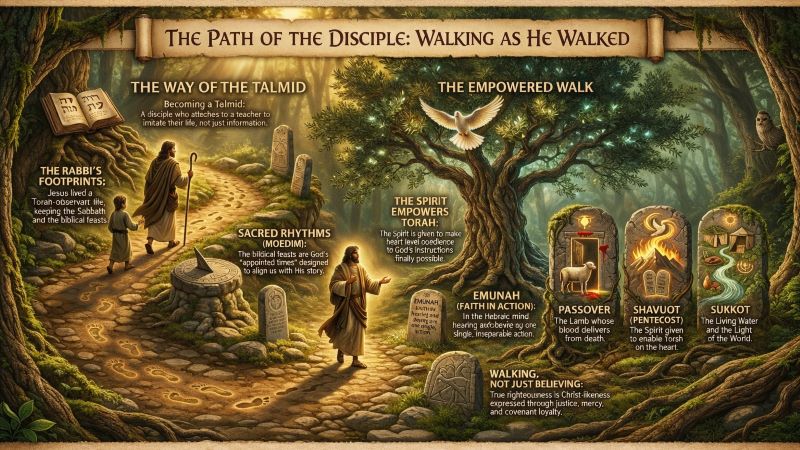
In the first century, when someone decided to follow a rabbi, they weren’t signing up for a belief system. They were signing up for a way of life. Discipleship wasn’t primarily about adopting certain theological positions or affirming certain doctrines about your teacher. It was about imitating him. You watched how he lived, how he prayed, how he interpreted Scripture, how he treated people, what he valued and what he avoided. And then you patterned your own life after his.
In Hebrew, a disciple is a talmid (תלמיד); someone who attaches themselves to a teacher not just to learn information, but to become like them. A talmid didn’t just study under a rabbi; they followed him everywhere, watching how he prayed, how he interpreted Scripture, how he treated people, how he handled conflict, what he ate, how he rested. The goal wasn’t just to know what the rabbi knew, but to become like the rabbi; to imitate their life.
So here’s the question that should be obvious but somehow gets lost in modern Christianity: If Jesus is our rabbi, our teacher, our Master, what path did He walk? And are we walking it?
Jesus was a Torah-observant Jew. He kept the Sabbath. He celebrated the biblical feasts. He taught from the Torah and said it wouldn’t pass away until heaven and earth passed away. He intensified the commandments, not loosened them. The apostles who followed Him continued in those same rhythms. The early church met on Sabbath, celebrated Passover, gathered for Pentecost. These weren’t “Jewish customs” they’d left behind. These were the sacred rhythms of covenantal life with God that Messiah Himself affirmed and fulfilled.
If we claim to be His disciples; to ‘follow Jesus’ and He lived His life as an example for us; as Paul declared; “Be imitators of me, even as I also am of Christ” (1Corinthians 11:1), at some point we have to ask ourselves: Why would we walk a different path to the One we’re claiming to follow?
Before we go further, we need to clarify what we mean by Torah. In another article, we explore this Hebrew concept in depth, but here’s what you need to know: Torah doesn’t mean “law” in the legal sense Western minded believers often assume. It means “instruction”, specifically, God’s instructions for human flourishing.
Torah is not to be confused with the Mosaic Covenant, which was the covenant-specific application of Torah that functioned as Israel’s constitution under the Old Covenant. The Mosaic Covenant was the administrative framework, the particular way God structured His relationship with Israel as a nation at a specific point in history. But Torah itself is broader and more fundamental. It’s God’s wisdom for how life works best, His character revealed through instruction, His blueprint for human flourishing that predates Sinai and extends beyond any single covenant administration.
When we talk about walking a Torah-observant path, we’re not talking about recreating ancient Israel’s theocratic system. We’re talking about aligning our lives with God’s eternal wisdom as it has been revealed through His instructions; instructions that Jesus Himself affirmed, lived, and taught.

The biblical feasts aren’t Jewish holidays in the ethnic sense. In Hebrew they’re called moedim which means “appointed times” or “rehearsals.” In fact, they’re God’s appointed times; moments on His calendar when He invites His people to remember His mighty acts, to anticipate His promises, and to align their lives with His redemptive story. In this respect, they are annual appointments that God expects His covenant people to keep.
Jesus kept them. He revealed His deepest identity through them. At Passover, He showed Himself as the Lamb whose blood delivers from death. At Sukkot, He declared Himself the living water and the light of the world. His resurrection timing aligns perfectly with the Feast of Firstfruits. The Spirit was sent at Shavuot, the feast commemorating the giving of Torah at Sinai. These aren’t coincidences. These are God’s calendar playing out exactly as designed.
When we participate in Passover today, we’re not playing at being Jewish. We’re entering into the rhythm Messiah Himself observed and through which He reveals His work. When we gather the firstfruits of barley, we’re celebrating the very feast that pointed to His resurrection. When we blow the shofar on Yom Teruah, we’re rehearsing for His return. The feasts aren’t outdated rituals. They’re living connections to God’s story from creation to consummation.
And they ground our faith in something more than abstract theology. They give us tangible rhythms, embodied practices, appointed times to remember, to celebrate, to anticipate, to teach our children. They are reminders that we are covenant people and God is our faithful covenant partner.
Year after year, we return to the same stories of His deliverance, His provision, His promises kept. We rehearse Passover and remember He rescued us. We count the omer and remember He sustains us. We gather at Sukkot and remember He sheltered us in the wilderness. Each feast becomes a covenant marker, a recurring testimony that the God who was faithful then remains faithful now. The feasts don’t just teach us history; they train us in faithfulness. They anchor our identity as His people throughout the rhythm of the year, making faith something we live in our kitchens and our calendars, not just something we think about on Sunday mornings.
Sabbath And The Rhythm of Creation
Of all the commandments in Torah, Sabbath might be the one Western Christianity has most radically reinterpreted. We’ve turned it into a principle about rest, disconnected it from the seventh day, and often reduced it to “take a day off when you can.” But Sabbath is far more than that, and understanding what it actually is requires us to go back to the beginning.
God didn’t just rest on the seventh day because He was tired, He doesn’t get tired. He ceased from His creative work because it was finished, complete, functioning exactly as He intended. And then He blessed that day and made it holy. He established a pattern, a rhythm embedded into creation itself. When He later commands His people to keep Sabbath, He’s not adding a religious obligation. He’s inviting them to participate in something that reflects His own nature and purpose.
Here’s what’s remarkable: humanity’s first full day of existence was the seventh day. Adam didn’t work six days and then rest. He entered into rest, first, and then he worked. That ordering isn’t accidental. We were designed to work from rest, not toward it. Our identity comes before our activity. Our being precedes our doing. Sabbath teaches us that weekly rhythm of remembering who we are before we do anything to prove it.
Now, Jesus didn’t break the Sabbath, not once. What He broke were the hundreds of human traditions that had buried the heart of Sabbath under layers of prohibition. Look at His Sabbath practice carefully and you’ll see something fascinating: He consistently healed on Sabbath, restored people on Sabbath, did good on Sabbath. He wasn’t violating Sabbath; He was demonstrating what Sabbath was always meant to be about. It’s a day set apart for restoration, for making things whole, for bringing creation back into alignment with God’s purposes.
And His invitation is still open: “Come to Me, all who are weary and heavy-laden, and I will give you rest.” The word there is the same one used for Sabbath rest; menuchah in Hebrew. Jesus isn’t offering something different from Sabbath. He’s offering what Sabbath was always pointing toward, and inviting us to enter it through Him.
Modern disciples desperately need this rhythm. We’re exhausted from trying to establish our worth through constant productivity. We’ve lost the ability to simply be, to exist in God’s presence without having to achieve something. Sabbath interrupts that anxious cycle. It’s a weekly invitation to remember that your value isn’t in what you produce, but in whose you are. It’s a space to realign with your true purpose as someone made in God’s image, created not primarily to work but to reflect His character and rest in His completed work.
This isn’t legalism. It’s liberation. It’s not about earning God’s favour, it’s about living in the rhythm of the One who already delights in you. It’s a gift that’s been there since creation, waiting for us to receive it.
Torah, the Spirit and the New Covenant
This is where many Christians get nervous. Torah observance sounds like legalism, like we’re trying to earn our way to God, like we’ve misunderstood grace. So let me be absolutely clear: we are saved by grace through faith in Messiah, period. Nothing we do earns righteousness. That’s settled.
But here’s what we’ve catastrophically misunderstood about the New Covenant.
Most Christians assume the New Covenant represents a clean break from the Old; that God somehow scrapped Torah and started afresh with the Church. But that fundamentally misreads the biblical narrative. The Old Covenant didn’t collapse because Torah was flawed. It collapsed because the human heart was. And the New Covenant doesn’t discard Torah; it empowers the very obedience the Old Covenant required but could never produce.
Here’s the shift in perspective we desperately need: The Old Covenant didn’t fail because Torah was defective. It failed because we were. The New Covenant doesn’t replace Torah; it replaces the people we used to be.
When Scripture talks about the “flesh” (basar in Hebrew), Christians immediately think “sin nature”; the inherently evil part of us. But that’s not what the word means at all. Basar simply describes mortal, limited, vulnerable human existence. It’s the condition of being a frail creature rather than the Creator. When Paul says in Romans 8 that the Torah was “powerless because of the flesh,” he’s not saying Torah failed because people were morally depraved. He’s saying Torah was working with ordinary human material that lacked the capacity for covenant faithfulness without God’s empowering presence.
And that’s exactly what the prophets promised God would fix. Jeremiah prophesied: “I will put My law within them and write it on their hearts” (Jeremiah 31:33). Notice what stays the same: the law. Notice what changes: where it’s written and who does the writing. The emphasis isn’t on what is being written, the Torah itself doesn’t change. The emphasis is on who is doing the writing. At Sinai, the command was “You shall write these words on your heart.” Israel was commanded to internalize Torah themselves, and they couldn’t. In the New Covenant, God says, “I will write it on their hearts.” God is taking full responsibility for what Israel could never accomplish on their own.
Ezekiel goes even deeper: “I will give you a new heart and put a new spirit within you. I will remove the heart of stone from your flesh and give you a heart of flesh. And I will put My Spirit within you and cause you to walk in My statutes” (Ezekiel 36:26-27).
Read that last line again slowly. The Spirit isn’t given to make Torah irrelevant. The Spirit is given to make Torah possible. God is declaring: “I will give you the power to do what you could never do by willpower alone.”
When Christians celebrate Pentecost they often do so without ever noticing that it happened on Shavuot, the day Israel commemorated the giving of the Torah at Sinai. That timing isn’t an accident; it’s prophetic. At Sinai, God gave Torah. At Pentecost, God gave the Spirit who enables Torah. The New Covenant doesn’t replace the purpose of Shavuot; it fulfils it.
In Matthew 5, when Jesus intensified the commandments; moving them from hands to heart, from external compliance to internal desire, He wasn’t lowering the standard or making Torah obsolete. He was revealing what Torah always aimed at and providing the Spirit who makes that heart-level obedience finally possible.
Think about it this way: If you love someone, you want to know what delights them. You want to understand their heart, their values, their desires. Torah is God revealing His heart to us. These aren’t arbitrary rules. They’re glimpses into the character of God Himself, patterns for human flourishing, guardrails for a life lived in covenant relationship with Him.
When Paul talks about “the weightier matters of the law; justice, mercy, and faithfulness“, he wasn’t dismissing the rest of Torah. He was identifying its beating heart. And those things absolutely must show up in how we live.
Discipleship means embodying justice and mercy in our daily decisions, showing faithfulness in our relationships, treating the poor with dignity, speaking truth, handling conflict with wisdom.
Faith That Moves
In another article, we explored the Hebrew understanding of faith as emunah; not just believing something to be true, as in mental agreement, but covenant faithfulness. This requires the same sort of trust that Abraham exhibited throughout his life. Confidence expressed as steadfast action. A willingness to obey simple instructions because he heard. “Leave your country, and your family and your father’s house and go to a land I will show you.” “Take your son, your only son, whom you love and offer him as a burnt offering on the mountain I tell you.”
How do we know Abraham believed God? Because he ‘heard’; and the Hebrew word matters here. Genesis 22:18 and 26:5 both say Abraham shama’d; technically, that he heard God’s voice. But shama (שָׁמַע) doesn’t mean “hear” in the passive sense, as though understanding and obeying were separate from each other. It means hear-and-obey as one inseparable action. You can’t shama without responding. Hearing that produces no action isn’t shama at all, it’s just noise passing through your ears. This is the word used throughout Torah when God’s people are called to obey, and it’s why Abraham’s emunah (faith) is demonstrated through shama. His trust in God necessarily produced obedient action. The belief and the obedience weren’t two separate things, they were one integrated reality.
This is precisely the issue James confronts in chapter 1, verse 22: “But be doers of the word, and not hearers only, deceiving yourselves.” Wait…how can you “hear only” without “doing”? To those of us with a Greek mindset, that sounds perfectly reasonable. You hear something, you understand it, you believe it’s true, but whether you act on it is a different question. But to Hebrew ears, this is logically impossible. Writing to Jewish believers who understood shama, James is exposing a dangerous error; the idea that you can “hear” without “doing”. You haven’t truly shama’d if you haven’t acted upon what you heard.
For the Hebrew mind, core concepts like emunah (faith) and tzedakah (righteousness) work the same way. They can’t be separated from their corresponding action. Emunah means faithful action. Tzedakah means righteous deeds enacted in relationship with others; justice. These aren’t two steps, belief, and then behaviour, but a single unified reality.
Think of it in terms of playing tennis with someone who claims to “understand the rules” but consistently breaks them. Or a child who insists that they’ve learned their spellings or times tables and then fails the test, at school, the following day. The claim doesn’t match the reality, thereby making the claim false. You can’t say you have emunah (faith) unless you have faithful action. You can’t claim to have tzedekah (righteousness) without doing righteous deeds. The concepts themselves are intrinsically dynamic. To claim tzedakah while doing nothing isn’t weak righteousness, it’s not righteousness at all. If you have heard, then you obey. If you have faith, it will show in how you live. If you are righteous, others will see its fruit in how you walk.
This is why Paul and James can appear to be saying different things and both quote Genesis 15:6 about Abraham’s faith being credited to him as righteousness. Paul emphasises that Abraham was justified by faith, not by works he could boast about (Romans 4:3). James emphasises that Abraham’s faith was completed by his works; specifically his willingness to offer Isaac (James 2:21-23). They’re both recognising the same Hebrew reality: genuine emunah necessarily expresses itself in a corresponding action. James wasn’t contradicting Paul; he was thinking like a Hebrew. Faith that doesn’t produce anything isn’t “a lesser kind of faith”, it’s no-faith-at-all, according to the Hebrew definition of emunah.
So, when Paul writes that “the righteous requirement of the law is fulfilled in us who walk not according to the flesh but according to the Spirit” (Romans 8:4), he’s operating from this same Hebraic framework. As Christians we rightly claim to have received Christ’s imputed righteousness. Our standing before God is secure in Him; that’s justification, that’s settled. But if righteousness is by its very nature dynamic; if tzedakah is righteousness-that-enacts-justice, then it will express itself in righteous deeds.
The on-going work of salvation, that we call sanctification, in which we walk out the life that we’ve been placed into, is about Christ-likeness. The righteousness that wasn’t possible for corrupted humanity has been achieved by our Messiah, who fully walked the path of righteous living, following the instructions of the Torah. Paul is saying that the Spirit now makes it possible for us to display that same righteousness in our lives as He guides us along the very same path. He enables the same obedience that tzedakah, by definition, requires.
The question isn’t whether you possess righteousness if you are in Christ.
The question is: What is that righteousness doing? Walking in the Messiah’s ‘righteous’ footsteps or charting a new path of its own?
Restored for Fruitfulness
The New Covenant isn’t a moral relaxation or a divine reset. It’s a restoration of vocation. God didn’t save us instead of obedience. He saved us into obedience; not as a burden, but as the natural expression of restored humanity. Ephesians 2:10 becomes explosive in this light: “We are His workmanship, created in Christ Jesus for good works which God prepared beforehand that we should walk in them.“
God placed us in Christ precisely so we could bear fruit, so we could do the good works He prepared for us. The restored relationship, the empowerment, the works; these are all His works of grace, making us the light, the salt, the justice, and the mercy of God. When we align with His restorative purposes, we bring Him ratzon; delight and pleasure.
The New Covenant doesn’t scrap Torah and start again. It cures the problem Torah exposed: the human heart. And now; with hearts of flesh instead of stone, with the Spirit dwelling within us, the people of God can finally embody what Torah always aimed at: justice, mercy, covenant loyalty, love of neighbour, holiness, fruitfulness, faithful witness, restoration of the world around us.
This is what brings God delight. This is what it means to walk the path of the talmid (disciple).
The Narrow Path Is Walked, Not Just Believed
Here’s what discipleship looks like on the ground, in real life: It’s what you celebrate. How you rest. How you forgive. How you treat people who can’t repay you. How you handle conflict. How you speak when no one’s watching. How you work. What you value. What you refuse to participate in.
The narrow way Jesus talks about isn’t narrow because it’s intellectually complex. It’s narrow because it requires actual obedience, actual change, actual alignment of your life with God’s kingdom values. It’s a path to be walked, not a concept to be believed.
And here’s the beautiful, difficult truth: Messiah makes Torah possible, not obsolete. Before Messiah, we were trapped, we knew what God required but couldn’t do it. Our nature was bent away from Him. But now, through Messiah’s faithfulness and the Spirit’s power dwelling in us, we can actually walk in obedience. Not perfectly; we may stumble, we may well fail, we’ll need His steadfast love every single day. But the trajectory of our lives can genuinely align with God’s ways.
The early believers weren’t debating whether Torah still mattered. That wasn’t the question. The question was how ‘the nations’ who were being grafted into Israel should begin walking in it. How much, how fast, in what order. But the assumption that God’s instructions were still good and beautiful and worth following?
That was never in doubt.
Following the Tracker

This isn’t about going backward. It’s about recognising something we’ve been doing.
Imagine you’re searching for someone lost in the woods, a brother who went missing days ago. You hire an expert tracker to help. As you walk through the forest, the tracker stops and points:
“See these footprints? The broken branches? He went this way.”
But you interrupt. “Wait…what was that sound?
I thought I heard something over there.”
You point in a different direction.
“And look at this disturbed ground here…maybe he doubled back.”
You keep second-guessing the tracker, following your own hunches, interpreting random disturbances as signs, all while ignoring the clear trail the expert is showing you.
Eventually, the tracker asks: “Why did you hire me if you’re not going to follow where I’m leading?”
This is what we’ve done with the Spirit. We have clear evidence of the path Jesus walked; He kept Sabbath, celebrated the feasts, lived Torah-observantly, and told us these things wouldn’t pass away. The Spirit points to that path and says, “This is the way, I came to empower you to follow Jesus along the path of righteousness.” But we override Him: “What about this tradition? What about that feeling of freedom? What about this other interpretation?” We claim to be Spirit-led while ignoring where the Spirit is actually leading.
Here’s the question: Why would the Spirit lead us away from the path Jesus walked? He wouldn’t. The Spirit was given to empower us to walk that same path. Jesus walked a life pleasing to the Father and we are to imitate Him. In fact, this is exactly what John wrote: “This is how we know that we are in him: he who says he remains in him ought himself also to walk just like he walked” (1 John 2:6).
So, whose path are we walking along?
This Isn't About Becoming Jewish
Let me address the elephant in the room: This is not about becoming ethnically Jewish or pretending to be something you’re not. The Israelite nation has a unique, irreplaceable, ongoing covenant relationship with God. Those from the other nations don’t become Jewish by keeping Torah.
But through Messiah, ‘the nations’ have been grafted into Israel’s story. Paul’s metaphor in Romans 11 is perfect. We don’t replace Israel. We don’t become Israel. We join Israel. And when you’re grafted into a tree, you start drawing life from that tree’s roots. You start producing fruit consistent with that tree’s nature.
This isn’t about going backward. It’s about returning to the ancient path that leads forward into the kingdom. It’s about recognising that God’s ways are eternally good, that His instructions for human flourishing don’t have an expiration date, and that if we truly want to follow Jesus then it means living lives that have the same purpose and bear the same fruit.
Walking the Path Together
Discipleship is costly. It means we are to live differently than the culture around us. It means our calendars look different, our priorities look different, our rhythms look different. It means we have to swim against some pretty strong currents, even within Christianity.
But it also means we’re walking in a way that pleases God. We’re keeping the same appointments Jesus kept. We’re treasuring the same words He treasured. We’re learning to love what He loved and value what He valued.
This isn’t about being perfect. It’s about being faithful. It’s not about having it all figured out. It’s about being willing to learn, to grow, to change. The invitation stands: Come and follow. Not believe ideas about Jesus, but follow Jesus, the One who walked this earth as a Torah-observant Israelite, who calls us to take up our cross and walk carefully down that same narrow path.
The path is ancient. One that is good and one that leads to life.
Will you choose to walk it?