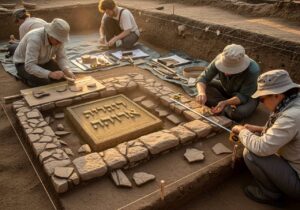
Tabernacle in the Wilderness

The Presence of Grace

The Presence of Grace

The Presence of Grace

The Presence of Grace

Immanuel: More Than A Pardon

Under Grace, Not Law

“We’re not under law, we’re under grace.”

You’ve heard it a thousand times. Maybe you’ve even said it yourself. It’s one of the most quoted ideas in Christian teaching, and it’s usually meant to communicate something beautiful: God’s acceptance isn’t based on our performance. We don’t have to earn His love. We’re saved by grace, not by keeping rules.

But somewhere along the way, this truth got twisted into something else entirely. For many believers, “under grace, not law” has come to mean that God doesn’t actually require anything of us. Grace becomes a permanent exemption from obedience. A divine free pass. Since salvation doesn’t depend on what we do, what we do must not matter. We’re free; free from obligation, free from expectation, free from any sense that following God’s commands has anything to do with living under His grace.

Ask many Christians about obedience and you’ll get an uncomfortable shuffle. “Well, I mean… we’re saved by grace, not works. I don’t want to fall into legalism. Jesus fulfilled the law so I don’t have to keep it.” The implication is clear: grace means God asks nothing of me. To suggest otherwise sounds dangerously like works-righteousness, like denying the sufficiency of Christ, like putting people back under the burden of the law that Jesus came to abolish.

But is that really what grace means? Is that what the Hebrew Scriptures present when they speak of God’s favour? When Noah “found grace in the eyes of the LORD,” did that mean God expected nothing from him? When Moses found favour before God at Sinai, did that free him from following God’s instruction? When David sang of God’s grace in Psalm after Psalm, was he celebrating exemption from God’s ways?

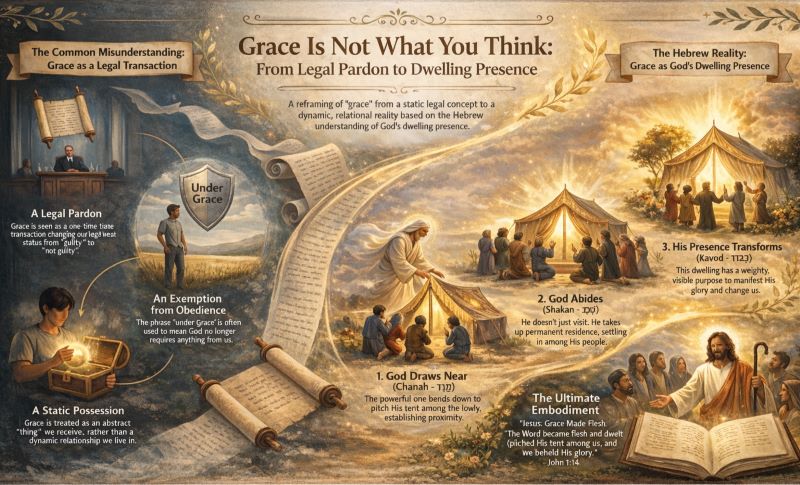
The problem runs deeper than we realize. Western Christianity has inherited a Greek philosophical framework that turns grace into an abstract legal concept; a change in our judicial standing before God. In this view, grace primarily answers the question: “How do I avoid punishment for my sins?” And the answer is simple: God declares you righteous through faith in Christ. Transaction complete. Your legal status has changed. You’re under grace now, not under law.

But that’s not the Hebrew understanding of grace at all. The Hebrew words; chen (חֵן) and its related verb chanah (חָנָה), reveal something entirely different. Grace isn’t primarily a legal status. It’s a relational reality. It’s not God declaring you innocent from a distance. It’s God drawing near to dwell with you. And when the Holy One takes up residence in your midst, everything changes—including, especially, what’s expected of you.

The Workshop on Via dell'Agnolo

Florence, Italy, 1466

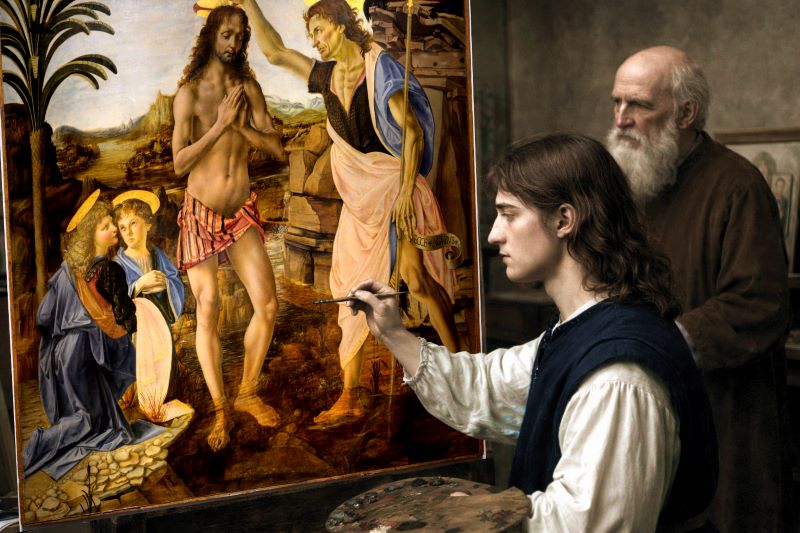
Young Leonardo - Baptism of Christ

Leonardo was fourteen years old. The illegitimate son of a notary and a peasant woman. No formal education. No prospects beyond manual labour. In Renaissance Italy, your birth determined your future, and Leonardo’s birth had determined nothing good.

But his father had connections. Ser Piero knew Andrea del Verrocchio, who ran one of the finest artist workshops in Florence. Against every social convention, Verrocchio agreed to take the boy as an apprentice. This wasn’t a scholarship. This wasn’t a mentorship program where Leonardo would visit the workshop for lessons and then return home. Verrocchio brought him into his household.

Leonardo moved into the workshop on via dell’Agnolo. He slept in the attic above the studio. He ate at Verrocchio’s table, dinner at midday, supper in the evening.

Every single day. For years.

At first, his work was menial. He ground pigments into powder. He prepared wooden panels for painting. He swept floors and washed brushes. The labour of a servant.
But he lived in the master’s presence.
He watched Verrocchio paint. He listened to Verrocchio discuss technique with Botticelli, Perugino, and Ghirlandaio, masters who gathered in the workshop. He learned not just how to mix colours but how a master saw. He absorbed not just techniques but vision.

The transformation didn’t happen over night. There was no single dramatic event where Verrocchio pronounced him “talented” and everything changed. But over ten years of being in the presence of his master, Leonardo changed. Breakfast after breakfast; conversation after conversation. Another word of correction. Another word of encouragement.
Then, in 1472, Leonardo qualified as a master in the Guild of St. Luke. His father, proud of his son’s achievement, set him up with his own workshop. Leonardo was free to leave.

But he didn’t.

Leonardo continued to live with Verrocchio. He continued collaborating with him. The relationship had become more than an apprenticeship. Being with Verrocchio every day had become his new reality.

When Verrocchio painted “The Baptism of Christ” in 1475, he invited Leonardo to paint one of the angels. Leonardo’s angel was so luminous, so alive, so superior to everything else in the painting that according to the biographer Vasari, Verrocchio said he would never touch a brush again.

The student had surpassed the master. Not through raw talent alone. Not through a single gift or lesson. But through years of dwelling with the master in his home. A daily closeness that gradually, imperceptibly, transformed everything about how Leonardo saw the world.

And this is grace.

The Field and the Marriage

Ruth and Boaz

Consider Ruth. A Moabite widow following her mother-in-law Naomi back to Bethlehem, Ruth had no legal claim on Israel’s God or Israel’s blessings. She was exactly the kind of person the Torah could have excluded, a foreigner, from a nation with a troubled history with Israel, coming with nothing. But when she arrived in Bethlehem during the barley harvest, she went to glean in the fields, and “as it happened” (the narrator’s way of showing God’s providence), she ended up in a field belonging to Boaz, a wealthy relative of Naomi’s deceased husband.

What Boaz did next demonstrates the Hebrew understanding of grace perfectly.

He didn’t just give Ruth a one-time gift of grain and send her away. He invited her into an ongoing relationship. “Don’t go to glean in another field, and don’t go from here, but stay here close to my maidens.” He told her, and “When you are thirsty, go to the vessels, and drink from that which the young men have drawn.” (Ruth 2:8-9). He instructed his workers to leave extra grain for her, to protect her, to make sure she was fed.

Day after day, Ruth came to Boaz’s field. Day after day, she worked under his protection, benefited from his provision, lived within the boundaries he’d set for her safety and flourishing. The text emphasizes this ongoing nature: “So she kept close to the young women of Boaz, gleaning until the end of the barley and wheat harvests” (Ruth 2:23). This wasn’t a single transaction. It was being present, daily, in the field of one who’d shown her favour.

Was Ruth free to do whatever she wanted because Boaz had shown her favour? Could she glean wherever she wished, work on her own schedule, ignore his instructions about staying close to his workers? Of course not. His grace; his chen, created expectations. But these weren’t burdens. They were the wisdom of how to flourish under his protection and guidance. “Don’t go elsewhere” wasn’t about control. It was her provision. “Stay with my workers” wasn’t a restriction. It was about safety.

And notice where this grace led: to marriage. The story doesn’t culminate with Ruth receiving a lifetime supply of grain while being single and maintaining her independence, she became Boaz’s wife. The favour he showed in his field resulted in covenant relationship. The grace that allowed her to glean led to a permanent dwelling place in his household. She went from being a foreign widow to a covenant wife, from gleaning scraps from the fields to a full membership in the family of Israel; and through her, the lineage of King David and ultimately the Messiah.

This is the Hebrew understanding of grace: not a one-time gift but a permanent invitation. It’s not a cancelled debt, that frees us from any expectation. It’s an open door. A covenant relationship that redefines who we are; turning strangers into family. Grace isn’t Boaz throwing grain at Ruth from a distance. It’s Boaz inviting her into his field, daily, and ultimately, into his home.


Chen and Chanah: The Hebrew Words for Grace

The Hebrew noun chen (חֵן) means “favour,” “grace,” “graciousness.” It describes finding yourself in someone’s favourable regard; seeing their face turn toward you rather than away, experiencing their disposition toward you as benevolent. But chen is never abstract. It’s always relational, always between persons.

Noah didn’t possess grace as a commodity. He “found chen in the eyes of the LORD” (Genesis 6:8). Moses didn’t earn grace as a reward. He pleaded, “If I have found chen in your sight, please show me now your ways” (Exodus 33:13). Ruth asked Boaz, “Why have I found chen in your eyes?” (Ruth 2:10). The favour we see in all these passages exists in relationship, in the eyes of the one showing it.

But the verb chanah (חָנָה); closely related through its root, reveals how this favour actually manifests in the world. Chanah has two primary meanings that illuminate each other: to bend down, to incline from a higher position to a lower one; and to pitch a tent, to encamp, to settle down and dwell.

These aren’t separate meanings. They are two facets of the same reality. Grace is what happens when the superior one bends down to dwell with the inferior one. When the one on-high stoops to encamp among the lowly. When, instead of choosing to help from a distance, the powerful and mighty draw near, to pitch their tent and live in the midst of the powerless.

We see this woven throughout Israel’s worship. The priestly blessing in Numbers 6:24-26 declares: “Yahweh bless you, and keep you. Yahweh make his face to shine on you, and be gracious to you. [vichuneka, from chanah]; Yahweh lift up his face toward you, and give you peace.” God’s gracious action is His face bending down, inclining toward His people, shining upon them. But it’s more than a momentary glance, chanah implies taking up residence, encamping, dwelling near.

When God reveals His essential character to Moses after the golden calf disaster, He doesn’t do it from heaven. Exodus 34:5-6 tells us: “Yahweh descended in the cloud, and stood with him there, and proclaimed Yahweh’s name…. ‘Yahweh! Yahweh, a merciful and gracious [chanun, the adjective of chanah] God, slow to anger, and abundant in loving kindness and truth“. His gracious nature is demonstrated by the very fact that He descends, rather than declaring from a distance, and by standing with Moses; by drawing near.

Grace isn’t God’s attitude toward us from heaven. Grace is God bending down to dwell with us.

Grace is Presence

The Complete Picture: Encampment, Dwelling, and Glory

Like the Hebrew words tselem (צלם – image) and tahor (טָהוֹר – clean) (see my book the Messiah’s way) chanah appears to be part of a triad; God’s fingerprint. Therefore, we need to see how God’s grace operates alongside these two other Hebrew concepts, to fully understand what it accomplishes.

When God commanded Israel, “Let them make me a sanctuary, that I may dwell among them” (Exodus 25:8), the Hebrew word for “dwell” is shakan (שָׁכַן); to settle down, to abide, to take up residence. It’s the root of mishkan (מִשְׁכָּן), the Tabernacle itself, literally “the dwelling place.” And when God’s dwelling manifests, Scripture speaks of His kavod (כָּבוֹד); His glory, His weighty, visible, transforming presence.

These three are woven together in Scripture to paint a more complete picture of what happens when God extends grace:

  • Chanah (חָנָה) answers where God positions Himself: He encamps, He draws near, He establishes proximity with His people.
  • Shakan (שָׁכַן) answers how long He stays: He doesn’t just visit; He abides, He takes up permanent residence’, He settles in.
  • Kavod (כָּבוֹד) answers why it matters: His presence has weight, visibility, transforming power that changes those who dwell in it.

We see all three operating together in Numbers 9:15-23, one of Scripture’s clearest presentations of God’s grace in action, after the Tabernacle is erected. The passage describes the following:
On the day that the tabernacle was raised up, the cloud covered the tabernacle, even the Tent of the Testimony: and at evening it was over the tabernacle, as it were the appearance of fire, until morning…Whenever the cloud was taken up from over the Tent, then after that the children of Israel travelled; and in the place where the cloud remained, there the children of Israel encamped. At the commandment of Yahweh, the children of Israel travelled, and at the commandment of Yahweh they encamped. As long as the cloud remained on the tabernacle they remained encamped. When the cloud stayed on the tabernacle many days, then the children of Israel kept Yahweh’s command, and didn’t travel” (Numbers 9:15, 17-19).

There’s the complete picture. Shakan, God has taken up residence in the mishkan, dwelling consistently among them. Kavod, the cloud by day and fire by night make God’s weighty presence visible to the entire camp. And chanah, “in the place where the cloud remained, there the children of Israel encamped.” God doesn’t just dwell passively among them. He governs their proximity. He determines when they move and when they stay.

This is critical for understanding grace. God’s dwelling doesn’t remove His authority. His nearness doesn’t relax His rule. And Israel doesn’t manage the proximity, they respond to it. When the cloud moves, they move. When it stays, they stay. They live their entire lives organised around the reality of God dwelling in their midst, and that dwelling comes with both the gift of His presence and the expectation of obedience to His direction.

The whole purpose of God’s nearness is kavod; that His presence would have weight in their lives, that His glory would be visible, that they would be changed by dwelling with Him. When Western Christianity reduces grace to a legal pardon or the freedom and permission to live unchanged, it’s missing the point of God’s dwelling entirely, severing the purpose from the gift. God encamps among us and abides with us for the sake of manifesting His glory. Without that third element; without kavod, without the transforming weight of His essence making a visible difference, we turn His dwelling into an empty ritual.

God's Tent in Israel's Camp

The Tabernacle embodies everything we’ve just seen. Think for a moment about what God didn’t do. He didn’t command Israel to build a permanent temple in a distant holy city where they would make pilgrimage when they needed Him. He commanded them to build a portable tent-sanctuary that would travel with them through the wilderness.

When Israel made camp, the Tabernacle was erected in the centre, not at the edge or in a separate sacred zone, but right in the middle of the camp. The twelve tribes arranged themselves around it in divinely specified positions (Numbers 2). God’s tent of dwelling surrounded by His people’s dwellings. When the cloud lifted, they packed up God’s ‘abode’ and carried it with them. When they made camp again, they set it up again, always in the centre.

This is what grace looks like. God didn’t send blessings from heaven, choosing to keep His distance from their messy, wandering existence. He moved His dwelling to live among them. He shared their journey. He encamped in their camp. He pitched His tent so He could be with them. The presence itself was the grace.

But here’s what you must understand: God’s dwelling presence didn’t mean Israel could live however they wanted. Quite the opposite. The entire book of Leviticus; the book of instructions for living with God in your midst, flows from this reality. God’s abiding presence created expectations. Boundaries about clean and unclean had to be established. Sacrifices and offerings needed to be brought. Holiness had to be maintained. Not to earn God’s presence (He had already chosen to encamp there) but because His presence changed everything about how they were to live.

At sunrise, every morning, when Israel awoke, they saw the cloud hovering over the Tabernacle. Every day they went about their ordinary tasks; baking bread, tending flocks, settling disputes, knowing that the Holy One dwelt in their midst. Their entire camp was organised around His dwelling. Everything flowed from that central reality: God is here – Yahweh Shammah (יהוה שמה). The grace was the dwelling itself. Torah was the instruction for living faithfully in light of that dwelling.

Just as Leonardo didn’t earn his place by learning Verrocchio’s methods; Verrocchio had already brought him into the household by grace. But living in that household meant learning the master’s ways. Just as Ruth didn’t earn Boaz’s favour by following his instructions; he’d already shown her chen before she knew what he expected. But responding to his favour meant following his wisdom about where to glean and how to stay safe. The grace was the invitation. The obedience was the natural and expected response.

את

PROJECT GERAR

FIELD REPORTS

PG Logo

LIVING WORD


<b>Trust in Yehovah</b><br/>


The Hebrew word batach means “to cling to, to lean on completely.” Trusting God isn’t passive, it’s an active reliance, refusing to depend on your own limited understanding (binah – insight). He makes your path (orach) straight, guiding you with precision….<br/>


<b>Proverbs 3:5-6</b>

THE LIVING WORD

Support Us

Upholding the Word: your support helps us to continue this mission, sharing the wisdom of Torah and faith with those seeking truth.

Grace Didn't Begin with Jesus

Form vs Fulfilment
Many Christians believe grace is a New Testament concept, that the Old Testament was about ‘law’ and judgment while the New Testament dispensed with that and brought grace. They’ll quote John 1:17: “For the law was given through Moses; grace and truth came through Jesus Christ.” But look at what actually happened in Israel’s history. We’ve already seen how Noah “found chen in the eyes of the LORD” (Genesis 6:8), seven hundred years before Moses. Abraham was chosen by grace five hundred years before Sinai. Moses only received Torah because he’d already found favour: “I know you by name, and you have also found chen in my sight” (Exodus 33:17). The entire Torah was given after the Exodus, not before it. God didn’t say, “Keep these commands and then I’ll rescue you.” He said, “I have rescued you; now here’s how to live as my rescued people.” Grace came first. Instruction followed. The Tabernacle; the ultimate expression of God encamping among His people, was built in the wilderness. Israel lived for forty years with the visible manifestation of chanah (God positioned among them), shakan (God dwelling consistently), and kavod (God’s glory transforming them). And here’s what makes this even more remarkable: Israel hadn’t yet begun to live the full Torah life. Torah’s social, agricultural, and civic laws were designed for life in the Land, for settled communities with fields to cultivate, cities to govern, and a functioning society to maintain. The wilderness was like driving with L-plates, learning how to function as God’s people. Let’s face it, they couldn’t keep most of it even if they’d wanted to. They were sustained entirely by the miraculous. Manna appeared every morning, not because they’d earned it, but because God fed them. Water flowed from rocks, not as a reward for obedience, but because God gave it. The cloud moved, and they followed, not because they’d proven themselves worthy, but because God directed them. Their sandals didn’t wear out (Deuteronomy 29:5). Their clothes didn’t deteriorate. For forty years, they lived in a state of total, unsustainable dependence on God’s gracious presence. The wilderness wasn’t Israel successfully maintaining God’s dwelling through Torah observance. It was God sustaining Israel through sheer, unearned, daily chen so they could become a people capable of living in His presence. That’s grace. Pure, visible, undeniable grace. David sang about it in the Psalms. The prophets declared it. And it completely dismantles the idea that the Old Testament is about law while the New Testament brought us grace. If even the Mosaic covenant began with a forty-year, miracle-saturated season of pure sustaining grace; if Israel’s entire wilderness experience was God dwelling among them before they could properly keep Torah, then grace has always been first. Grace wasn’t discovered or invented in the first century AD. So what is John 1:17 actually saying?
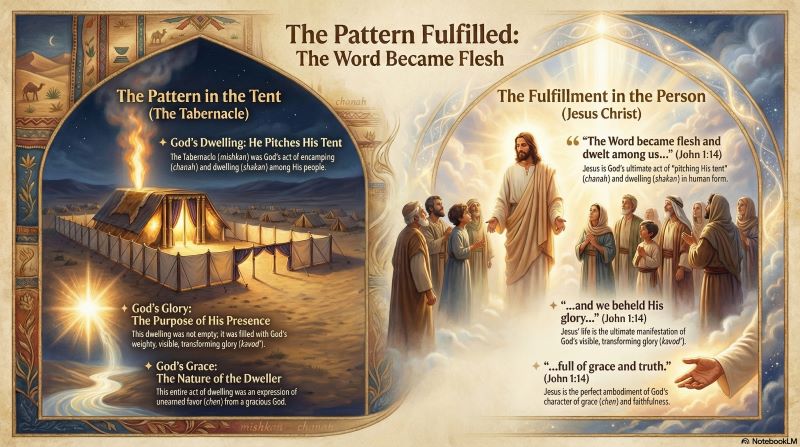
John 1:14-18: The Triad Embodied

Jesus Tabernacled Among Us
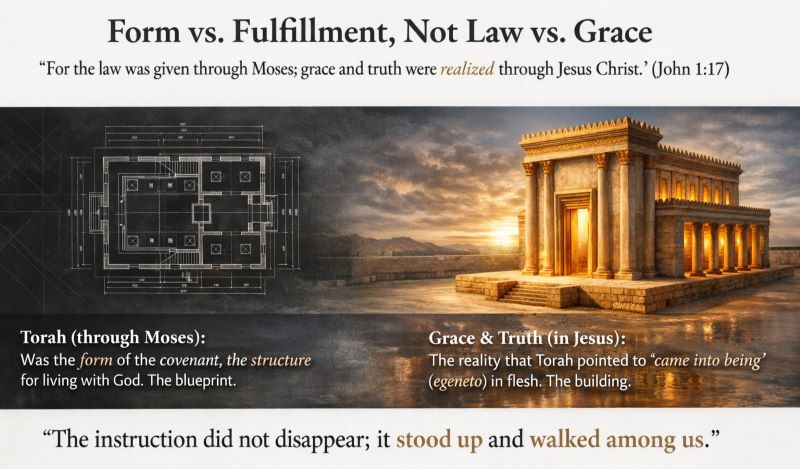
The confusion lies in the thinking that John is contrasting different modes of revelation (the existence of grace), but John is actually contrasting the mode of delivery (the form of its expression). John 1:17 doesn’t say that grace ‘as a divine reality’ began with Jesus. It says that grace and truth ‘came into being’ (ἐγένετο egeneto) in a particular mode through Jesus Christ. Torah was given through (διά dia) Moses; handed down as covenantal instruction that reveals God’s gracious and faithful character. Grace and truth became (egeneto) through Jesus; they came into being as a reality in a human life. We have already seen that grace existed as God’s nature; His disposition expressed as covenant loyalty, and now John is saying that it will be fully revealed in an embodied form. So, grace did not originate in Christ; it was actualised, completed, and made personally encounterable in Him. What was written became visible. What was commanded became lived. The instruction did not disappear; it stood up and walked among us. But John isn’t just making that point. He’s doing something far more profound. In verses 14-18, John is giving us the New Testament’s definitive commentary on the entire chanah-shakan-kavod reality we’ve been tracing through Scripture. He’s saying: What God did in the Tabernacle, He has now done in Jesus. The same pattern, the same purpose, now in human flesh. Watch how John structures it: “And the Word became flesh and dwelt among us...” (John 1:14). The Greek word John uses for “dwelt” is eskēnōsen (ἐσκήνωσεν); literally “pitched his tent” or “tabernacled.” This isn’t a casual word choice. John is deliberately, unmistakably invoking the Tabernacle. He’s saying: The divine Word performed the ultimate act of chanah, He encamped in human flesh. And in doing so, He established His mishkan (dwelling) among us. The form of God’s dwelling is no longer a tent of acacia wood and linen curtains, but a body of human flesh and blood. There’s your chanah and shakan. God positioning Himself in human space, taking up residence, dwelling permanently among His people. “...and we beheld his glory...” (John 1:14). The Greek word is doxan (δόξαν), the standard Greek translation of the Hebrew kavod. John is saying: The purpose of God’s dwelling; “that I may dwell among them… and the glory of the LORD filled the tabernacle” (Exodus 40:34-35), is now fulfilled in a person. The glory is no longer a cloud confined to the Holy of Holies. It’s the visible, tangible life, power, love, and sacrifice of Jesus. The purpose of the dwelling is achieved: God’s manifest glory is beheld. There’s your kavod. The weighty, transforming presence that makes God’s dwelling visible and consequential. “…glory as of the only Son from the Father, full of grace and truth” (John 1:14). That phrase; “grace and truth”, isn’t new. It’s a direct quotation from Exodus 34:6, where God reveals His character to Moses: “The LORD, the LORD, a God merciful and gracious [chanun], slow to anger, and abounding in steadfast love [chesed] and faithfulness [emet].” The Greek translation (the Septuagint) renders “steadfast love and faithfulness” with the language of mercy and truth. John condenses this revelation into its ultimate theological expression: χάρις καὶ ἀλήθεια (charis kai alētheia – “grace and truth”). He is deliberately invoking Sinai and saying: The same God who revealed Himself as gracious at the mountain, who descended in the cloud to stand with Moses, who proclaimed His character as full of chen and emet, that God has now revealed Himself in the flesh. The divine attributes that were proclaimed to Moses are now incarnate. Jesus is the walking, breathing embodiment of God’s chen and covenant faithfulness. “From his fullness we have all received, grace upon grace” (John 1:16). This is the ongoing, transformative outcome of the dwelling. The glory (kavod) John and the disciples beheld wasn’t a static light show. It was a fountainhead of transforming grace. It’s the permanent seat at David’s table. It’s the daily presence in Boaz’s field. It’s the shared workshop with Verrocchio. The glory produces an unending supply of grace that reshapes those who dwell in its presence. “For the law was given through Moses; grace and truth were realised through Jesus Christ” (John 1:17). Again, John isn’t contrasting law against grace. He’s contrasting form with fulfilment. Torah (given through Moses) was the form of the covenant, the structure of the relationship, the instruction for living with God in your midst. But in Jesus, the grace (chen) and faithfulness (emet) that Torah pointed to and depended on “came into being”, they took on flesh and dwelt among us. Jesus is both the chanah (grace in motion, God drawing near) and the shakan (covenant in permanent residence) that the Mosaic form anticipated. The blueprint became the building. The instruction became incarnate. “No one has ever seen God; the only God, who is at the Father’s side, he has made him known” (John 1:18). This is the ultimate purpose of kavod: revelation. The glory we saw in Jesus is the definitive explanation of the unseen Father. The dwelling of God among us in Christ makes the invisible God knowable. As Hebrews says; “His Son is the radiance of his glory, the very image of his substance” (Hebrews 1:3)This is what God’s presence was always meant to accomplish, not just proximity, not just dwelling, but the manifestation of God’s glory in a way that transforms and reveals. So when someone says “Grace began with Jesus,” they’re missing the entire story. Grace didn’t start with Jesus. Grace took on flesh in Jesus. What was always true about God; that He is gracious, that He bends down to dwell with His people, that He shows chen to those who don’t deserve it, that His presence manifests as transforming kavod, has now become a walking, talking, flesh-and-blood human being. The pattern established in the Tabernacle is fulfilled in Christ:
  • Chanah (God’s gracious positioning) → The Incarnation (“became flesh and dwelt”).
  • Shakan (God’s abiding presence) → The Person of Christ (“the Word was God… and dwelt among us”).
  • Kavod (God’s manifest purpose) → The Glory Beheld (“we have seen his glory”).
And now, through the Spirit, that same triad operates in believers. God doesn’t just encamp near us, He dwells within us. The Tabernacle in the centre of the camp becomes the Spirit in the centre of our hearts. And that indwelling presence produces the same outcome it always did: transforming kavod, God’s glory made visible in and through His people. This is why any understanding of grace that separates it from God’s dwelling presence, from ongoing transformation, from visible kavod; any view that reduces grace to legal pardon or permission to live unchanged, has lost connection to what John is talking about. It’s become a doctrinal abstraction that has severed itself from the reality: God bending down, God pitching His tent, God’s glory manifesting in transforming power. That’s grace. That’s what it’s always been. And that’s what Jesus came to embody.


What Does This Change?

When grace is understood as God’s ongoing dwelling presence rather than legal exemption, everything shifts.

First, the tension between grace and obedience evaporates. If grace is a permanent free pass; “I’m under grace not law so my behaviour doesn’t matter”, then obedience feels like a contradiction. Why would I follow commands if grace has already secured my standing? Isn’t trying to obey, evidence that I don’t really understand grace?

But when grace is God’s presence dwelling with you, obedience isn’t earning the relationship. It’s living in the relationship. Israel didn’t earn God’s presence by keeping Torah; God had already chosen to encamp among them despite the golden calf. But living with the Holy One in their midst required learning how to walk in holiness. The commands weren’t conditions for God’s dwelling. They were instructions for how to live faithfully when God dwells with you.

Second, grace becomes empowering rather than permissive. Much of Western Christianity operates on a “permission paradigm.” The most extreme form (“hyper-grace”) treats grace as universal license: “God’s forgiveness covers everything, so I’m free to do as I please.” The more common form treats grace as subjective permission: “I’m free to live by the Spirit and love as I understand it.” Both centre on the believer’s liberty. The boundary shifts from external revelation to internal feeling, but the focus remains on what I am permitted to do.

The Hebrew understanding shatters this paradigm. Grace (chen) is not about permission at all. It’s about presence. It’s God’s decision to dwell (shakan) with His people. This presence isn’t neutral; it’s holy, glorious, and transformative (kavod). The result isn’t a life of navigating permissions, but a life being reconfigured by proximity to holiness. The question changes from “What am I allowed to do?” to “Who am I becoming as I dwell with the Holy One?” Grace isn’t the freedom to define my own path; it’s the power of a shared life that says; ‘This is the way. Follow my lead’.

You cannot live in daily proximity to holiness and remain unchanged. Leonardo didn’t spend a decade in Verrocchio’s workshop and emerge the same. The presence itself transformed him. The dwelling itself taught him. He became a different person because of the one he lived with.

This is why Paul says grace “instructs” us (Titus 2:11-12). Not just forgives us. Not just covers our sins. It instructs us. It teaches, disciplines and transforms. How? Because grace isn’t a legal status. Grace is a Person dwelling with us. And when that Person is the Holy Spirit; God’s ultimate chanah, God’s tent pitched within our hearts, we’re being guided from the inside out.

Third, grace becomes concrete rather than abstract. The Western view makes grace theoretical: a change in our status before God that we accept by faith but something we can’t see or touch. But Hebrew grace is as concrete as a tent in the middle of your camp. As tangible as sitting at the master’s table every morning. As real as gleaning in Boaz’s field day after day.

Israel didn’t theorise about God’s grace. They saw the cloud every morning. They smelled the incense from the Tabernacle. They heard the priests performing their duties. God’s dwelling was visible, present, undeniable reality around which their entire life was organised.

The Marriage Betrothal, Not Just a Proposal

Grace is a Betrothal

Here’s the fundamental misunderstanding: Western Christianity treats grace like an engagement ring; a precious gift that secures the relationship, after which nothing more is required. God proposed, we said yes, we’re engaged, and now we’re just waiting for the wedding in heaven. In the meantime, we’re free to live however we determine because the relationship is already secured.

But Hebrew grace is the marriage covenant itself, the binding relationship that creates obligations, identity, and transformation. For Israel at Sinai, this meant completed marriage: “I will take you to be my people, and I will be your God” (Exodus 6:7). God didn’t propose from a distance and wait. He brought them out of Egypt, led them to the mountain, and entered into covenant relationship with them. The dwelling, the presence, the transformation, all of it was a present reality, not a future hope.

Under the New Covenant, this same grace takes the form of a betrothal. Yes, we await the bridegroom’s return (John 14:2-3). Yes, the wedding feast still lies ahead of us. But in the biblical world, a betrothal was not purely symbolic or provisional, it was binding, identity-forming, and life-altering. From the moment of betrothal, everything began to change. The bride belonged to her bridegroom. She was faithful to him even though the marriage wasn’t yet consummated. She lived under his protection, learned his ways, and was shaped by the life they would one day share together.

This is what Ruth experienced. Between her commitment to Boaz and their marriage, she wasn’t living independently with the promise of future blessing. She was gleaning daily in his field, under his protection, eating from his provision, learning his character, being transformed by proximity to him. The relationship was already real, already intimate, already obligating, even before the wedding.

This is grace under the New Covenant. We are not living on a distant promise. We are betrothed. The Spirit of Christ dwells within us. We bear His name. We live under His care. We are being shaped by His presence. We remain faithful to Him. All of these are present realities, not because we’re earning the right to be married to Messiah, but because we’re already His.

This is precisely what Jeremiah 31 and Ezekiel 36 promised: Torah written on our hearts, God’s Spirit within us, to empower us to walk in His ways. This isn’t describing heaven. This is describing covenant life now. This is chanah at its most intimate. God not just bending down to encamp among us but dwelling within us. The Tabernacle in the centre of the camp becomes the Spirit within our hearts. And that indwelling presence; even now, even in betrothal as we await its consummation, is the grace that transforms all that we are.

So when someone says “We’re under grace, not law” as if that means God requires nothing of us, they’ve misunderstood what this covenant relationship truly means. Israel at Sinai didn’t say, “God has chosen us, so we can live however we choose.” They said, “We are His people. Who bear His name. Who dwell in His presence. Who choose to walk in His ways.” A betrothed bride didn’t say, “He’s chosen me, so I can live as I see fit until the wedding.” She said, “I’m already His“.

Grace; whether experienced as a completed marriage covenant or as a betrothal, isn’t an exemption from God’s ways. Grace is God dwelling with us so closely that His ways become written on our hearts. Torah isn’t an external burden imposed despite grace. Torah is the wisdom of how to walk when you’re in covenant with the Holy One, when His Spirit lives in your midst, when you bear His name.

The question isn’t whether we are “under grace or under law.” The question is whether we are living as a covenanted people; indwelt by God’s Spirit, formed by His presence, and faithful to the One to whom we belong.

What is grace?

God bending down. God pitching His tent. God taking up residence; first in the Tabernacle with Israel, then in the flesh through His Son and now by His Spirit within us, as we await the day when we see Him face to face.

It’s not a proposal nor simply permission.

It’s a binding covenant that transforms us now.

Leave a Reply

Your email address will not be published. Required fields are marked *

More Articles Like This

Project Gerar

We believe much of the Hebraic roots and Jewish context that shaped the early Christian faith has been buried under layers of tradition and misinterpretation. We explore the original meaning of Biblical Hebrew words, study Torah as God’s instruction (not law), understand how Sabbath, biblical feasts (moedim), and covenant formed first-century believers. Seeking to remove centuries of accumulation to learn to walk ‘the way’ of the first disciples; following Yeshua (Jesus) the Messiah, empowered by the Spirit.

We’re not adding Jewish flavour to Christianity. This is a work of restoration; a return to the ancient paths. The water is still flowing.

Let’s dig together to uncover those wells.

Stay Connected

Sign up to receive teachings, updates, and resources by email. You can unsubscribe at any time using the link in our emails. By submitting this form, you acknowledge our Privacy Policy.
Your information is securely stored and processed through our email service provider (Mailchimp).
We never sell or share your personal data.

© 2026 Project Gerar. All Rights Reserved

Contact Form

Please complete the form below to contact us or email: contact@projectgerar.com

By submitting this form, you acknowledge our Privacy Policy.